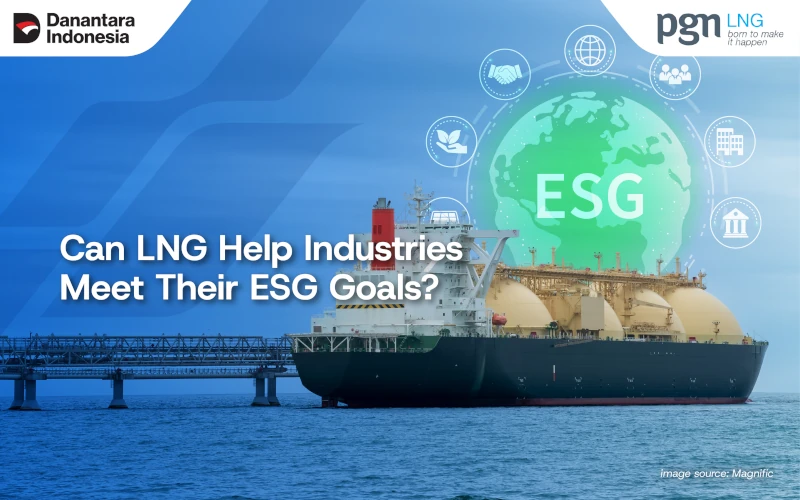
Industries that still rely on coal and diesel to meet their energy needs face challenges in reducing operational emissions. Both fuels produce carbon emissions and are one of the obstacles for companies in achieving Environmental, Social, and Governance (ESG) targets.
On the other hand, companies cannot simply replace their energy sources because production activities still require a stable and continuous energy supply.
For this reason, industries need fuel alternatives that have the potential to produce lower emissions without sacrificing operational reliability. One fuel option that suits these needs is Liquefied Natural Gas (LNG).
What Is ESG and Why Is It Important for Industry?
Environmental, Social, and Governance (ESG) is a framework used to assess how companies manage impacts, risks, and opportunities related to the environment, society, and governance.
This framework helps companies and investors understand how business activities affect the environment and society, while also identifying sustainability risks that can affect company performance.
ESG has three main pillars that form the basis for assessing a company’s sustainability practices, namely:
- Environmental: Management of carbon emissions, pollution, natural resource use, and the environmental impact of operations.
- Social: Company responsibility for worker safety, public health, labor rights, and communities around operational areas.
- Governance: Transparency, accountability, risk management, business ethics, and the implementation of good corporate governance.
For industry, implementing ESG is important for managing risks that can disrupt business activities, whether related to the environment, occupational safety, or corporate governance. This risk management helps companies reduce the potential for operational disruption while maintaining their reputation in the eyes of customers and the public.
In addition, ESG implementation is increasingly considered by investors, financial institutions, and business partners in making decisions.
Companies that can demonstrate good management of sustainability aspects have a greater chance of meeting stakeholder expectations and maintaining access to funding.
Read More: The Benefits of Non-Renewable Energy That Are Hard to Replace
How Does Energy Use Affect the Achievement of ESG Targets?
One aspect of concern in the Environmental pillar of ESG is how companies manage their environmental impact, including greenhouse gas emissions.
In industrial activities, energy combustion is one of the sources of these emissions. The use of fuel to generate electricity, heat, and operate equipment leads to the formation of carbon dioxide (CO2) and other greenhouse gases.
These emissions add to a company’s carbon footprint, so the greater the emissions produced, the greater the environmental impact that needs to be managed to achieve ESG targets.
For this reason, industries with high energy consumption need to consider fuel type, energy efficiency, and electricity supply sources in their emission reduction strategies. The use of energy sources with lower emission intensity can help reduce carbon footprint and support the achievement of a company’s Environmental targets.
How Can LNG Help Industry Reduce Emissions?
LNG is natural gas that has been cooled until it becomes liquid, so its volume is much smaller and it is easier to store and transport.
The potential of LNG to help reduce emissions comes from the characteristics of natural gas, which produces lower CO2 emissions during combustion compared to coal and diesel for the same amount of energy.
According to EIA data in the Electric Power Annual, the CO2 emission factor of natural gas is 52.91 kg CO2 per MMBtu. Meanwhile, the emission factors for coal and diesel are 93.24 kg CO2 per MMBtu and 74.14 kg CO2 per MMBtu, respectively.
In addition to producing lower CO2, natural gas combustion also produces relatively lower sulfur dioxide (SO2) and particulate emissions compared to coal and fuel oil.
These characteristics make LNG a potential fuel alternative for industries that require large amounts of energy, such as power generation, smelting, and manufacturing.
By utilizing LNG to generate heat or electricity, industries can reduce combustion emission intensity compared to using coal or diesel, thereby supporting efforts to reduce operational carbon footprint.
Read More: 7 Organic Wastes That Produce Energy
To What Extent Can LNG Help Industry Achieve ESG Targets?
LNG can help industry achieve some ESG targets. From the Environmental aspect, using LNG to replace fuels with higher emission intensity, such as coal and diesel, has the potential to reduce combustion CO2 emissions.
Natural gas also produces relatively lower SO2 and particulate emissions, which can support air quality management around industrial facilities.
From the Social aspect, this reduction in air pollutants can help companies manage the impact of operations on workers and surrounding communities. Meanwhile, from the Governance aspect, the use of LNG can be part of a company’s energy transition strategy and sustainability risk management.
To ensure that this strategy contributes to ESG targets, companies need to record energy consumption, measure the emissions produced, and evaluate emission reduction progress on a regular basis.
This data can be used as a basis for decision-making and for reporting ESG performance to stakeholders.
What Do Industries Need to Consider Before Switching to LNG?
Before switching to LNG, companies need to ensure that its use matches their energy needs and production process characteristics. This evaluation covers energy consumption volume, electricity or heat needs, and the specifications of the equipment used so that LNG supply can meet operational needs.
In addition, companies need to ensure the readiness of supporting infrastructure because LNG requires receiving, storage, and transportation facilities before being delivered to the user location. LNG also has to go through a regasification process to convert it back into gas before being used as industrial fuel.
After ensuring the suitability of energy needs and infrastructure readiness, companies also need to consider how LNG can be obtained and distributed all the way to the operational location.
This is important because every industry has different requirements for volume, distribution access, and supporting facilities. For this reason, choosing an LNG provider partner is an important part of ensuring that the procurement and utilization process runs in line with business needs.
PGN LNG Indonesia is present as an LNG provider partner offering integrated solutions, from supply, storage, and distribution to regasification of LNG for various industrial needs.
With the support of these services, companies can obtain LNG supply solutions tailored to their operational characteristics and energy needs.
Want to know more about our concrete solutions for your industry? Find the complete information here: LNG Provider in Indonesia.
References
- EIA. Accessed 2026. Electric Power Annual
- IFC. Accessed 2026. IFC ESG Guidebook
- ILO. Accessed 2026. What is ESG and how is it related to the work of the ILO?
- IEA. Accessed 2026. Assessing emissions from LNG supply and abatement options