High waste generation remains a challenge in environmental management in Indonesia. Based on the latest data from Indonesia’s National Waste Management Information System of the Ministry of Environment for 2026, waste generation was recorded at around 144,158 tons per day.
Of that amount, only 24.69% is managed, while around 75.31% remains unmanaged. One approach to utilizing waste is to process the fraction that has calorific value into an alternative fuel, namely Refuse-Derived Fuel (RDF).
This fuel has the potential to meet part of industrial energy needs. However, can RDF be used by all industrial sectors, or only certain industries?
What Is Refuse-Derived Fuel (RDF)?
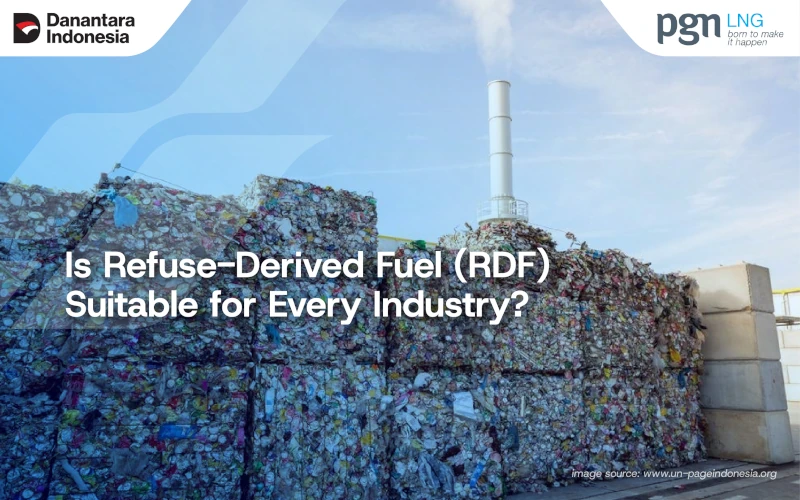
Refuse-Derived Fuel (RDF) is an alternative fuel produced from the processing of household waste or household-like waste.
The raw material for RDF comes from the combustible waste fraction that has calorific value, such as non-recyclable plastics, paper, cardboard, and textiles.
To produce RDF, waste is first sorted to separate materials unsuitable for combustion, such as metals and glass. The fraction that meets the criteria is then shredded and dried if necessary to reduce its moisture content.
After going through this process, the material can be used as RDF in shredded form or compacted into pellets, depending on the processing technology used.
However, not all waste can be processed into RDF because the quality of the raw material and the processing method determine the characteristics of the resulting fuel.
Read More: Can LNG Meet the Energy Needs of Textile Factories?
What Are the Benefits of RDF as an Alternative Fuel?
RDF provides benefits in terms of both waste management and meeting industrial energy needs.
In terms of waste management, the use of RDF helps reduce the amount of waste fraction that must be sent to final disposal sites (landfills) because material that still has calorific value can be processed into fuel.
This approach also supports the circular economy by recovering the value of materials previously regarded as waste. As such, waste is not only seen as something to be discarded, but can also be reused as a resource.
In terms of energy, RDF can be an alternative fuel source to support industrial production activities. Its use has the potential to replace part of the need for coal or other conventional fuels, giving industries an alternative for meeting their energy needs.
Which Industries Have the Potential to Use RDF?
RDF is not suitable for all industries. Its use requires facilities with combustion systems that can utilize solid fuel, as well as emission control equipment that meets environmental requirements. Here are some sectors that have the potential to utilize it:
Cement Industry
The cement industry is one of the relevant users of RDF because clinker production requires large amounts of thermal energy.
RDF can be used to replace part of the coal in the combustion process in the rotary kiln, so that fossil fuel needs can be reduced without having to replace the entire energy source.
One example of its application is at the Tritih Lor RDF Waste Processing Site (TPST) in Cilacap, Central Java. At this location, the RDF facility processes around 120 tons of waste each day and produces 40 to 50 tons of RDF.
This fuel is then utilized to replace part of the coal in the kiln combustion process at the PT Solusi Bangun Indonesia cement plant, according to data from Indonesia’s Ministry of Energy and Mineral Resources.
Power Generation
RDF also has the potential to be used in coal-fired steam power plants through a co-firing scheme, which involves mixing alternative fuel with coal in the same combustion system.
With this method, part of the coal requirement can be replaced by RDF without having to build a new power plant. Indonesia’s Ministry of Energy and Mineral Resources notes that PLN, Indonesia’s state-owned electricity company, has conducted trials and commercialization of biomass/RDF co-firing at its power plants.
However, its application requires adjustments to the fuel feeding system, boiler characteristics, and emission control so that the combustion process continues to meet technical requirements.
Manufacturing Industry
Manufacturing industries that use boilers or solid fuel combustion systems also have the potential to utilize RDF to meet heat needs in the production process. One example is the textile industry, which uses coal as a fuel to generate heat.
According to data from Indonesia’s Ministry of Energy and Mineral Resources, the textile industry is one of the sectors that can utilize waste pellets as an alternative fuel.
Even so, its use still depends on the suitability of the RDF’s calorific value, moisture content, and composition with the characteristics of the boiler or combustion equipment available.
Read More: Why the Energy Crisis Poses a Serious Threat to the Global Economy?
What Determines the Suitability of RDF for Industrial Needs?
The suitability of RDF for industrial needs is determined by the quality of the fuel produced. One of the main factors is calorific value, which is the amount of thermal energy produced when RDF is burned. High moisture content can reduce the available energy because some of the heat is used to evaporate water.
Meanwhile, ash content and non-combustible material reduce the portion of energy-producing material. For this reason, RDF quality must match the heat needs and combustion specifications of the user industry.
Beyond fuel quality, companies need to ensure that RDF is compatible with the available combustion technology, such as boilers or kilns, including the emission control system. If it is not yet compatible, the facility may require equipment modifications.
What Are the Limitations of Using RDF in Industry?
Although it has the potential to be an alternative fuel, the use of RDF in industry still faces a number of limitations. One of them is that fuel quality can vary because the composition of waste as its raw material is not always the same.
These differences in composition can cause the calorific value, moisture content, and ash content of RDF to be inconsistent.
In addition, the content of chlorine, sulfur, and certain elements needs to be controlled because it can affect combustion emissions, increase the risk of corrosion in equipment, and influence the characteristics of the residue produced.
These conditions mean that industries need to ensure that RDF quality meets technical and environmental requirements before use.
The use of RDF may also require additional infrastructure, such as storage facilities, feeding systems, or adjustments to combustion technology so that the fuel can be used safely and stably.
On the other hand, supply continuity is not necessarily guaranteed because it depends on the availability of suitable waste and the capacity of RDF processing facilities. If supply is disrupted, industries risk experiencing fuel shortages to support production activities.
Read More: How Geothermal Works?
What Other Fuel Alternatives Can Meet Industrial Energy Needs?
The limitations of RDF as an energy source show the importance of considering alternative fuels with different characteristics and applications. One option that can be used is Liquefied Natural Gas (LNG), which is natural gas liquefied through a cooling process, so its volume is smaller and it is easier to store and transport.
In industrial activities, LNG can be utilized as boiler fuel to produce the steam and heat needed in production processes, as well as an energy source for power generation.
Before use, LNG is first converted back into gas through a regasification process. In terms of combustion, natural gas has advantages over coal and petroleum because it produces far lower carbon dioxide emissions, sulfur dioxide emissions, and particulates.
For LNG to be utilized optimally, industries need a supply system that can ensure supply availability until the fuel is ready for use at the operational location.
This includes LNG procurement, storage in dedicated facilities, transportation to the consumer’s location, and the regasification process to convert it back into natural gas. The integration of each of these stages helps ensure that LNG can be utilized in line with the energy needs and operational characteristics of the industry.
PGN LNG Indonesia is present as an LNG provider partner with integrated services, from procurement and distribution to regasification. Through the support of these services, we help industries obtain reliable and sustainable energy access.
Want to know more about what our LNG solutions look like for your industry? Find the complete information here: LNG Provider in Indonesia.
References
- SIPSN. Accessed 2026. National Waste Management Information System
- Regulation. Accessed 2026. Regulation of the Minister of Environment and Forestry of the Republic of Indonesia Number P.19/Menlhk/Setjen/Kum.1/2/2017
- ScienceDirect. Accessed 2026. Production, quality and quality assurance of Refuse Derived Fuels (RDFs)
- ESDM. Accessed 2026. Bioenergy Pocket Book 2023
- ESDM. Accessed 2026. Waste Management Solutions Through Pellet-Based Biomass Co-firing Implementation