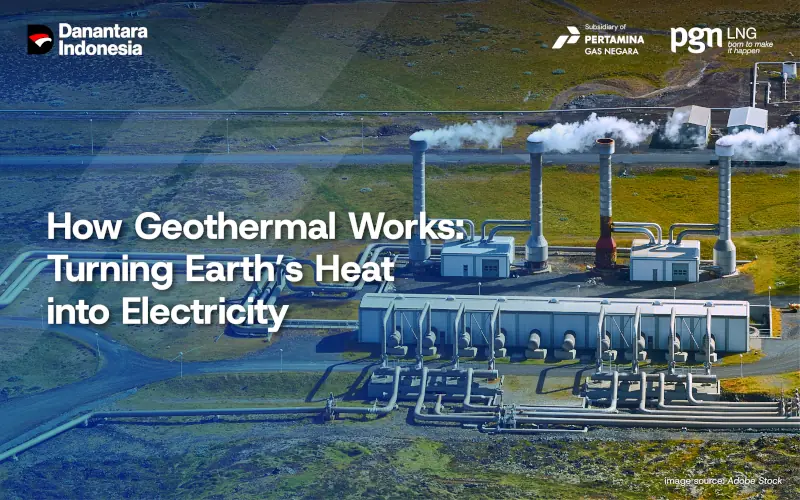
Geothermal energy in Indonesia holds tremendous potential. According to Indonesia’s Ministry of Energy and Mineral Resources, Indonesia ranks second as the world’s largest producer of geothermal electricity.
However, only about 10% of this potential is currently being harnessed. If fully utilized, geothermal energy could become a future clean energy solution, offering numerous advantages compared to coal.
So what makes geothermal so promising in Indonesia, and how does a geothermal power plant actually generate electricity? Let’s explore the complete process.
Is Geothermal Considered Renewable Energy?
Yes, absolutely. Geothermal energy is categorized as renewable energy. By nature, it originates from the Earth’s internal heat, which is naturally generated and sustainable.
As long as the Earth’s core remains hot, the likelihood of this energy depleting within a human timescale is very low. However, proper reservoir management is essential to ensure sustainable utilization.
Read More: Refinery Process, How Crude Oil Is Turned into Fuel
Where Does Geothermal Energy Come From?
Geothermal energy originates from magma activity and the Earth’s core, which can reach temperatures of over 5,000 degrees Celsius. This heat radiates through the rock layers toward the Earth’s crust.
In certain locations, this heat comes into contact with groundwater trapped in porous rocks, forming geothermal reservoirs containing hot water or high-pressure steam.
Areas with the greatest geothermal potential are generally along tectonic plate boundaries, also known as the Ring of Fire.
Indonesia, located on this ring, possesses one of the world’s largest geothermal potentials, covering nearly 40% of global reserves. Active volcanoes indicate rich subsurface hydrothermal systems.
Read More: Virtual Pipeline, an Innovation to Deliver LNG Without Pipelines!
How Does Geothermal Generate Electricity?
Converting geothermal energy into electricity involves a complex process, including drilling, energy conversion, and distribution. Here’s the step-by-step process:
1. Drilling and Extracting Geothermal Fluids
The process begins by drilling production wells to depths of around 1,500–3,000 meters to reach the geothermal reservoir. Hot geothermal fluids, consisting of high-pressure water, are then brought to the surface.
Because surface pressure is lower than the reservoir pressure, some of the hot water spontaneously turns into steam through a process called flashing.
2. Converting Thermal Energy into Mechanical Energy
The generated steam is directed to spin turbine blades, converting thermal energy into mechanical energy.
Depending on fluid characteristics, there are three main geothermal power generation systems:
- Dry steam: Steam from the well directly drives the turbine.
- Flash steam: High-temperature hot water is rapidly depressurized to produce steam.
- Binary cycle: Geothermal water heats a secondary working fluid with a low boiling point, whose vapor spins the turbine.
3. Electricity Generation and Distribution
The rotating turbine is directly connected to a generator shaft. Inside the generator, the rotor’s movement induces an electric current in the stator.
The electricity is then transmitted to a transformer to increase voltage before distribution to the national grid or industrial users.
A critical part of the cycle is the reinjection system. Cooled fluids after turbine passage are injected back into the ground to maintain reservoir pressure and fluid volume, ensuring stable steam production over the long term.
Read More: Can Water Become Energy? Here’s the Explanation
Advantages of Geothermal as an Energy Source
Geothermal energy offers several advantages difficult to match by either fossil fuels or other renewable sources:
- Low carbon emissions: Geothermal plants emit far less greenhouse gas than fossil fuel plants.
- Stable operation 24/7: Unlike solar or wind, geothermal provides a consistent electricity supply.
- High land-use efficiency: Geothermal requires relatively small land per megawatt (MW) compared to large-scale solar or wind farms.
Read More: Renewable vs Non-Renewable Energy, Here’s the Real Difference!
Limitations and Challenges of Geothermal
Despite its reliability, geothermal development faces complex challenges:
- Plants can only be built in specific geologically active areas, often in remote, mountainous regions.
- Exploration and drilling require massive investments, often before commercial viability is confirmed.
- Geological risks, such as dry wells, can result in significant financial losses during the early stages.
- Development timelines are long, typically 7–10 years from initial survey to full operation.
Read More: These Are the Components in Natural Gas That Make It Highly Valuable
How LNG Complements Geothermal Limitations
Given that geothermal development takes time and suitable locations are limited, Liquefied Natural Gas (LNG) serves as a strategic solution to support a clean and stable energy supply.
As a bridge energy in the energy transition era, LNG complements geothermal characteristics:
- Lower carbon emissions: LNG emits 40–50% less carbon than coal.
- Supports peak-load power plants: Provides instant energy when electricity demand spikes.
- Reaches hard-to-access areas: LNG can supply regions without gas pipelines or undeveloped renewable infrastructure.
- Ensures energy stability: Combining geothermal as a base load with LNG as backup ensures a reliable electricity supply.
This approach maintains energy stability without compromising environmental sustainability. Geothermal provides a solid energy foundation, while LNG offers the flexibility needed to safeguard national energy security.
References
- Kementerian ESDM. Accessed 2026. Indonesia Siap Jadi Negara Produsen Listrik Panas Bumi Terbesar Dunia
- DOE. Accessed 2026. Geothermal Electricity Generation
- EIA. Accessed 2026. Geothermal Explained
- IEA. Accessed 2026. The Role of Gas in Today’s Energy Transitions