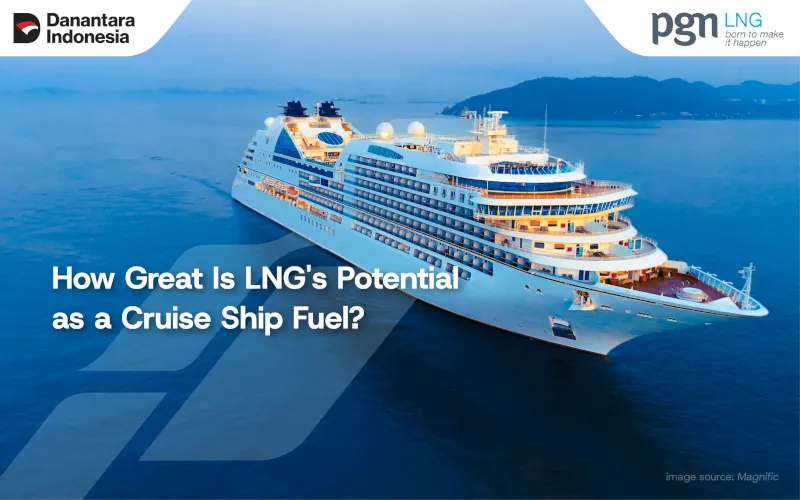
The shipping industry faces growing pressure to reduce emissions, a consequence of the decarbonization targets set by the International Maritime Organization (IMO).
For cruise ship operators, fuel selection is not simply a matter of operational costs, but also relates to vessel investment, engine technology, operational efficiency, and long-term business competitiveness.
The emergence of Liquefied Natural Gas (LNG) as an alternative fuel is worth considering to support emission reduction efforts. But how great is the potential of LNG as fuel for cruise ships and as a supporter of the shipping industry’s decarbonization targets?
Why Is the Cruise Ship Industry Starting to Shift to LNG?
The IMO’s decarbonization targets are pushing cruise ship operators to evaluate fuels that can reduce emissions without sacrificing the vessel’s high energy needs.
Cruise ships require large amounts of energy, both to propel the vessel and to run various passenger facilities and services that operate almost around the clock.
On the other hand, conventional fuels such as heavy fuel oil (HFO) and marine gas oil (MGO) face growing challenges in supporting long-term emission reduction targets.
Under these conditions, LNG has become one of the alternatives with a relatively high level of implementation readiness for cruise ships. LNG infrastructure and technology have developed, while its use can help reduce certain emissions compared to conventional petroleum fuels.
This makes LNG an attractive choice for operators that need a fuel capable of supplying large amounts of energy while also wanting to reduce environmental impact.
Read More: 7 Types of Fuel, Which Is the Most Environmentally Friendly?
What Does the LNG Adoption Trend Look Like in the Global Cruise Ship Industry?
The use of LNG in cruise ships has entered the commercial implementation stage and is no longer limited to pilot projects. Some major cruise ship operators have already incorporated LNG-fueled vessels into their fleets. Some examples include:
- AIDAnova (AIDA Cruises): began operations in 2018 and became one of the early milestones in the use of LNG on modern cruise ships.
- Mardi Gras (Carnival Cruise Line): began operations in 2021 as the largest ship in Carnival’s fleet at that time.
- Costa Toscana (Costa Cruises): began operations in 2021 as the largest cruise ship in Costa’s fleet.
- MSC World Europa (MSC Cruises): began operations in 2022 and is the first ship in MSC Cruises’ World Class.
- Disney Wish (Disney Cruise Line): began operations in 2022 as the first ship in Disney Cruise Line’s Wish class.
- Icon of the Seas (Royal Caribbean): began operations in 2024 and became the world’s largest cruise ship at the time of its launch.
The adoption by these various operators shows that LNG has become part of cruise fleet investment strategies to keep pace with the development of international emission regulations.
Read More: Here Are the Differences Between Petroleum and Gas
What Are the Benefits of LNG as Cruise Ship Fuel?
LNG can help cruise ship operators meet emission regulations while reducing air pollutants such as sulfur oxides (SOx), nitrogen oxides (NOx), and particulate matter (PM) compared to conventional petroleum fuels.
The use of LNG can also reduce CO2 emissions from combustion compared to some petroleum fuels.
Beyond the emissions aspect, the use of LNG can support the ESG (Environmental, Social, and Governance) strategy and sustainability targets of cruise ship operators.
LNG is also often viewed as a transition fuel because the engine technology and infrastructure currently used have the potential to support the use of methane-based fuels with lower carbon intensity, such as bio-LNG.
As such, LNG not only offers an alternative to current conventional fuels, but can also become part of a long-term energy transition strategy and fleet competitiveness.
Read More: 5 Countries That Rule the World’s Natural Gas!
What Needs to Be Prepared to Operate an LNG-Fueled Cruise Ship?
Switching from petroleum fuel to LNG is not simply a matter of changing the type of fuel a ship uses. Cruise ships that use LNG require adjustments to the ship’s systems, bunkering facilities at ports, and the operational procedures and competencies of the crew.
This means that the potential of LNG as cruise ship fuel also depends on the readiness of the technology and its supporting ecosystem.
LNG Compatible Ship Technology
LNG-fueled ships generally use dual-fuel engines or engines designed for LNG, and are equipped with cryogenic storage tanks and dedicated fuel distribution systems.
Because LNG is stored in liquid form at low temperatures, the ship’s design and layout need to be adapted to accommodate the LNG tanks and handling systems.
Supporting Infrastructure
Operating an LNG cruise ship also requires adequate LNG bunkering infrastructure along the shipping route. Ports need to have appropriate refueling facilities supported by a reliable LNG supply.
Coordination between ship operators, ports, and LNG providers is also important to ensure that fuel needs are available in line with the ship’s operational schedule.
Operational Safety Aspects
The use of LNG requires different safety standards from petroleum fuel due to its characteristics as a cryogenic and flammable fuel.
LNG-fueled ships must comply with the IMO IGF Code requirements, including provisions related to ship design and safety systems. In addition, crew members need to have the appropriate competencies and training to handle LNG, the bunkering process, and emergency conditions related to the fuel.
Read More: Alternatives to Petroleum That Are Environmentally Friendly
What Needs to Be Considered Before Adopting LNG?
Before adopting LNG, operators need to consider the scale of investment required, whether for building new ships or retrofitting existing fleets.
The readiness of LNG infrastructure along the shipping route and the reliability of the supply chain are also important factors to ensure that fuel needs can be consistently met while the ship is in operation.
On the other hand, investment decisions need to take into account the development of decarbonization regulations and the direction of low-emission fuel technology over the long term.
Because cruise ships are assets with long operational lifespans, the selection of LNG should not be based solely on current needs, but should also be aligned with the company’s business strategy, fleet investment plans, and energy transition direction.
In this planning, supply chain readiness is one aspect that needs to be factored in from the outset. LNG availability, distribution schemes, and infrastructure support need to be ensured so that the chosen fuel can be implemented effectively.
PGN LNG Indonesia supports LNG supply needs for sectors that require a planned and sustainable energy supply. With solutions tailored to operational needs, companies can prepare for the utilization of LNG as part of an energy strategy and the transition toward lower-emission shipping.
Want to know what complete solutions we provide to support your shipping industry? Read the information here: LNG Provider for the Maritime Sector.
References
- IMO. Accessed 2026. IMO alternative fuel and technology safety guidelines
- Cruising. Accessed 2026. Fueling The Future of Cruise
- MDPI. Accessed 2026. Safety of LNG-Fuelled Cruise Ships in Comparative Risk Assessment
- Cruise. Accessed 2026. Liquefied natural gas: How do LNG-powered cruise ships work?