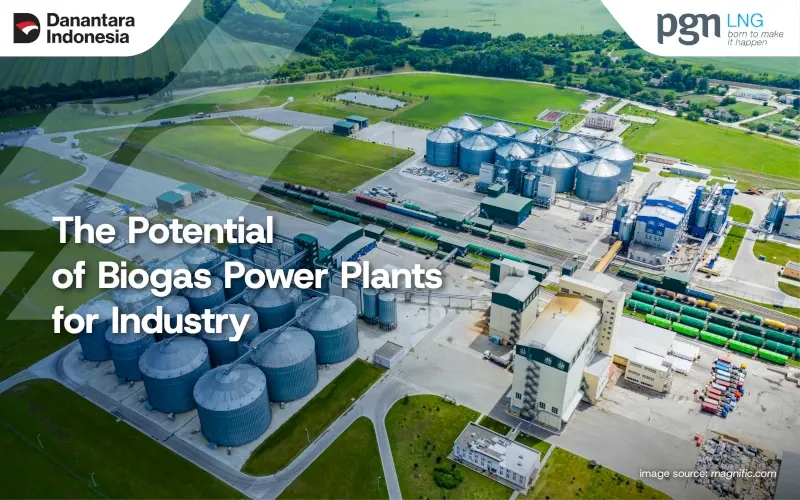
Biogas is an alternative energy source that can be used to generate electricity through biogas power plants.
Biogas is produced from the breakdown of organic materials, including agricultural waste, livestock waste, and industrial activities. This allows companies to turn organic waste back into a source of energy.
However, having biogas potential does not automatically make it the right energy source for every industry. The feasibility of a biogas power plant depends on feedstock supply, generating capacity, the company’s energy needs, and investment costs.
What Is a Biogas Power Plant?
A biogas power plant is a facility that uses biogas as fuel to generate electricity. Biogas is produced through anaerobic digestion, a process in which microorganisms break down organic material in the absence of oxygen.
Biogas contains methane (CH₄), which can be burned to produce energy. It also contains carbon dioxide (CO₂) and other components in varying amounts.
Biogas feedstock can come from agricultural waste, livestock manure, food waste, wastewater containing organic matter, and organic residues from certain industrial processes. These materials are processed in a digester to produce biogas.
For industries that generate organic waste, this system can turn that waste into an energy feedstock to support their operations.
Read More: 5 Ways to Tackle Global Warming
How Much Potential Do Biogas Power Plants Offer for Industry?
Industries that regularly generate organic waste have an opportunity to use biogas power plants. However, the potential depends not only on how much waste is available, but also on the ability to convert that waste into biogas and put the resulting electricity to use.
A study published in 2025 estimated that Indonesia’s biogas production potential from agricultural and agro-industrial waste exceeds 7 billion Nm³ per year. Meanwhile, Indonesia’s Ministry of Energy and Mineral Resources recorded installed biogas power plant capacity in Indonesia of 164.10 MW as of April 2026.
These figures show both the estimated biogas resource potential and the biogas power plant capacity already installed in Indonesia.
One example is the palm oil industry, which already uses Palm Oil Mill Effluent (POME), the liquid waste from palm oil processing, to produce biogas as fuel for power generation.
This shows that biogas power plants are more than just potential, as they are already in use in industrial operations in Indonesia. Even so, the amount of waste generated is not enough on its own to determine whether a biogas power plant is viable as an industry’s sole energy source.
Read More: Smart Strategies for Managing Boil-Off Gas
What Factors Determine the Feasibility of Biogas Power Plants for Industry?
Before developing a biogas power plant, a company needs to assess whether its feedstock, facilities, and generation system can reliably meet its energy needs at a reasonable cost.
This assessment covers several key factors:
- Feedstock availability: The volume and stability of the feedstock supply determine whether biogas and electricity production can be sustained.
- Feedstock characteristics: Organic content and moisture level affect biogas yield and the amount of feedstock processing required.
- Location and infrastructure: Collection distance, road access, gas treatment facilities, electrical systems, and gas storage needs all affect project costs.
- Facility scale and energy demand: Plant capacity should be matched to the company’s electricity usage profile.
- Investment and operating costs: Companies need to calculate the costs of building the digester, gas treatment system, and generator, as well as feedstock collection and maintenance.
- Safety and environment: The installation must have operational risk controls in place, including gas handling, worker safety, and environmental impact monitoring.
In addition, Indonesia’s Ministry of Energy and Mineral Resources has issued the Guidelines on Occupational Health, Safety, and Environment (K3L) for Operating Biogas Installations Based on Palm Oil Liquid Waste, as a reference for managing risks at POME-based installations.
For this reason, a feasibility study should assess the technical, economic, and safety aspects thoroughly before a company decides on the capacity and utilization scheme for a biogas power plant.
Read More: Refinery Process: How Crude Oil Is Turned into Fuel
Can Biogas Power Plants Meet All of an Industry’s Energy Needs?
A biogas power plant could meet all of an industry’s electricity needs if its generating capacity and biogas supply are sufficient for the company’s operations.
In most cases, however, this does not hold, because biogas production depends on the volume and continuity of the feedstock supply as well as the plant design. Industries that generate only limited amounts of organic waste may be able to cover just part of their electricity needs with biogas.
For this reason, companies should compare the electricity capacity the plant can produce against their actual load profile, including changes in demand during operating hours.
If the biogas power plant’s capacity or feedstock supply is not yet sufficient, a company can treat it as one component of its energy mix rather than its only source of supply.
Industries that operate continuously and need a reliable energy supply require a supporting energy source to keep their needs covered. One option worth considering today is Liquefied Natural Gas (LNG), which offers several advantages that industries need.
Read More: Advantages of Floating LNG You Won’t Find in Onshore Terminals
How Can LNG Support Industrial Energy Needs?
LNG can be one option to supplement an industry’s energy supply when biogas power plant capacity or biogas availability falls short of operational needs.
Unlike biogas, whose production depends on the availability of organic feedstock on site, LNG can be supplied through the natural gas distribution chain and stored until it is needed, according to the facility’s requirements.
After regasification, LNG can be used as fuel for power generation and for industrial equipment that requires heat.
However, using it still requires suitable infrastructure, from transport and storage to regasification, so that LNG can be used at industrial facilities.
PGN LNG Indonesia offers LNG solutions covering supply, storage, distribution, and regasification to support the energy needs of various industrial sectors. With these services, companies can consider LNG as a reliable energy solution.
Learn more about our LNG solutions here: LNG Supplier in Indonesia.
References
- ESDM. Accessed 2026. Book Launched, Government Improves Occupational Health and Safety at Biogas Power Plants
- ESDM. Accessed 2026. Directorate General of New, Renewable Energy and Energy Conservation (EBTKE)
- ScienceDirect. Accessed 2026. Biogas potential for sustainable power generation in Indonesia
- International Energy Agency (IEA). Accessed 2026. Introduction to biogas and biomethane