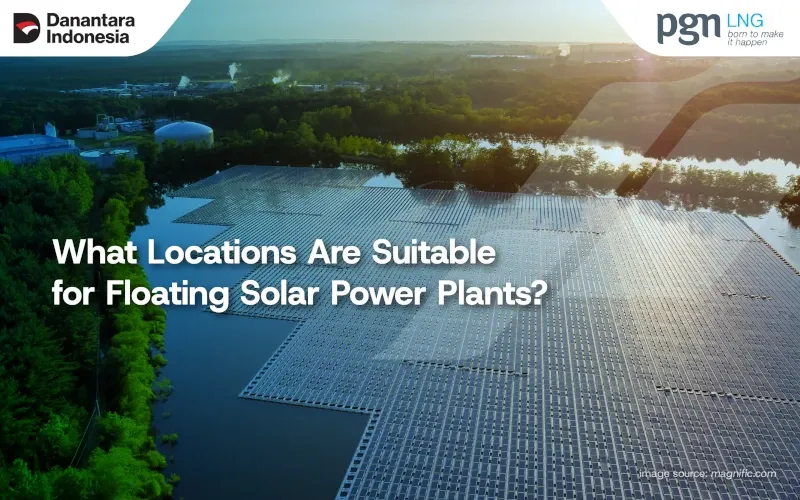
Indonesia has substantial solar energy potential, making solar power plants a promising way to increase renewable energy use. Solar power plants can be built not only on land but also on water surfaces, especially reservoirs and lakes. These systems are known as floating solar power plants or floating photovoltaic (FPV) systems.
However, not every body of water is suitable for FPV, because installations on water must account for changes in water level, wind, waves, and the surrounding environmental conditions. So what do suitable locations for floating solar power plants look like, and what should you look out for?
What Is a Floating Solar Power Plant?
A floating solar power plant is a power generation system that places solar panels on a floating structure on the surface of a body of water. The panels capture solar radiation to produce direct current (DC) electricity. An inverter then converts this into alternating current (AC), which can power electrical equipment or be fed into the grid.
The floating structure does more than hold the solar panels. It must also be designed so that the installation can operate reliably on the water.
Changes in water level, wind, and waves can affect the position and movement of the structure. For this reason, the structural design and mooring system need to be tailored to site conditions so the installation stays in its intended position.
One example is the Cirata Floating Solar Power Plant at Cirata Reservoir in West Java, which has a capacity of 192 MWp and has been in commercial operation since November 2023.
Read More: Renewable vs Non-Renewable Energy
How Do Floating Solar Power Plants Differ from Ground-Mounted Solar Power Plants?
The main difference lies in where they are installed and the environmental conditions they face. Ground-mounted solar power plants sit on land, while floating solar power plants rely on structures that float on water.
This means floating systems need floats or pontoons to support the panels, as well as a mooring system to hold the installation in place when wind, currents, or water level changes act on the structure.
Water conditions also deserve attention, because waves, humidity, and constant exposure to water can affect structural stability and increase the risk of corrosion in certain components.
The installation location also affects how the plant is operated and maintained. At a floating solar power plant, technicians must reach the panels and electrical components via walkways or access facilities over the water.
For this reason, work safety, ease of access, and maintenance methods should be considered from the design stage.
Read More: What’s the Difference Between LPG and LNG?
What Kind of Location Is Suitable for Floating Solar Power Plants?
Choosing a site for a floating solar power plant cannot rely solely on available space or sunlight. It must also consider the characteristics of the water body, the supporting structures required, and whether the site is accessible enough for long-term operation.
These factors are interrelated, since they determine whether the installation can be built safely, generate electricity efficiently, and operate as required. Below are the criteria for a site suitable for FPV development.
Has a Suitable Water Surface and Water Body Conditions
A floating solar power plant can be located on a reservoir, lake, or other body of water that meets the applicable technical and regulatory requirements. The water surface must be large enough to accommodate the planned generating capacity.
The depth and bed conditions of the water body also need to be checked, as both influence the design of the mooring and anchoring systems that keep the floating structure in place.
Has Manageable Water, Wind, and Wave Conditions
Water level fluctuations, currents, waves, and wind should be analyzed before construction, because these factors can affect the stability of the structure and the mooring system.
The mooring system must be able to accommodate changes in water level, currents, and waves, since these can cause the structure to move and place additional loads on the installation’s components.
If this movement is not properly accounted for, the reliability of the system and the performance of the plant may suffer.
Receives Adequate Sun Exposure
A floating solar power plant needs sufficient solar radiation for the panels to generate electricity in line with the site’s potential.
For this reason, the assessment should cover not only solar energy potential but also shading from hills, trees, buildings, or other structures around the water body that could reduce the sunlight reaching the panels.
The results of this assessment are used to estimate electricity production and help determine the plant’s capacity.
Does Not Interfere with the Primary Function of the Water Body
Before a water body is used for a floating solar power plant, its primary function should be identified, for example as a hydropower reservoir, a raw water source, an irrigation facility, or a flood control structure.
The installation of panels and floating structures must be adapted to these needs so that they do not hinder operations, obstruct management access, or cause environmental impacts.
In Indonesia, the government has identified potential for floating solar development on lakes and dams, and encourages the use of reservoir surfaces while keeping management considerations in view.
Has Access to the Power Grid
A water body that meets the technical requirements is not necessarily an ideal site if the electricity it generates is difficult to deliver to the grid or to demand centers.
For this reason, planning should consider the distance to transmission or distribution lines, the availability of substations, and the grid’s capacity to absorb the additional power from the plant.
Physical access to the site is also needed to transport materials, carry out construction, and perform inspection and maintenance. These considerations are also covered in Indonesia’s planning guidelines for floating solar power plants, which include grid infrastructure and site access as part of the feasibility assessment.
Read More: Can Gas Fuel Reduce Coal Pollution?
How Can Floating Solar Power Plants Support Industrial Energy Needs?
Floating solar power plants can serve as one source in a company’s energy mix, particularly for industrial facilities with suitable bodies of water near their operating areas.
They allow a company to generate electricity from solar energy without depending entirely on available land for panel installation. However, solar output depends on sunlight, so it can drop on cloudy days and stops at night.
For industries that need a continuous energy supply, this means solar power should be combined with other energy sources so that operational needs are still met when solar output falls short.
One complementary option worth considering is Liquefied Natural Gas (LNG), which is natural gas cooled into liquid form to make it easier to store and distribute. After regasification, LNG can be used as fuel for power generation or industrial equipment.
For a combination of floating solar and LNG to meet industrial energy needs, companies should look for energy supply solutions that fit the operational characteristics and location of their facilities.
This is especially important for industries that require a stable power supply, including when solar output declines due to weather or is unavailable at night.
PGN LNG Indonesia offers LNG solutions covering supply, storage, distribution, and regasification to support industrial energy needs.
Through these services, companies can explore LNG as a complementary energy source, taking into account power generation requirements, infrastructure readiness, and energy consumption patterns at their operating sites.
Find out how LNG solutions can complement your company’s energy supply strategy. Learn more about our services here: LNG Supplier in Indonesia.
References
- ESDM. Accessed 2026. Government Optimizes 14 GW Floating Solar Power Plant Potential
- ESDM. Accessed 2026. Ministry of Public Works and Housing Gives Green Light to Optimizing Floating Solar Power Plants on Reservoir Surfaces
- IESR. Accessed 2026. Cirata Floating Solar Power Plant
- IEA. Accessed 2026. Fact Sheet: Floating Photovoltaic Power Plants