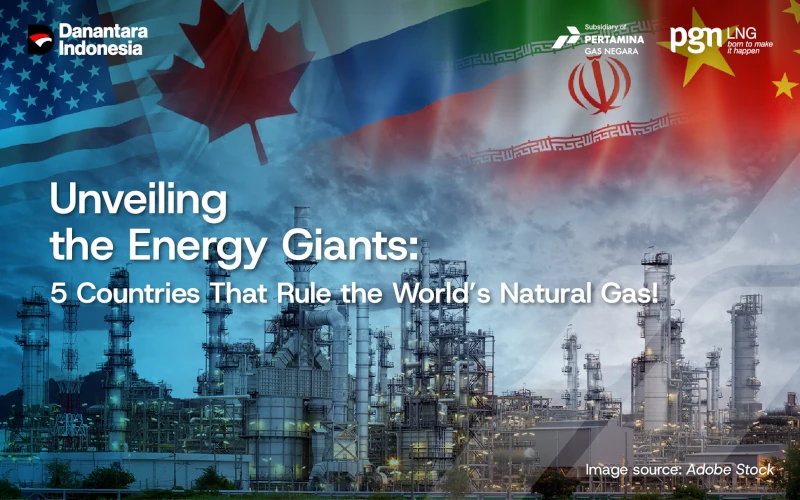
Natural gas continues to play a vital role in meeting global energy demand. According to data from the American Gas Association, natural gas accounted for approximately 25% of the world’s total energy supply in 2024, with demand increasing compared to the previous year.
Which countries currently dominate global natural gas production, and does Indonesia play a significant role in this sector? Discover the facts below.
Which Countries Are the World’s Largest Natural Gas Producers?
Below is a list of countries that have consistently ranked among the world’s largest natural gas producers in recent years.
1. United States
The United States has long been the world’s largest producer of natural gas. This position is largely driven by the shale gas revolution and advanced technologies such as hydraulic fracturing (fracking), which unlocked vast reserves that were previously uneconomical to extract.
In 2024, data shows that the U.S. produced more than 1 trillion cubic meters of natural gas, around one-quarter of global output, cementing its status as the world’s leading producer.
Advanced technology, an extensive pipeline network, and expanding LNG (Liquefied Natural Gas) export capacity have further strengthened the U.S. position in both domestic and international markets.
Read More: What’s the Difference Between LPG and LNG? A Clear Breakdown
2. Russia
Russia ranks second among the world’s largest natural gas producers, with an annual output of approximately 630 billion cubic meters.
Despite facing geopolitical pressures and Western sanctions that have reduced pipeline exports to Europe, Russia has gradually shifted its export focus toward Asian markets, particularly China, through the construction and expansion of pipelines such as the Power of Siberia.
In addition, Russia is home to several massive gas fields in Siberia, including Urengoy and Yamburg, reinforcing its long-term role as a major global energy supplier.
3. Iran
Iran holds the third position globally in natural gas production, with annual output approaching 250 billion cubic meters (bcm).
The South Pars gas field in the Persian Gulf serves as the backbone of Iran’s gas production and plays a critical role in supporting the country’s national energy supply.
Despite its substantial production volume, most of Iran’s natural gas is consumed domestically. International sanctions have frequently hindered the country’s ability to develop infrastructure and expand gas exports.
Read More: These Are the Components in Natural Gas That Make It Highly Valuable
4. China
In addition to being one of the world’s largest natural gas producers, China is also the world’s largest energy consumer.
China’s natural gas production capacity has shown strong growth, driven by national energy security policies and emission reduction targets. By 2024, China’s annual natural gas production had surpassed 200 billion cubic meters (bcm).
To enhance energy resilience, China has aggressively invested in gas exploration and production, including non-conventional resources such as shale gas and coalbed methane.
5. Canada
In 2024, Canada’s natural gas production capacity ranged between approximately 160 and 180 billion cubic meters (bcm).
Canada is on the brink of a major transformation in the global energy market with the launch of its first LNG terminal, LNG Canada, located in British Columbia, which is expected to begin phased operations.
This facility has the potential to position Canada as a key LNG exporter to Asian markets and could significantly influence global natural gas supply dynamics in the medium to long term.
Read More: Can Water Become Energy? Here’s the Explanation
Where Does Indonesia Rank in Global Natural Gas Production?
Based on PwC data, Indonesia ranked 13th globally in natural gas production in 2024, with a total output of approximately 61.49 billion cubic meters (bcm).
This figure is significantly lower than that of China and Canada, which ranked 4th and 5th, respectively, among the world’s largest natural gas producers.
Domestically, Indonesia’s natural gas production plays an important role in meeting national demand, although its contribution on the global stage remains relatively modest.
Why Is Indonesia Still Stuck at 13th Place?
Indonesia’s stagnant ranking as a global natural gas producer is not due to limited reserves, but rather to structural challenges in gas development.
Many newly discovered gas reserves are located in remote regions of eastern Indonesia and require deepwater technology and substantial investment. As a result, the timeline from discovery to production tends to be long and costly.
Beyond technical factors, gas development is highly dependent on infrastructure readiness and market certainty. Unlike oil, natural gas must be transported immediately or liquefied into LNG to hold economic value. Indonesia’s key challenges include:
- Limited pipeline networks and LNG facilities near newly discovered gas fields
- Dependence on secured buyers (offtakers) before projects can proceed
- Priority is given to meeting domestic demand (industry, fertilizers, and power generation), which limits export volumes
Together, these factors structurally constrain production growth and limit Indonesia’s ability to move up the ranks among global natural gas producers.
Read More: 7 Organic Wastes That Produce Energy
What Is the Future Potential of Indonesia’s Natural Gas?
According to data from Indonesia’s Ministry of Energy and Mineral Resources, Indonesia still possesses substantial natural gas potential to support long-term national energy needs.
Indonesia’s gas reserves amount to tens of trillions of cubic feet, with resources spread across Sumatra, Kalimantan, Natuna, Sulawesi, and Papua.
The government projects a gas surplus of more than 1,700 MMSCFD, equivalent to approximately 34 million tons of LNG per year (MTPA), within the next decade, driven by several major projects and a significant increase in LNG production.
The Ministry of ESDM also emphasizes optimizing natural gas utilization for domestic needs, including industry, electricity generation, and households, through expanded gas and LNG infrastructure development.
Currently, Indonesia’s national LNG processing capacity stands at around 35–35.25 million tons per year (MTPA), with actual production reaching approximately 17.35 MTPA in 2024. Additional projects, such as large-scale FLNG (Floating LNG) facilities, are expected to further boost production capacity by several million tons annually.
References:
- EIA. Accessed 2025. Three U.S. regions each produce more natural gas than most countries
- American Gas Association. Accessed 2025. Statistical Review of World EnergyNasdaq. Accessed 2025. Top 10 Countries for Natural Gas Production (Updated 2024)
- Investing News. Accessed 2025. Top 10 Countries for Natural Gas Production
- Enerdata. Accessed 2025. Natural Gas Production
- Kementerian ESDM. Accessed 2025. Sepuluh Tahun Mendatang, Indonesia Bakal Surplus Gas Hingga 1715 MMSCFD
- Kementerian ESDM. Accessed 2025. Gas Jadi Energi Transisi, Pemerintah Dorong Peningkatan Produksi dan Infrastruktur Gas Nasional
- PwC. Accessed 2025. Oil and Gas in Indonesia