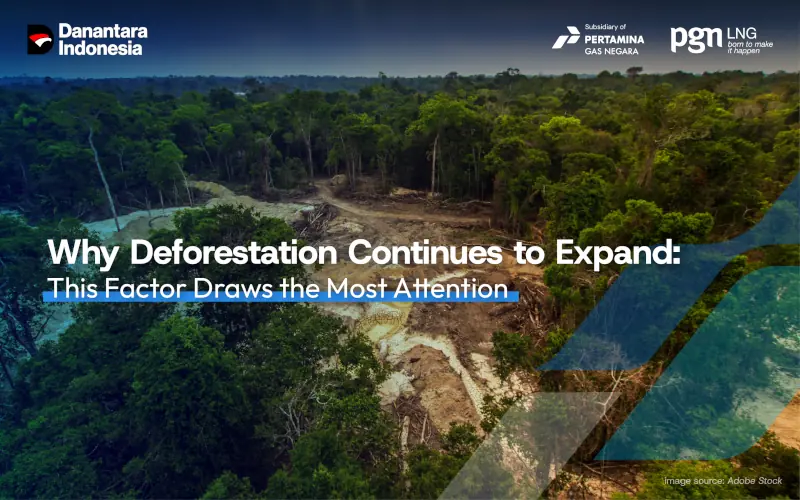
Forests are often referred to as the lungs of the planet due to their critical role in absorbing carbon dioxide, regulating the climate, and maintaining air quality.
However, this role is steadily weakening as deforestation continues to expand. The consequences range from heightened climate crisis risks and ecosystem loss to increasingly extreme weather patterns.
So, what is driving deforestation today? Let’s take a closer look at the key causes and explore how LNG can mitigate its environmental impact.
What Causes Deforestation to Keep Expanding?
Deforestation is a highly complex issue, driven by multiple factors rather than a single cause. A combination of legal and illegal activities contributes to this ongoing problem, including:
Land Conversion for Agriculture and Plantations
One of the most frequently highlighted causes is the conversion of forests into large-scale agricultural land. Global demand for commodities such as palm oil, soybeans, and other plantation crops continues to push the expansion of new agricultural areas.
According to the Food and Agriculture Organization (FAO), agricultural expansion, including food crops, plantations, and livestock, accounts for nearly 90% of global deforestation. In Indonesia, this issue is particularly pronounced given its position as the world’s leading palm oil producer.
Read More: 7 Impacts of Deforestation That Threaten Us
Mining Activities and Natural Resource Exploration
Beneath dense forest cover often lie valuable mineral and coal reserves. To extract these resources, forests are frequently cleared through open-pit mining methods.
Coal, gold, and nickel mining operations often leave permanent scars on the landscape. The impacts extend beyond tree loss to include soil degradation and water pollution, affecting surrounding communities.
Logging Activities (Legal and Illegal)
There is a subtle but crucial distinction between legal and illegal logging. Legal logging is typically regulated under selective cutting practices and sustainable forest management principles.
Illegal logging, however, often operates without regard for forest regeneration. These activities frequently evade monitoring, as they take place in remote areas with limited accessibility.
Infrastructure Development and Urbanization
In pursuit of economic growth targets, road construction, industrial zone expansion, and new residential developments often cut through forested areas.
This process leads to forest fragmentation, where large forest landscapes are divided into smaller patches. Such fragmentation disrupts wildlife migration routes and threatens overall ecosystem balance.
Read More: The Process of Global Warming
What Do Indonesia’s Deforestation Data and Trends Look Like?
Deforestation in Indonesia has shown a declining trend over several recent periods. According to data from Indonesia’s Ministry of Forestry, net deforestation in 2024 stood at approximately 175,400 hectares, marking a decrease compared to the previous year.
Nevertheless, Forest Watch Indonesia (FWI) notes that deforestation continues to occur, particularly within plantation concessions, industrial timber forests, and remaining natural forests.
Below is Indonesia’s deforestation trend over the past three years:
| Year | Net Deforestation (ha) |
| 2021–2022 |
104,000 |
| 2022–2023 |
257,384 |
| 2023–2024 |
175,400 |
Based on this data, after reaching a relatively low level in 2021–2022, deforestation increased in 2023 before declining again in 2024.
Read More: Smart Strategies for Managing Boil-Off Gas
How Does Deforestation Affect Climate and Carbon Emissions?
Forests function as highly effective natural carbon sinks. As trees grow, they absorb CO₂ from the atmosphere through photosynthesis and store it in their trunks, roots, and surrounding soil.
When forests are burned or cleared, the carbon stored over decades is released back into the atmosphere in a short period. This process is a major contributor to rising carbon emissions linked to deforestation.
These increased emissions directly contribute to global temperature rise, polar ice melt, and increasingly unpredictable rainfall patterns.
If sustained over the long term, deforestation not only accelerates environmental degradation but also heightens health risks for human populations.
Read More: Geothermal Energy, A Green Solution or Still Hiding Risks?
What Role Does LNG Play in Reducing Emissions from Deforestation?
As mentioned earlier, deforestation leads to increased carbon emissions due to the release of stored forest carbon.
This situation is further exacerbated by the continued use of fuels such as coal, whose combustion generates significant carbon emissions.
The impact becomes even more severe when deforestation occurs to open land for coal mining, as emissions are generated throughout the entire process, from forest clearing and exploration to extraction and distribution.
Many industrial sectors and power plants still rely heavily on coal. Therefore, efforts to reduce carbon emissions must be accompanied by a shift toward cleaner energy sources that can still provide a reliable supply.
One of the most realistic solutions today is the use of LNG (Liquefied Natural Gas).
Several factors explain why LNG is a relevant option in the energy transition era:
- It produces significantly lower carbon emissions, around 40–50% less than coal when used for power generation.
- It helps reduce pressure for new land clearing, as natural gas infrastructure typically has a smaller and more efficient physical footprint.
- It generates lower particulate emissions, reducing environmental and public health risks.
For industries, transitioning to LNG is not merely about following sustainability trends. It is a practical step to maintain productivity while reducing carbon emissions.
As a transition energy source, LNG plays a vital role in maintaining national energy security while gradually reducing dependence on environmentally harmful coal.
References:
- FAO. Accessed 2026. COP26: Agricultural Expansion Drives Almost 90 Percent of Global Deforestation
- Ministry of Forestry. Accessed 2026. Indonesia Forests and Deforestation 2024
- Forest Watch Indonesia (FWI). Accessed 2026. KLHK Deforestation Claims: Lowest Point or Different Methodology?
- IEA. Accessed 2026. The Role of Gas in Today’s Energy Transitions