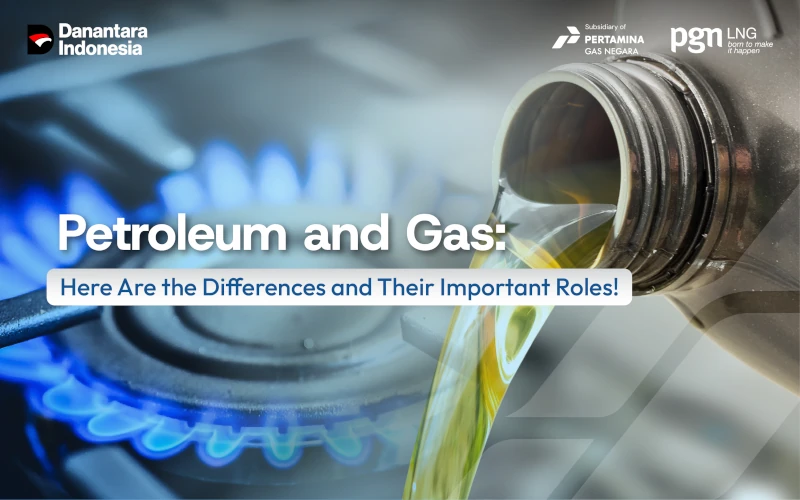
As energy sources, oil and natural gas are major contributors to today’s national energy mix. Despite having very different physical forms, both share several similarities and complementary roles, especially in supporting energy needs during the energy transition era.
On the other hand, their differing characteristics also influence how they are managed and utilized, making them important factors in determining cleaner and more sustainable energy options for the future.
To better understand these two energy sources, let’s explore their similarities, differences, and key roles in more detail.
How Are Oil and Natural Gas Formed?
The formation of oil and natural gas is a geological process that takes place over tens to hundreds of millions of years, involving high pressure and temperature deep within the Earth’s crust.
This process begins with the accumulation of microscopic organisms such as plankton and marine plants that settle on the seabed or in ancient swamp environments under low-oxygen conditions, preventing normal decomposition.
As layers of sediment build up, heat and pressure transform this organic material into hydrocarbons. Oil is formed within the so-called oil window at temperatures of around 60–120°C, while higher temperatures promote the formation of natural gas.
Once formed in source rocks, oil and gas migrate upward and become trapped in reservoir rocks sealed by impermeable layers. This process ultimately allows exploration and production through drilling.
Read More: The Pros and Cons of Using Coal for Energy
What Are the Similarities Between Oil and Natural Gas?
Although they differ in physical form, oil and natural gas are often referred to as “twin siblings” in geology. Their most fundamental similarity is that both are fossil fuels.
Chemically, both oil and gas are dominated by hydrocarbon compounds, which is why they are often formed and trapped within the same geological reservoir systems.
Beyond their role as energy sources, both also serve as strategic raw materials for the petrochemical industry, producing a wide range of derivative products that are essential to modern life.
Read More: Smart Strategies for Managing Boil-Off Gas
What Are the Differences Between Oil and Natural Gas?
Although formed through similar processes, oil and natural gas have fundamental differences that determine how they are processed and used.
Physical Form and Composition
Oil, often referred to as black gold, is a viscous liquid ranging in color from dark brown to black. Its composition is highly complex, consisting of various long-chain hydrocarbons.
In contrast, natural gas is a colorless and odorless gas in its pure form. Its primary component is methane (CH₄), the simplest and lightest hydrocarbon molecule.
Read More: Why Is the FSU a Game Changer in the LNG Industry?
Primary Uses
Oil remains the backbone of the global transportation sector. Its refined products, such as gasoline, diesel, and jet fuel, power almost all land, sea, and air transportation.
In addition, oil is an irreplaceable raw material for engine lubricants and road asphalt.
Natural gas, on the other hand, is more commonly optimized as a stationary energy source, such as fuel for power generation, space heating in four-season countries, and cooking fuel for households.
However, in some developed countries, forms of natural gas such as CNG (Compressed Natural Gas) and LNG (Liquefied Natural Gas) are also used in the transportation sector, although their adoption remains relatively limited.
Extraction and Transportation Processes
The extraction and transportation of oil and natural gas involve different challenges. Oil is a liquid, making it relatively easier to produce through pumping and store in closed tanks at near-atmospheric pressure.
In contrast, natural gas has low density and expands easily, requiring special handling, typically through high-pressure pipeline networks for onshore distribution.
For long-distance transportation, natural gas must be liquefied into LNG at temperatures of around −162°C to reduce its volume and make it easier to transport. Such complex transportation processes are generally not required for crude oil distribution.
Read More: The Refining Process, Turning Crude Oil into Fuel
What Are Their Key Roles?
The existence of oil and gas goes beyond fuel. They are pillars of national energy security and the global economy. Below are their key roles across various sectors.
The Role of Oil
Oil plays a fundamental role in modern manufacturing industries, not only as a transportation energy source but also as a primary feedstock for the petrochemical industry.
Many everyday products, such as plastics, synthetic rubber, artificial textile fibers, and medical equipment, depend on polymers and chemical derivatives derived from oil.
Although non-fossil alternatives are being developed, global industrial dependence on oil remains very high.
Read More: 5 Ways to Tackle Global Warming and Save the Planet’s Future
The Role of Natural Gas
Natural gas, including LNG, is often viewed as a transition energy source because its combustion produces significantly lower carbon dioxide, sulfur, and particulate emissions compared to coal, particularly in power generation and industrial applications.
These characteristics make natural gas a relatively fast and technologically mature option for reducing air pollution in the short to medium term.
Oil and natural gas are fossil resources that have played a central role in shaping global energy systems and economies since the late 19th century.
Despite their different physical forms, both complement each other in meeting human energy needs, from transportation and industry to electricity generation.
References:
- National Geographic. Accessed in 2025. Fossil Fuels
- EIA. Accessed in 2025. Oil and Petroleum Products Explained
- Britannica. Accessed in 2025. Natural Gas
- IEA. Accessed in 2025. Energy Supply & Transformation