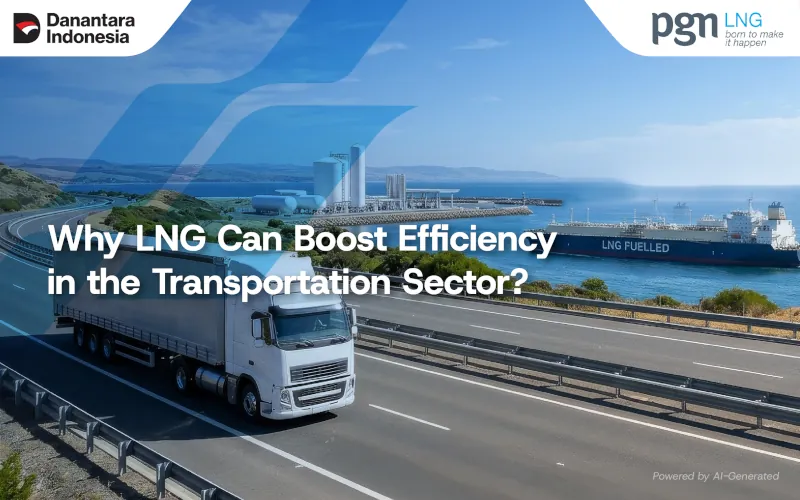
The transportation sector is one of the largest energy consumers, both for land and sea transportation. Diesel still serves as the primary fuel for trucks and heavy vehicles, gasoline is used for light vehicles, while ships generally rely on marine fuels such as HFO, MGO, or VLSFO.
However, this sector faces challenges in the form of fuel cost fluctuations, operational efficiency demands, and increasingly strict environmental regulations. These conditions are pushing transportation industry players to start considering a more efficient alternative fuel for various transportation needs, namely Liquefied Natural Gas (LNG).
Why Is Efficiency an Important Issue in the Transportation Sector?
Efficiency in the transportation sector deserves attention because it directly affects operational costs and company competitiveness.
For logistics, mining, shipping, and industrial companies, fuel costs are one of the largest expenditure components.
As a result, fuel consumption affects distribution costs, fleet productivity, and overall operational efficiency. The more efficient the energy use, the greater the potential for long-term cost savings.
On the other hand, efficiency today is no longer measured solely by fuel savings. Companies are also required to meet ESG (Environmental, Social, and Governance) targets and various emission regulations, so efficiency also encompasses energy supply reliability, maintenance costs, and compliance with environmental regulations.
Read More: Pros and Cons of Solar Power Plants
Why Can LNG Improve Efficiency in the Transportation Sector?
LNG can improve efficiency in the transportation sector because it offers a combination of storage efficiency, cleaner combustion, and the potential for operational cost reduction.
These advantages are making LNG increasingly considered as an alternative fuel for both land and sea transportation.
LNG Characteristics That Support Energy Efficiency
LNG is natural gas that has been cooled to around -162°C so that it becomes liquid and its volume shrinks to around 1/600 of natural gas under standard conditions, making it more efficient to store and distribute.
In addition, LNG is dominated by methane (CH4), which has cleaner combustion characteristics compared to many petroleum-based fuels.
Factors That Make LNG More Efficient
The high methane content makes LNG combustion more efficient. In addition, LNG produces almost zero sulfur emissions (SOx), so in certain applications it does not require sulfur control systems like those used with some types of marine fuel.
LNG also produces lower particulate matter (PM) emissions, while NOx and CO2 emissions are generally lower compared to diesel and heavy fuel oil. From an operational standpoint, the use of LNG also has the potential to improve cost efficiency when supported by adequate supply infrastructure.
Read More: Hybrid Solar Power – An Energy-Saving Solution or Just a Trend?
Examples of LNG Use in the Transportation Sector
Although the use of LNG in the transportation sector continues to grow, its application is still limited to certain uses and has not yet become a widely adopted primary fuel.
Currently, LNG is more commonly utilized in transportation modes that require large amounts of energy, cover long distances, or operate continuously, so that the efficiency and logistical benefits are more tangible.
LNG Use in Land Transportation
In the land transportation sector, LNG is used in long-haul logistics trucks, some mining operational vehicles, and intercity buses in some countries. Meanwhile, the use of LNG in railways is still limited to pilot projects and specific implementations, and has not yet become an industry standard.
Compared to passenger vehicles, LNG is more suitable for heavy vehicles because their energy needs are higher, their travel distances are longer, and refueling is more efficient.
The implementation of LNG-fueled vehicles has developed in China, several European countries, and the United States.
LNG Use in Maritime Transportation
In the maritime sector, LNG is increasingly being used as fuel for container ships, ferries, tankers, and cruise ships.
This increase is driven by emission regulations from the International Maritime Organization (IMO), the need to improve operational efficiency, and LNG’s ability to reduce sulfur (SOx) and particulate emissions compared to conventional marine fuels.
As the number of LNG-fueled ships grows, LNG bunkering facilities are also continuing to develop at various ports to support refueling needs.
Read More: Why LNG Is Making Modern Manufacturing More Profitable
What Are the Benefits of Using LNG for Companies in the Transportation Sector?
For companies that operate transportation fleets intensively, the use of LNG can provide both operational and strategic benefits.
When LNG prices are competitive and supported by adequate supply infrastructure, the use of LNG has the potential to reduce operational costs while helping companies meet sustainability targets and comply with emission regulations.
These benefits include:
- Reducing operational costs when LNG prices are competitive.
- Supporting the achievement of ESG targets through lower emissions.
- Reducing local air emissions so that the quality of the operational environment improves.
- Helping to reduce potential compliance costs associated with increasingly strict emission regulations.
- Strengthening the company’s image as a more sustainable business player.
These benefits are generally most relevant for companies with large energy needs and high-intensity fleets, such as those in the mining, smelting, manufacturing, logistics, and shipping sectors.
For LNG implementation to deliver optimal benefits, companies need to consider solutions that match the characteristics of their fleet and operational needs. LNG supply planning, distribution systems, and infrastructure support are important factors to ensure that LNG utilization runs effectively and sustainably.
PGN LNG Indonesia supports the needs of companies that want to optimize their use of LNG. From LNG supply to infrastructure support, we help companies access more efficient and reliable energy supply.
Find out the complete solutions we provide for your industry here: Experienced LNG Partner Provider.
References
- EIA. Accessed 2026. Natural gas explained
- DoE. Accessed 2026. Natural Gas
- IMO. Accessed 2026. IMO 2020 – cutting sulphur oxide emissions
- European Commission. Accessed 2026. Rail
- Wartsila. Accessed 2026. LNG as fuel for ships: expert answers to 17 important questions