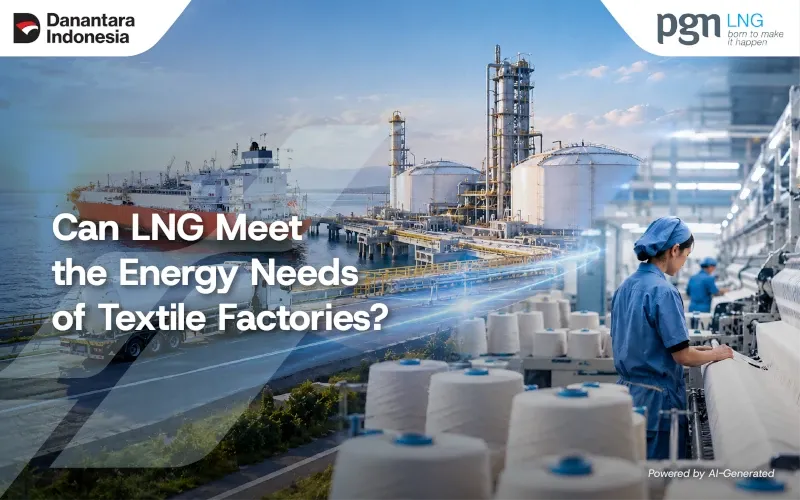
Textile mills need a stable energy supply to run machinery and generate heat for production processes. These needs can be met through various energy sources, such as coal and petroleum.
Liquefied Natural Gas (LNG) can be an alternative for meeting the energy needs of textile mills, particularly for producing heat and steam through boilers. Compared with coal and petroleum, burning LNG produces lower CO₂ emissions, which makes it a well-suited option for the energy transition.
What Energy Sources Do Textile Mills Use?
Textile mills use a range of energy sources, such as coal, fuel oil, and natural gas. The mix varies depending on the production process, the scale of the mill, its location, and the infrastructure available.
Fuel is generally used to produce heat and steam through boilers, especially for dyeing, washing, and drying fabric. Electricity, meanwhile, is used to run spinning and weaving machines, pumps, and other production equipment.
When choosing an energy source, mills consider not only fuel prices but also the ability to deliver the heat their processes require, supply availability, and compatibility with existing equipment.
Read More: What’s Driving the Surge in Electricity Demand in the Modern Era?
Why Should the Textile Industry Consider Reducing Emissions?
Burning coal and petroleum to produce heat and steam in textile mills generates carbon dioxide (CO₂) emissions. Coal in particular also produces ash and can release particulates and other pollutants that need to be controlled.
This makes the choice of energy source an important consideration in efforts to reduce emissions and pollution from industrial activities.
Emission reduction matters for the textile industry because it can relate to compliance with environmental regulations, meeting customer requirements, and achieving a company’s sustainability targets.
This is where the challenge lies: mills still need a stable energy supply to keep production running, yet the emissions from combustion must remain under control.
Switching to another energy source can be one way to reduce emissions, but the decision cannot be based on potential emission cuts alone. Mills also need to consider operating costs, supply reliability, and how well the fuel suits their boilers and other equipment.
Read More: Pros and Cons of Fossil Energy in Transition Era
What Affects the Energy Needs of Textile Mills?
A textile mill’s energy needs depend on the type of product and the stages of production. A mill that only spins and weaves has different energy needs from a facility that also handles dyeing, drying, and finishing.
In dyeing, heat is needed to warm the dye solution, while drying requires thermal energy to remove moisture from the fabric. These processes need an adequate heat supply so that production can proceed as operations require.
The heat and steam demands of these processes are one factor in assessing whether natural gas is suitable as a thermal energy source.
Mills also need to consider their electricity needs for running machinery, as well as the facilities available for using gas as a fuel.
Read More: Energy Crisis Impact on LNG Supply Shifts
How Can LNG Meet the Energy Needs of Textile Mills?
LNG is natural gas that has been cooled into liquid form to make it easier to store and transport. Before it can be used as fuel, LNG must go through regasification to return it to a gaseous state.
In a textile mill, this gas can be used as boiler fuel to produce the steam and heat needed for dyeing and drying fabric.
This makes LNG an option for meeting thermal energy needs, especially at mills that require a continuous supply of heat.
Natural gas can also be used to generate electricity through gas-fired power plants, if the mill’s needs and facilities support it. Using gas for power generation is different from using it to produce heat directly through boilers or heating equipment.
Compared with coal and petroleum, burning natural gas produces lower CO₂, sulfur dioxide, and particulate emissions.
These characteristics make LNG an option for textile mills that want to meet their heat and steam needs while also supporting efforts to reduce fuel-related emissions.
Read More: The Advantages of Biodiesel: Is It Suitable for Industrial Use?
What Is an Example of a Textile Mill That Switched from Coal to Natural Gas?
PT Easterntex is a manufacturer of polyester-cotton blended yarn and fabric. Founded in 1973, it is located in Pasuruan, East Java, Indonesia.
The company previously relied on coal as its main energy source for production. In March 2024, PGN (Perusahaan Gas Negara) announced the delivery of natural gas to Easterntex after the company switched to natural gas as its primary fuel.
The switch was made with energy efficiency, supply continuity, and carbon emission reduction in mind.
In the textile industry, the choice of fuel affects not only energy supply but also operational efficiency and a company’s efforts to cut carbon emissions. Easterntex’s experience shows that switching from coal to natural gas can be one step toward those goals.
With a sustainable energy supply and a fuel that fits production needs, textile mills can keep production running smoothly while strengthening the competitiveness of their products, especially as efficiency and emission reduction become growing concerns for the market.
Read More: Is Geothermal Energy a Green Solution?
How Does PGN LNG Indonesia Support Industrial Energy Needs?
PGN LNG Indonesia supports industrial energy needs through integrated LNG receiving, storage, transport, and regasification services.
Through this infrastructure, LNG can be distributed and converted back into natural gas to meet industrial energy needs, including as boiler fuel for producing heat and steam in textile production.
Using LNG can also help expand access to natural gas for industries whose energy needs are not yet served by gas pipeline networks, giving companies an alternative that supports smooth operations and a continuous energy supply.
For LNG use to work as operations require, companies need to consider supply availability and the infrastructure needed to deliver gas to the point of use.
Through its integrated LNG services, PGN LNG Indonesia supports industrial energy needs with solutions that cover LNG receiving, storage, transport, and regasification.
This support allows companies to consider using natural gas according to their energy needs and the infrastructure conditions at their operating sites.
Want to learn more about LNG solutions to support your industrial operations? Read more here: LNG Supplier in Indonesia.
References
- Government of Canada. Accessed 2026. Net-Zero Emissions Primer for Textile Manufacturing Firms
- Institute for Essential Services Reform (IESR). Accessed 2026. Industry Decarbonization Roadmaps for Indonesia
- Lawrence Berkeley National Laboratory (LBNL). Accessed 2026. Energy-Efficiency Improvement Opportunities for the Textile Industry
- MDPI. Accessed 2026. Electrification of Steam and Thermal Oil Boilers in the Textile Industry
- ANTARA. Accessed 2026. PGN commits to business expansion by supplying natural gas to PT Easterntex