One of the primary advantages of Liquefied Natural Gas (LNG) is its flexibility in distribution, enabling energy access to regions beyond the reach of traditional gas pipeline networks. This flexibility is supported by a critical facility within the LNG supply chain: the offtake station.
More than just a transfer point, an offtake station plays a vital role in ensuring LNG quality, maintaining supply continuity, and enabling reliable distribution, especially to remote and underserved areas.
What Is an Offtake Station?
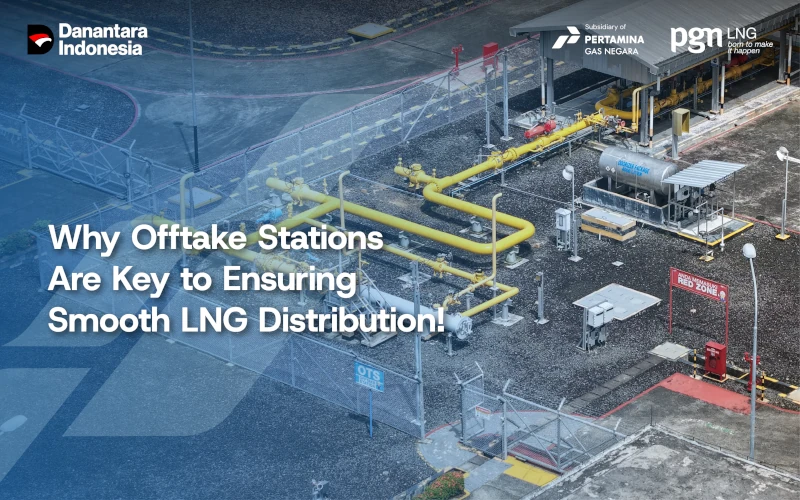
An offtake station is an infrastructure facility that functions as a handover point for natural gas or LNG from primary facilities such as regasification terminals or mini-LNG plants, before being distributed to end-users.
Typically, offtake stations can deliver regasified gas or liquid LNG through non-pipeline distribution modes. This enables industrial users, power plants, and transportation sectors in areas without pipeline access to continue receiving reliable gas-based energy supplies.
Read More: Do Alternative Energy Sources Have Limitations? Here’s the Solution
What Are the Main Components of an Offtake Station?
An LNG offtake station is equipped with several key components designed to ensure safe and efficient LNG storage and transfer, including:
- LNG Storage / Buffer Tanks: Double vacuum-insulated tanks used for temporary storage
- Loading Arms & Cryogenic Hoses: Specialized transfer equipment designed to handle extremely low temperatures without leakage or material degradation
- Vaporizers: Units that convert a portion of LNG into gas as required
- Pressure Control Units: Systems that maintain stable operating pressure
- Safety Systems: Including Emergency Shutdown (ESD) systems, gas detectors, and cryogenic monitoring to prevent operational incidents
- Flow Meters: Devices that accurately measure transferred LNG volumes for operational assurance and commercial transactions
With these components in place, an offtake station can operate safely and efficiently while maintaining LNG at cryogenic temperatures of approximately –160°C.
Read More: The Huge Potential of Micro-Hydro Energy and Its Challenges
How Does an Offtake Station Work?
An offtake station operates through a series of highly precise and tightly controlled technical procedures, where even minor errors are unacceptable.
The process requires synchronized coordination of pressure regulation, temperature monitoring, and flow rate control in real time. Below is an overview of how an offtake station distributes LNG:
LNG Transfer Process
At the offtake station, the transfer process begins with LNG flowing from the storage tank to a buffer tank or directly to the loading bay.
Before loading, transfer pipelines and hoses undergo a cool-down process to prevent thermal shock. During this stage, system pressure and boil-off gas (BOG) are carefully managed to maintain operational stability.
LNG is then transferred into tanker trucks using highly insulated cryogenic hoses to minimize heat ingress while ensuring safety and operational efficiency.
Safety Operations
Safety is a critical aspect of LNG-based offtake station operations. In accordance with NFPA 59A, LNG facilities covered by this standard must be equipped with Emergency Shutdown Systems (ESD) capable of automatically stopping LNG or gas flow when abnormal conditions are detected.
These systems are supported by pressure relief valves and cryogenic mitigation systems designed to manage risks associated with leaks or overpressure events.
In addition, both operators and truck drivers are required to strictly adhere to detailed Standard Operating Procedures (SOPs) to ensure all transfer connections are properly secured and leak-tight throughout the loading process.
Read More: Are LNG Terminals No Longer Efficient? Here Are the Facts
What Are the Core Functions of an Offtake Station in LNG Distribution?
An offtake station serves as a critical quality control and logistics hub, determining whether LNG is fit for delivery before it reaches end users. Its main functions include:
Regulating and Controlling LNG Flow
Flow rate regulation ensures that vehicle loading operations are conducted efficiently and safely.
Advanced control and automation systems, such as PLC (Programmable Logic Controllers) and SCADA (Supervisory Control and Data Acquisition), enable real-time monitoring of pressure and temperature.
This allows operators to control boil-off gas formation caused by heat ingress and maintain system stability.
Ensuring LNG Quality
LNG quality is maintained through strict system controls and operational procedures at the offtake station.
Facilities typically monitor key operational parameters such as pressure, temperature, and leak detection to ensure LNG is transferred safely and without contamination risks.
This approach aligns with LNG industry standards in Indonesia, where product quality is tightly controlled upstream, while safety aspects, such as leak detection and system integrity, remain the primary focus during downstream distribution.
Optimizing Loading and Unloading Operations
Offtake stations coordinate LNG loading and unloading processes by managing schedules and workflows between storage facilities and transport fleets, reducing truck waiting times and improving overall logistics efficiency.
During operations, boil-off gas (BOG) generated due to heat ingress is managed through pressure control, re-routing back to storage tanks, or utilization as fuel gas. These measures are essential to maintain system safety and minimize operational losses.
Read More: Why LNG Plays a Key Role in the Global Energy Transition?
Why Are Offtake Stations Critical to Smooth LNG Distribution?
Offtake stations are widely regarded as a solution to logistical challenges commonly encountered in long-distance energy distribution. This is why they play a pivotal role in ensuring reliable LNG delivery.
Reducing Distribution Bottlenecks
The presence of well-designed offtake stations significantly reduces the risk of bottlenecks in the LNG supply chain.
Through proper throughput management, sufficient loading bays, and effective operational planning, these facilities can serve transport fleets efficiently while minimizing truck queues.
As a result, supply schedules to industrial customers remain reliable without compromising operational safety or system integrity.
Supporting LNG Distribution Flexibility
Indonesia requires small-scale LNG distribution schemes to effectively serve its archipelagic geography and remote regions.
Offtake stations enable flexible LNG distribution by facilitating delivery through non-pipeline modes such as tanker trucks and ISO tanks.
This approach provides a more adaptive energy supply solution, particularly for power plants in remote areas that are not yet connected to conventional gas infrastructure.
Minimizing Operational Disruption Risks
The reliability of equipment at offtake stations plays a crucial role in maintaining LNG supply continuity through robust monitoring and operational control systems.
With early warning and control mechanisms in place, potential disruptions, such as minor leaks or pressure fluctuations, can be detected and addressed at an early stage.
An offtake station is therefore not merely a loading facility, but a strategic element of the LNG supply chain. It helps safeguard system stability, operational safety, and distribution efficiency, while also contributing to improved logistics performance and national energy security.
References
- U.S. Department of Energy (DoE). Accessed 2025. Global LNG Fundamentals
- JFE Engineering. Accessed 2025. LNG Receiving and Offtake Terminals
- PMC. Accessed 2025. Optimization of the Risk-Based Small-Scale LNG Supply Chain in the Indonesian Archipelago
- BB Library. Accessed 2025. Controlling the Gas Flow