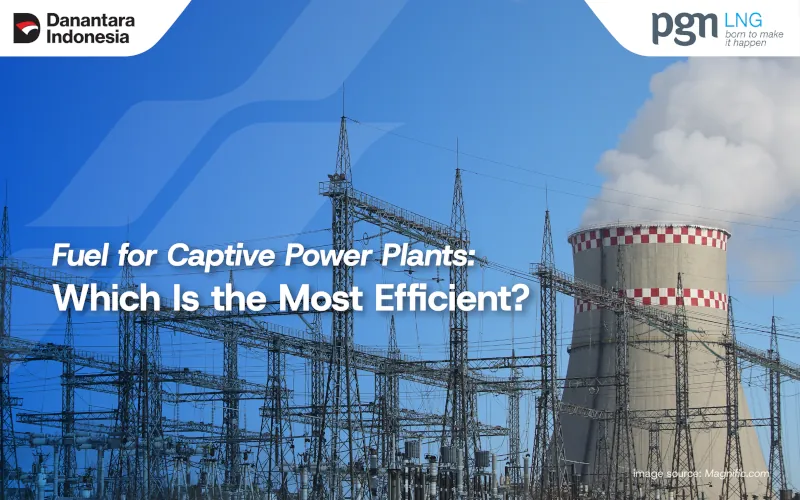
Industrial sectors whose operational locations have inadequate energy supply risk experiencing operational disruptions that can hinder productivity and increase costs.
To overcome this challenge, many companies build captive power plants, which are power generation facilities used to meet a company’s internal electricity needs so that energy supply remains secure.
However, the decision to build such a plant must also be accompanied by the selection of the right type of fuel, because a wrong choice will affect electricity generation costs, operational efficiency, maintenance requirements, emission levels, and long-term business sustainability.
What Factors Determine Fuel Efficiency in a Captive Power Plant?
Efficiency in the context of a captive power plant is not only determined by fuel price, but also by the plant’s ability to generate electricity optimally with efficient fuel consumption and operational costs.
This performance is the result of a combination of the type of fuel used, the generation technology, and the operating conditions during plant operation.
Some factors that affect captive power plant efficiency include:
- Plant thermal efficiency.
- Fuel consumption per kWh of electricity generated.
- Operation and maintenance costs.
- Continuity of fuel supply.
- Emissions and compliance with environmental regulations.
Because each type of fuel has different characteristics, companies need to compare all of these factors thoroughly before determining the choice that best fits their operational needs.
Read More: 5 Smart Strategies to Save Fossil Energy
What Is the Most Efficient Fuel Type for a Captive Power Plant?
The efficiency level of each fuel type in a captive power plant is influenced by the generation technology used, operating conditions, and fuel quality. Below is a comparison of the data.
| Fuel | Generation Efficiency Range | Characteristics | Suitability for Captive Power Plant |
| LNG (Liquefied Natural Gas) | 42–48,5% (gas engine), up to >60% (combined cycle) | High efficiency, lower emissions, relatively low maintenance | Highly suitable for base load operations and industries with continuous electricity needs |
| Coal | 39–45% (subcritical–supercritical) | Competitive fuel costs, but generates higher emissions and maintenance costs | Suitable for large-capacity plants with a stable coal supply |
| Diesel/HSD | 35–45% (modern diesel engine) | Flexible and easy to operate, but high fuel costs | Generally used for backup power or remote locations |
| Biomass | 20–35% (steam cycle) | Utilizes renewable energy sources, efficiency is influenced by biomass quality | Suitable for industries that have their own biomass supply |
Based on the table above, LNG has the highest potential generation efficiency, especially when using combined cycle technology.
In addition, LNG also offers a combination of competitive operational costs, relatively lower maintenance requirements, and lower emissions compared to coal and diesel.
Read More: Energy vs Industry: Which Sector Is the Biggest Emitter?
Why Is LNG Efficient for Captive Power Plants?
LNG has become one of the most widely chosen fuels for modern captive power plant projects because it offers a combination of operational efficiency, supply reliability, and a more environmentally friendly profile compared to diesel.
Higher Generation Efficiency
LNG can be used in gas engine technology as well as combined cycle gas turbine (CCGT) technology. These technologies are capable of producing higher thermal efficiency than many conventional power plants.
This efficiency results in lower fuel consumption per kWh, which can reduce operational costs while providing long-term benefits for industries that operate continuously 24 hours a day.
Lower Emissions Compared to Coal and Diesel
Compared to coal and diesel, LNG produces lower CO2 emissions, almost no sulfur emissions (SOx), and significantly lower particulate emissions.
These characteristics help companies meet ESG (Environmental, Social, and Governance) targets while complying with increasingly strict environmental regulations.
Lower Maintenance Costs
LNG combustion produces less residue than coal and diesel, reducing the risk of fouling, scale formation, and equipment cleaning requirements.
With equipment in better condition, the potential for downtime can be reduced, and plant availability becomes higher.
Reliable Energy Supply for Industrial Needs
LNG can be distributed to areas not yet connected to the gas pipeline network through specialized transportation and storage systems.
As long as it is supported by a reliable supply chain, energy supply can remain secure, making it suitable for industries that require a stable electricity supply 24 hours a day.
The use of LNG in a captive power plant will deliver more optimal results when supported by an integrated energy supply solution.
With supply planning and infrastructure tailored to operational needs, companies can optimize plant performance while maintaining the continuity of their production processes in the long term.
To support this need, PGN LNG Indonesia provides LNG solutions designed to meet the energy needs of various industrial sectors.
Through services covering LNG supply along with supporting infrastructure, we help companies optimize the use of LNG as an efficient and reliable energy source that supports their energy transition targets.
Find out the complete solutions we provide for your industry here: LNG Partner Provider.
References
- IEA. Accessed 2026. Fossil fuel-fired power generation
- Reference Global. Accessed 2026. Comparison of the Overall Energy Efficiency for Internal Combustion Engine Vehicles and Electric Vehicles
- UNFCCC. Accessed 2026. Determining the baseline efficiency of thermal or electric energy generation systems
- UNFCCC. Accessed 2026. Tool to calculate the emission factor for an electricity system