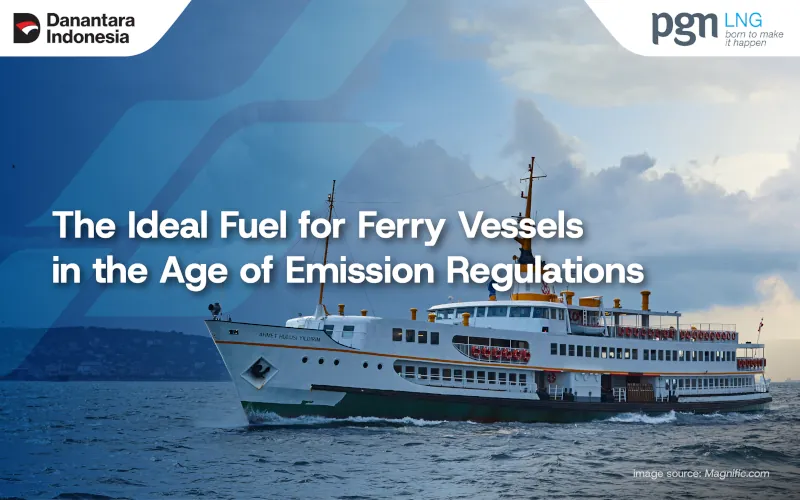
The shipping industry faces growing pressure to reduce greenhouse gas (GHG) emissions and air pollution. International regulations now not only limit sulfur emissions, but also push for a reduction in the carbon intensity of vessel operations.
Ferry vessels are among the most affected types of ships because they operate at high frequency and consume large amounts of fuel. This condition requires shipping companies to choose more efficient and environmentally friendly energy sources to remain compliant with applicable regulations.
So, what type of fuel is ideal for meeting the needs of the shipping sector amid increasing regulatory compliance demands?
Why Are Emission Regulations a Major Challenge for the Shipping Industry?
Emission regulations in the shipping sector continue to tighten in order to reduce greenhouse gas emissions and air pollutants such as SOx, NOx, particulate matter (PM), and CO2 that impact the environment and public health.
Shipping companies are now not only required to meet sulfur emission limits, but are also being directed to reduce the carbon intensity of vessel operations. This poses a challenge because most fleets still rely on conventional fuels that produce higher emissions.
At the same time, pressure is also coming from customers, investors, and cargo owners who are increasingly prioritizing sustainable shipping practices.
To be able to comply with regulations while maintaining business competitiveness, shipping companies need to start adjusting their fuel use strategies and consider cleaner and more efficient alternatives.
Read More: Top Benefits of Natural Gas, More Than Just Low Emissions
What Emission Regulations Apply in the Shipping Sector?
As pressure to reduce emissions grows, the shipping industry must now comply with various international regulations governing emission limits, energy efficiency, and decarbonization targets.
MARPOL Annex VI as the Primary Regulation for Ship Emission Control
MARPOL Annex VI is a regulation issued by the International Maritime Organization (IMO) to control air emissions from ships.
This regulation sets various provisions to control sulfur (SOx), nitrogen oxides (NOx), and particulate matter (PM) emissions from vessels. One of its provisions is the IMO Global Sulfur Cap, which limits the sulfur content in ship fuel to a maximum of 0.50% globally.
In Emission Control Areas (ECA), this limit is tightened to 0.10%, thereby encouraging the use of cleaner fuels.
Ship Energy Efficiency Regulations through EEXI and CII
In addition to regulating emissions, the IMO also implements the Energy Efficiency Existing Ship Index (EEXI) to assess the design efficiency of ships already in operation, and the Carbon Intensity Indicator (CII) to measure carbon emission intensity based on the operational performance of vessels.
Both regulations push shipping companies to improve energy efficiency and serve as important considerations when selecting fuels that can help meet vessel performance targets.
IMO Decarbonization Targets Toward Low Emission Shipping
The IMO has also set long-term targets to reduce greenhouse gas emissions from the international shipping sector toward net-zero emissions on or around 2050.
To support these targets, the use of low-carbon fuels is becoming one of the increasingly adopted strategies because it can help reduce emissions while supporting compliance with evolving regulations.
Read More: Is IMO 2020 and LNG the Final Solution?
What Fuels Are Currently Used in Ferry Vessels?
To date, the shipping industry still uses several types of petroleum-based fuels. Fuel selection is generally adjusted to the operational needs of the vessel, applicable regulations, and cost considerations.
- Heavy Fuel Oil (HFO): economical, but has a high sulfur content that requires additional emission controls to meet regulations.
- Marine Gas Oil (MGO): produces lower sulfur emissions than HFO, but comes with higher usage costs.
- Very Low Sulfur Fuel Oil (VLSFO): developed to meet the IMO’s 0.50% sulfur limit, but still produces carbon emissions.
The use of all three fuels still faces challenges in meeting long-term decarbonization targets. For this reason, the shipping industry is starting to consider fuel alternatives that can reduce carbon emissions while still supporting operational efficiency.
Read More: Is LNG Truly a Low-Emission Alternative Fuel?
Why Is LNG the Ideal Fuel for Ferry Vessels?
LNG (Liquefied Natural Gas) is one of the ideal fuel choices for ferry vessels because it can help meet emission regulations, support operational efficiency, and serve as a transition solution toward lower-carbon shipping.
These advantages are making LNG increasingly considered by shipping companies as a strategy to maintain regulatory compliance while improving business competitiveness.
Helping to Meet International Emission Regulations
Compared to petroleum-based fuels, the use of LNG produces almost no sulfur emissions (SOx). Beyond that, LNG also produces lower NOx, particulate matter, and CO2 emissions.
These characteristics help shipping companies meet the provisions of MARPOL Annex VI while supporting improvements in vessel performance against energy efficiency indicators such as EEXI and CII.
Suited to the Operational Characteristics of Ferry Vessels
Ferry vessels generally operate on fixed routes, making the development of LNG bunkering infrastructure more straightforward compared to vessels with variable routes.
In addition, the high operational frequency makes fuel efficiency increasingly important, so the use of LNG can deliver more optimal benefits.
Supporting the Company’s Energy Transition Strategy
LNG is positioned as a transition fuel that helps companies reduce emissions without having to immediately switch to zero-emission fuels whose infrastructure and technology are still developing.
For this reason, LNG is one of the relevant choices for shipping companies to support ESG (Environmental, Social, and Governance) targets, decarbonization, and compliance with increasingly strict regulations.
As the potential for LNG use in the maritime sector grows, the availability of services capable of supporting LNG distribution and supply becomes one of the important factors in ensuring smooth operations.
Support from an experienced provider partner helps shipping companies adopt LNG more effectively in line with their operational needs.
To support this need, PGN LNG Indonesia provides integrated LNG solutions designed to meet the energy needs of various sectors, including the maritime sector.
Through LNG bunkering services along with supporting infrastructure, we help companies utilize LNG as part of their transition strategy toward more efficient and lower-emission operations.
Find out what complete solutions we provide for your industry, read the information here: LNG Provider in Indonesia.
References
- IMO. Accessed 2026. 2023 IMO Strategy on Reduction of GHG Emissions from Ships
- IMO. Accessed 2026. IMO’s work to cut GHG emissions from ships
- ICCT. Accessed 2026. Aligning the IMO’s Greenhouse Gas Fuel Standard with its GHG strategy and the Paris Agreement
- Global Maritime Forum. Accessed 2026. A guide to the IMO’s Net-Zero Framework