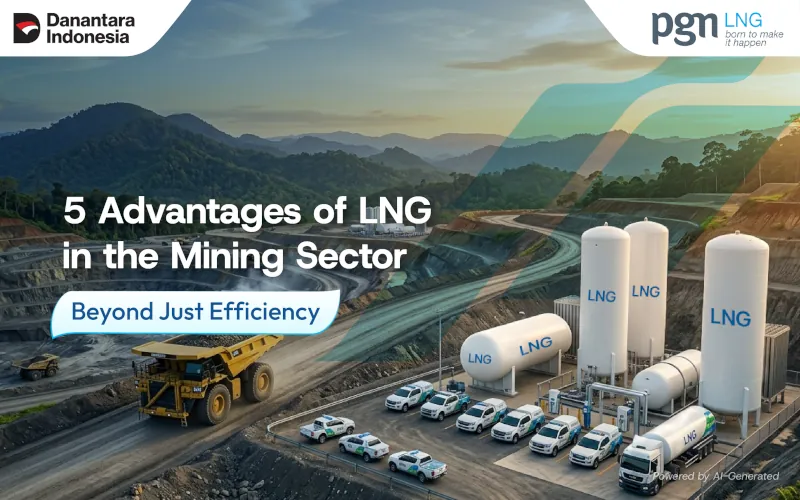
The mining sector is an industry with very large energy needs to support operational activities, ranging from drilling, excavation, crushing, and hauling to mineral processing.
At the same time, many mining locations are in remote areas not yet reached by electricity grids or gas pipelines. This condition forces many companies to build diesel-fueled captive power plants to supply their operational electricity needs.
This decision brings various challenges, from high fuel logistics costs and diesel price fluctuations to greater emissions. So, can switching to Liquefied Natural Gas (LNG) be a solution to address these challenges?
Why Is LNG Relevant for the Mining Sector?
The reason LNG is being considered in the mining sector is its ability to supply large-scale energy needs, including at mine sites located in remote areas not yet connected to the gas pipeline network.
LNG is natural gas that has been cooled to around -162°C so that it becomes liquid and its volume shrinks to around 1/600 of its gas form. This makes LNG more efficient to store and distribute to mine sites.
Because it does not depend on a pipeline network, LNG is transported using ISO tank trucks and vessels, making its distribution more flexible.
This is one of the factors that make LNG a reliable energy alternative for the mining industry to improve operational efficiency while reducing dependence on higher-emission fuels such as diesel.
Read More: 5 Industries That Have Moved On to LNG
What Are the Advantages of LNG in the Mining Sector?
For mining companies, the choice of energy source affects not only operational costs, but also supply reliability, logistical efficiency, and the achievement of sustainability targets.
In this context, LNG offers some advantages that are making it increasingly considered to support mining operations.
1. More Efficient Operational Costs
The use of LNG has the potential to help reduce energy costs in operations with large fuel consumption, especially when replacing diesel.
The potential for efficiency comes not only from competitive energy prices, but also from a more efficient energy generation and distribution system.
2. Lower Emissions Compared to Diesel
LNG produces lower CO2 emissions compared to diesel. In addition, particulate matter (PM), sulfur oxide (SOx), and nitrogen oxide (NOx) emissions are also lower.
For this reason, its use can help companies reduce operational emissions while supporting the achievement of compliance targets for environmental regulations.
3. More Reliable Energy Supply for Remote Mines
LNG can be stored in cryogenic tanks so that companies have energy reserves at the mine site and are not entirely dependent on the national electricity grid.
The availability of this supply helps maintain mine operations that run 24 hours a day while also reducing the risk of production disruptions due to limited energy access.
4. Flexible for Various Mining Operational Needs
LNG can be utilized for various energy needs, ranging from captive power plants and boiler fuel to heating processes at mineral processing facilities or smelters, as well as fuel for heavy vehicles.
This flexibility allows a single energy source to support various operational needs within one mine area.
5. Supporting Corporate ESG and Decarbonization Targets
Many mining companies are targeting a reduction in emission intensity as part of their ESG (Environmental, Social, and Governance) strategy.
In this context, LNG can serve as one of the transition solutions to reduce operational emissions and can be combined with renewable energy such as solar power plants in a hybrid system to improve energy efficiency while reducing diesel consumption.
Read More: The Role of Virtual Pipeline in LNG Distribution
What Needs to Be Considered Before Using LNG in the Mining Sector?
Before switching to LNG, companies need to evaluate whether the characteristics of their energy needs are compatible with LNG use.
This analysis covers the scale of energy consumption, operational patterns, and the potential benefits that can be obtained compared to the energy sources currently in use. The results of this analysis form the basis for determining the technical feasibility and cost of LNG implementation.
In addition, companies need to prepare supporting infrastructure, such as LNG storage tanks and regasification systems to convert LNG back into gas before use. Because LNG is stored at a cryogenic temperature of around -162°C, its handling must also comply with applicable safety standards.
Beyond technical aspects, the availability of an LNG supplier capable of guaranteeing supply continuity is also an important factor so that mining operations can run stably without disruption.
Given that LNG implementation involves various technical aspects, companies need to work with a partner that understands the needs of the mining sector.
With the right support from the planning stage through to energy provision, the transition process toward LNG use can proceed more effectively and in line with the mine’s operational needs.
PGN LNG Indonesia is present as a solution to these challenges in the mining sector. Through LNG supply services along with supporting infrastructure, we help companies prepare for LNG implementation in a more planned, safe, and reliable manner suited to their operational characteristics.
What solutions do we provide for your industry? Find out more here: LNG Provider in Indonesia.
References
- EIA. Accessed 2026. Natural gas explained – Liquefied natural gas
- ScienceDirect. Accessed 2026. A systematic review for sustainability of global liquified natural gas industry: A 10-year update
- Farmonaut. Accessed 2026. LNG Shipping Cost & Companies: 2026 Innovations Power Mining
- International Mining. Accessed 2026. Hatch study looks at diesel replacement with LNG in mining