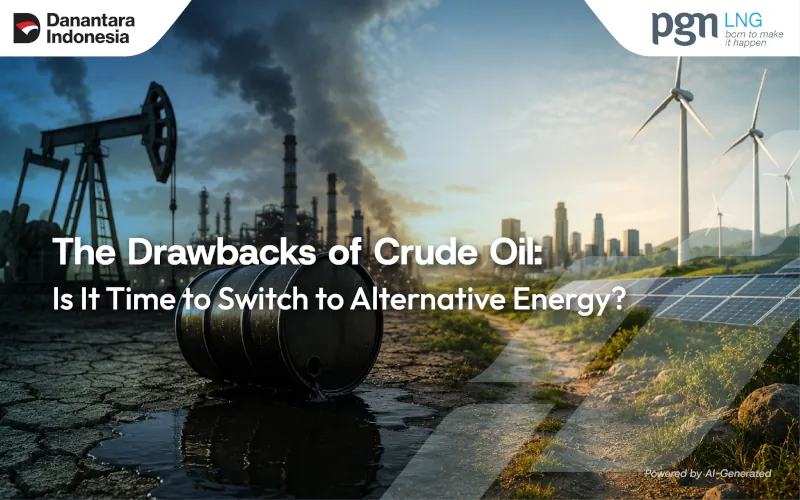
The use of petroleum in the industrial sector today faces several challenges, ranging from high carbon emissions and environmental regulatory pressure to fuel price volatility. At the same time, companies are also required to improve energy efficiency and operational sustainability.
These various challenges mean that dependence on petroleum needs to be evaluated, especially for long-term energy needs. Understanding the drawbacks of petroleum can help companies consider whether the use of alternative energy needs to be accelerated to maintain business continuity.
Why Does Petroleum Still Serve as the Primary Energy Source in Various Industries?
Petroleum is still widely used across various industries because it has high energy density, mature infrastructure, and flexibility in its use.
These characteristics allow petroleum to meet large-scale energy needs while also being easy to distribute, store, and use for various operational requirements.
From a technical standpoint, petroleum can provide large amounts of energy with a relatively small fuel volume. Meanwhile, its distribution networks, storage facilities, and utilization infrastructure have developed extensively, supporting its availability across various sectors and regions.
Beyond serving as a fuel, petroleum is also used as a raw material for the petrochemical industry to produce various products such as lubricants, plastics, synthetic fibers, and chemicals.
Read More: The Advantages of LNG That CNG Simply Cannot Match
What Are the Drawbacks of Petroleum as an Energy Source?
Despite these advantages, the use of petroleum also presents challenges for companies, particularly related to emissions, air pollution, cost uncertainty, resource limitations, and compliance with environmental regulations.
Produces High Greenhouse Gas Emissions
The combustion of petroleum produces carbon dioxide (CO2), which contributes to increasing greenhouse gas concentrations and climate change. Its use in industrial activities is also one of the sources of emissions that need to be reduced to achieve decarbonization targets.
For this reason, a growing number of companies are setting emission reduction targets as part of their sustainability strategy and efforts to achieve Net Zero Emissions targets.
Causes Air Pollution That Impacts the Environment
Burning petroleum can produce various air pollutants, including nitrogen oxides (NOx), sulfur oxides (SOx), and particulate matter (PM). If these emissions are not properly controlled, the pollutants can reduce air quality and increase environmental impact.
This condition also means that companies need to meet increasingly strict emission standards through the control and monitoring of emissions from their operational activities.
A Non-Renewable Energy Source
Petroleum is formed through geological processes that take millions of years, so it cannot be renewed. Its limited availability means that dependence on petroleum needs to be considered as part of a long-term energy strategy.
This condition is pushing companies to start considering energy source diversification so as not to be entirely dependent on fossil fuels.
Petroleum Prices Tend to Fluctuate
Petroleum prices are influenced by various factors, including geopolitical conditions, global production levels, and market demand. Changes in these factors can cause oil prices to move significantly within a relatively short period of time.
For companies that depend on petroleum as an energy source, price volatility can increase uncertainty in operational costs and make energy budget planning more difficult.
Increasing Challenges in Complying with Environmental Regulations
Environmental policies continue to evolve, including through the tightening of emission standards and carbon emission reduction policies. Companies that still depend on petroleum need to adjust their energy strategy to remain compliant with applicable regulations and manage the environmental impact of their operations.
Beyond regulations, Environmental, Social, and Governance (ESG) factors are also increasingly being considered in investment decisions and business strategies, making energy use part of a company’s competitiveness considerations.
Read More: Why Can LNG Improve Efficiency in the Transportation Sector?
How Do the Drawbacks of Petroleum Affect a Company’s Energy Strategy?
The various limitations of petroleum are pushing companies to reduce dependence on a single energy source and evaluate energy options that are more suited to their operational needs.
Energy costs, energy efficiency, and price volatility are also considerations because they can affect operational costs and business competitiveness. On the other hand, ESG targets and decarbonization policies are increasingly pushing companies to consider the impact of emissions in their energy investment decisions.
Energy diversification can help companies improve operational resilience while reducing the risks that arise from dependence on a single type of energy source. However, an energy strategy cannot be applied uniformly across every company.
Industry characteristics, energy needs, load profiles, and operational conditions need to be considered so that the choice of energy source can deliver benefits suited to business needs.
Read More: 5 Advantages of LNG in the Mining Sector Beyond Just Efficiency
Is It Necessary to Switch to Alternative Energy?
Yes, alternative energy is worth considering as part of a company’s long-term energy strategy. However, this does not mean companies must immediately stop all use of petroleum.
Every industry has different energy needs, production process characteristics, infrastructure readiness, and economic conditions. For this reason, the decision to switch needs to be based on a technical evaluation, operational needs, and emission reduction targets.
Factors to Consider Before Switching to Alternative Energy
Before switching, companies need to consider energy needs for the production process, the potential for efficiency and emission reduction, investment feasibility, and the availability of alternative energy supply.
Environmental regulatory factors also need to be taken into account so that the new energy choice not only meets operational needs, but also supports the company’s compliance and long-term sustainability objectives.
Why Should the Energy Transition Be Carried Out Gradually?
The energy transition should be carried out gradually because not all industrial equipment and assets can be immediately converted to a new energy source.
This approach gives companies time to adjust their investment, infrastructure, and operational processes while also reducing the risk of disruptions to production.
In this process, companies can consider more suitable energy sources as part of the transition stages, one of which is LNG, which is increasingly being utilized to meet industrial energy needs.
Read More: Is LNG Truly a Low-Emission Alternative Fuel?
Why Is LNG One of the Alternatives Worth Considering?
LNG (Liquefied Natural Gas) is one of the alternatives worth considering for industries that want to reduce dependence on petroleum without neglecting their need for a reliable energy supply.
Compared to many petroleum-based fuels for comparable applications, LNG combustion produces lower CO2 emissions. Beyond that, sulfur content and SOx emissions are also lower, which can help companies meet emission standards and improve the quality of their operational environment.
In addition to offering a lower emission profile, LNG is capable of providing a reliable energy supply for various industrial needs, including power generation, manufacturing, mining, and shipping.
The use of LNG still needs to be supported by a supply system capable of guaranteeing energy availability at the operational location.
PGN LNG Indonesia is present as an LNG provider to support industrial energy needs through services and infrastructure that enable LNG distribution to various locations, including areas not yet reached by the gas pipeline network.
Find out what solutions we provide to support the sustainability of your industry in the energy transition era. Read the complete information here: LNG Partner Provider in Indonesia.
References
- IEA. Accessed 2026. World Energy Outlook 2025 – Executive summary
- Global Bioenergy. Accessed 2026. Petroleum Pros And Cons: Discover Its Positives and Negatives
- OECD. Accessed 2026. The Role of Gas in Today’s Energy Transitions
- PMC. Accessed 2026. International oil price uncertainty and enterprise investment efficiency: An empirical research of listed companies in China