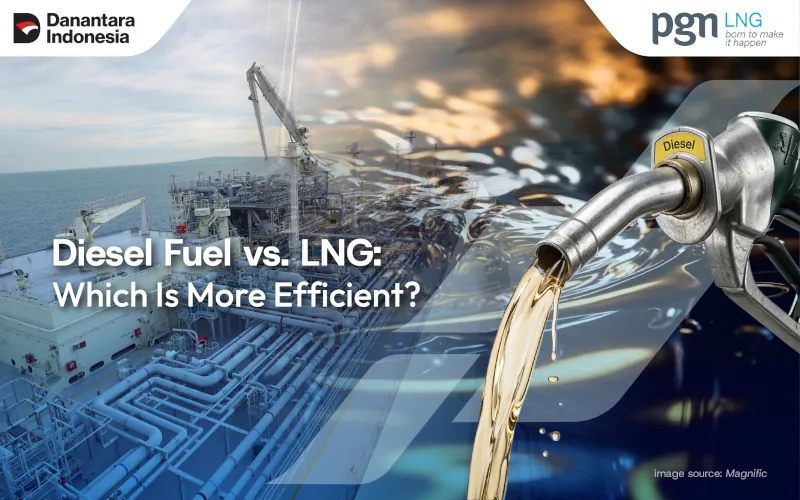
Diesel fuel remains the primary energy source across various industrial sectors, supported by an extensive distribution infrastructure and technology that has proven reliable in meeting industrial operational needs.
However, rising operational costs, emission reduction demands, and increasingly strict environmental regulations are pushing companies to reassess their use of diesel. For this reason, companies need to find alternative energy sources that are more efficient and capable of meeting environmental compliance standards.
One alternative that is increasingly being considered is Liquefied Natural Gas (LNG). So, is LNG truly more efficient than diesel and does it offer the solution that companies need today and in the future?
What Is Meant by Efficiency in Industrial Fuel Use?
In industrial operations, fuel efficiency is not determined solely by the purchase price of fuel. Efficiency also reflects the ability of an energy source to produce optimal operational output while keeping usage costs under control.
To find out whether diesel or LNG is more efficient, both need to be compared based on several key indicators, namely:
- Emissions to assess environmental impact and regulatory compliance.
- Operational costs to compare energy consumption and day-to-day usage costs.
- Maintenance to see the effect of fuel on machine reliability and maintenance costs.
- Initial investment to calculate the costs of procuring or converting facilities.
- Infrastructure requirements to evaluate the readiness of fuel distribution, storage, and handling.
Through these indicators, companies can assess more objectively which fuel is capable of delivering the best efficiency for their operational needs.
Read More: The Advantages of LNG That CNG Simply Cannot Match
Which Is More Efficient Between Diesel and LNG for Industrial Needs?
LNG offers various advantages that are making it increasingly relevant as an alternative to diesel across various industrial sectors.
However, to find out how much these benefits can improve operational efficiency, diesel and LNG need to be compared based on indicators commonly used in industrial energy evaluation.
| Parameter | Diesel | LNG |
| CO₂ Emissions | Higher | Generally around 20–30% lower than diesel. |
| SOx Emissions | Produces sulfur emissions depending on the sulfur content of the fuel. | Nearly zero, as natural gas contains very low sulfur content. |
| Particulate Matter (PM) | Higher due to the diesel combustion process. | Significantly lower because natural gas burns more cleanly. |
| Long-Term Operating Costs | Highly influenced by diesel price fluctuations and fuel consumption. | Potentially more cost-competitive, as fuel and maintenance costs can be lower for industries with high energy demand and stable operating patterns. |
| Maintenance | Potentially higher due to soot and carbon deposit buildup in engines. | Cleaner combustion helps reduce carbon deposits, potentially lowering engine maintenance frequency. |
| Initial Investment | Relatively lower because the required infrastructure is already widely available. | Higher, as it requires LNG storage, distribution facilities, or system conversion depending on operational requirements. |
| Infrastructure | Widely available. | Requires access to adequate LNG supply and supporting infrastructure |
Based on these indicators, LNG tends to be more efficient than diesel for industries with large energy needs that operate continuously.
Although it requires a larger initial investment, savings in operational costs, reduced emissions, and lower maintenance requirements can provide economic benefits over the long term.
Read More: Why Can LNG Improve Efficiency in the Transportation Sector?
When Does LNG Become the More Efficient Choice?
LNG can be particularly attractive for industries with high energy consumption, long operating hours, and stable energy needs. Under these conditions, the potential for operational cost savings and the benefits of cleaner combustion can help offset the initial investment required for LNG implementation.
However, this level of efficiency is not always the same for every company. Factors such as industry type, energy consumption volume, facility location, and LNG infrastructure readiness will determine how great the benefits can be.
Industries Most Likely to Benefit from LNG
Industries with large energy needs that operate continuously generally have greater opportunities to gain efficiency from using LNG, including:
- Smelters that require large amounts of energy for mineral refining processes.
- Power plants, especially those that operate continuously with high fuel needs.
- The cement industry, which requires thermal energy in the kiln firing process.
- Process industries, such as chemical, food and beverage, and textile industries that rely on boilers and heating systems.
- Mining, particularly for power generation at mine sites and certain heavy equipment applications that support LNG use.
- Shipping, especially vessels with long operating routes and large fuel needs.
Because they have high energy consumption and operate continuously, these sectors have the potential to gain greater benefits from operational efficiency compared to industries with lower energy needs.
Operational Factors That Affect LNG Efficiency
Beyond industry type, the magnitude of benefits obtained from LNG is also influenced by several operational factors, including:
- Operating hours, because facilities that operate longer have greater savings potential.
- Energy consumption volume, which affects the magnitude of operational cost efficiency.
- LNG infrastructure availability, including storage, distribution, and regasification facilities.
- Facility location, which determines the ease of access to LNG supply.
- Stability of energy needs, so that LNG supply can be utilized optimally.
Read More: 5 Advantages of LNG in the Mining Sector Beyond Just Efficiency
What Factors Need to Be Evaluated Before Switching from Diesel to LNG?
Switching from diesel to LNG is a strategic decision that needs to be based on a thorough evaluation, not just a comparison of fuel prices.
Companies need to understand their energy consumption profile, from usage volume and load patterns to operating hours, to assess whether the use of LNG can deliver optimal benefits.
In addition, a Total Cost of Ownership (TCO) calculation also needs to be carried out by considering all costs during the operational period, including initial investment, operational costs, maintenance, and other costs related to the use of the energy system.
A Return on Investment (ROI) analysis is also important to estimate how quickly the conversion investment can deliver economic value to the company.
Beyond financial aspects, companies also need to ensure the availability of adequate LNG supply and infrastructure so that operations can run reliably.
This evaluation should be aligned with the company’s emission reduction targets and sustainability strategy so that the benefits of using LNG are felt not only in terms of operational efficiency, but also in supporting the achievement of environmental objectives.
For this reason, before deciding to convert from diesel to LNG, companies need to conduct a thorough feasibility study to ensure that the investment truly aligns with operational needs and delivers long-term benefits.
Once these various aspects have been evaluated, the next step is to choose an LNG solution provider capable of supporting implementation according to the company’s needs. The right support not only helps ensure energy supply availability, but also facilitates the transition process from diesel to LNG so that it runs more efficiently.
This is precisely why PGN LNG Indonesia provides LNG solutions to support energy needs in your industry. Through LNG supply and supporting infrastructure services, we help companies transition to cleaner energy in a way that fits their operational needs.
Want to know what concrete solutions we provide? Find the complete explanation here: LNG Partner Provider in Indonesia.
References
- Crowley. Accessed 2026. LNG vs. Diesel and Propane as a Commercial Fuel
- TGGL. Accessed 2026. LNG vs. Natural Gas vs LPG vs Diesel Fired Steam Boiler: Complete Comparison
- LR. Accessed 2026. Liquefied Natural Gas (LNG) Fuel – Alternative Shipping Fuel
- ResearchGate. Accessed 2026. Evaluation of difference between LNG and diesel heavy-duty commercial vehicle’s life cycle environmental emission