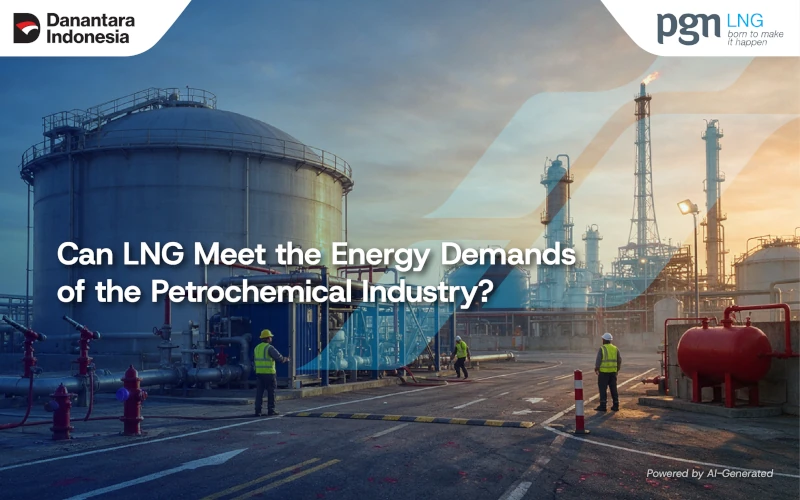
The chemical industry requires a sustainable energy supply to support various production processes, from generating heat and steam to operating industrial equipment.
The availability of reliable energy plays a role in maintaining operational efficiency and controlling production costs, so that companies can maintain the competitiveness of their products.
To meet these needs, the chemical industry has various energy source options. One alternative worth considering is Liquefied Natural Gas (LNG) because it offers advantages that are difficult for other energy sources to match.
How Is LNG Utilized in the Chemical Industry?
LNG is natural gas that has been cooled into liquid form so that its volume is smaller, making it easier to store and transport.
Before being used in industrial operations, LNG needs to be regasified to return it to natural gas form. The regasified gas can then be channeled to meet various energy needs at production facilities.
LNG to Meet Heat and Production Energy Needs
Natural gas from LNG regasification can be utilized to meet heat and energy needs in various chemical industry processes.
This gas can be used as boiler fuel to generate steam, to operate burners or furnaces that provide process heat, and to support power generation using gas turbines or gas engines.
The steam and heat produced can be used to heat raw materials, maintain reaction temperatures, and support product processing.
LNG to Meet Gas Needs at Industrial Locations
LNG also allows industrial facilities to gain access to natural gas even when their locations are not yet connected to the gas pipeline network, so that industries can still obtain a reliable and flexible energy supply.
In its distribution system, LNG can be transported using specialized vessels to receiving facilities, then stored in cryogenic tanks before undergoing the regasification process.
LNG is transported in liquid form using specialized vessels or tank trucks. Once regasified into natural gas, it is distributed through pipeline networks to end-user facilities.
This system makes natural gas accessible to industries located beyond the reach of existing pipeline networks.
Read More: The Hidden Drawbacks of Geothermal Energy
Is Using LNG Beneficial for the Chemical Industry?
The use of LNG has the potential to provide a number of benefits for the chemical industry, particularly by expanding access to natural gas as an energy source to support production activities.
Its benefits can be seen in three aspects, namely helping to maintain energy supply reliability, potentially reducing combustion emissions, and offering opportunities to obtain competitive energy costs.
Supporting Energy Supply Reliability
The chemical industry requires a reliable energy supply so that production processes can run sustainably. Supply disruptions can affect process temperature stability, steam availability, and equipment operation.
Under these conditions, LNG can be one of the options for expanding access to natural gas, especially for industrial facilities not yet reached by the gas pipeline network.
However, supply reliability is not only determined by LNG availability in the market, but also by the readiness of receiving facilities, storage and regasification capacity, distribution smoothness, and gas demand planning.
With proper supply chain management, LNG can help industries obtain an energy supply that matches their operational needs.
Potentially Reducing Combustion Emissions
The use of LNG has the potential to reduce carbon dioxide (CO2) emissions from combustion when used to replace coal.
Based on EIA data, natural gas combustion produces around 52.91 kg of CO2 per MMBtu, while coal produces around 93.24 kg of CO2 per MMBtu for an equivalent amount of energy. This comparison shows that CO2 emissions from natural gas combustion are far lower.
Even so, the potential for emission reduction still depends on the type of fuel being replaced, equipment efficiency, and process energy needs.
Optimizing Chemical Industry Energy Costs
Energy cost is one of the components that affects the operational efficiency and competitiveness of the chemical industry.
Under certain conditions, LNG has the potential to be an option with competitive energy costs, especially if gas needs, facility location, and distribution systems are supportive.
However, the calculation is not sufficient by simply comparing the price of LNG with the price of the fuel currently in use.
Companies also need to account for transportation, storage, regasification, and distribution costs, infrastructure investment, and equipment adjustments if required.
Read More: Is Geothermal Energy Renewable?
When Does LNG Become a Beneficial Choice for the Chemical Industry?
LNG can be a beneficial choice for the chemical industry when production facilities are located in areas not yet reached by the gas pipeline network or when building a pipeline to that location is not economical.
Through transportation by vessels or specialized tank trucks, LNG allows natural gas to be distributed to locations that are difficult for pipeline infrastructure to reach.
Beyond supply access, LNG is also worth considering if the gas cost, after accounting for procurement, transportation, storage, and regasification, is more competitive than the cost of using currently available energy sources.
Consistent gas demand can help improve infrastructure utilization and make investment costs more worthwhile over the long term.
To achieve this efficiency, industries also need to pay attention to how the entire LNG supply chain process is managed. From gas availability and storage facilities to transportation to user locations, every stage needs to be coordinated so that supply can meet production needs without incurring unnecessary logistics costs.
PGN LNG Indonesia is present as a partner that supports industrial LNG needs through integrated services, from supply, storage, distribution, to regasification. This support helps companies obtain LNG solutions that take into account supply needs and operational conditions at the destination location.
Want to know more about LNG solutions to support the energy needs of your industry? Find the complete information here: LNG Provider in Indonesia.
References
- EIA. Accessed 2026. Energy products are key inputs to global chemicals industry
- EIA. Accessed 2026. Use of energy explained – Energy use in industry
- DOE. Accessed 2026. Process Heat Basics
- IEA. Accessed 2026. Assessing emissions from LNG supply and abatement options