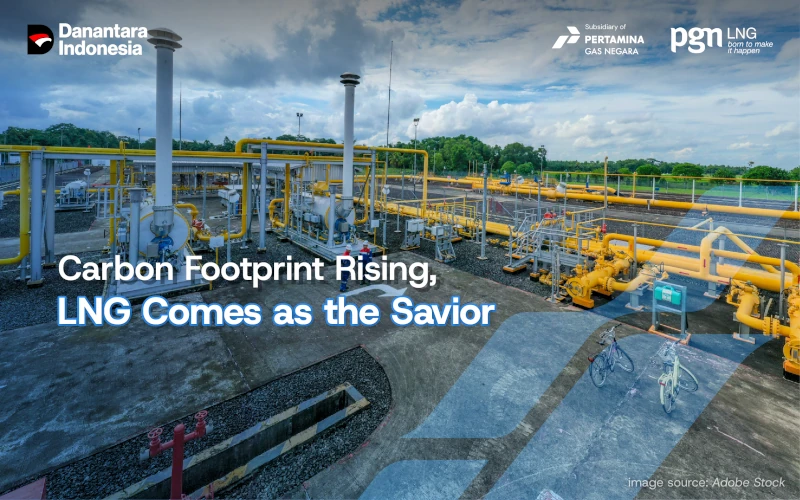
The increase in global temperatures has made the climate crisis more tangible, primarily due to massive emissions of greenhouse gases (GHGs).
In this context, measuring the carbon footprint becomes crucial to understanding how human activities contribute to global warming.
Efforts to reduce the carbon footprint require the use of cleaner energy sources, such as LNG (Liquefied Natural Gas). But can LNG be the solution today? Let’s explore this topic in this article.
What Is a Carbon Footprint?
A carbon footprint is a measure of the total greenhouse gas emissions released into the atmosphere due to the direct or indirect activities of an individual, company, product, or even a country.
These emissions include various gases such as carbon dioxide (CO₂), methane (CH₄), and nitrous oxide (N₂O).
To simplify measurement, all these gases are converted into a single unit called CO₂e (Carbon Dioxide Equivalent).
This unit shows the contribution of each GHG to global warming relative to carbon dioxide. Calculating the carbon footprint is a crucial foundation for designing effective and sustainable emission reduction strategies.
Read More: Wind Energy vs Fossil Fuels, Facts and Figures!
What Are the Main Sources of the Carbon Footprint?
Most of the global carbon footprint comes from the energy sector, industry, and daily activities that still rely on fossil fuels.
Some major contributors include:
- Combustion of fossil fuels for electricity and heat (coal and petroleum).
- Heavy industrial processes, such as cement, steel, fertilizer, and chemical production.
- Transportation by land, sea, and air that uses fossil fuels.
- Household and commercial energy consumption, such as electricity, air conditioning, and heating, is from non-renewable sources.
These activities are the primary causes of greenhouse gas emissions directly linked to energy needs and material production in modern life.
Read More: IMO 2020 and LNG as the Final Solution? Check the Facts
How Is the Carbon Footprint Measured?
Measuring a carbon footprint involves a systematic process following international standards to ensure accurate, transparent, and accountable results.
The initial step usually includes identifying emission sources and converting various greenhouse gases into CO₂e.
Some common standards used for measuring and reporting carbon footprints include:
- GHG Protocol: the world’s most widely used framework for emission accounting, dividing emissions into Scope 1, Scope 2, and Scope 3.
- ISO 14064: an international standard for measuring, reporting, and verifying GHG emissions.
Standardized calculations provide a scientific foundation to set emission reduction targets and effective, credible mitigation strategies.
Read More: Can Gas Fuel Reduce Coal Pollution? Here’s the Fact
What Are the Impacts of an Increasing Carbon Footprint?
A carbon footprint directly contributes to global warming. IPCC reports confirm that human activity has caused a rise in the global average surface temperature since the pre-industrial era (1850–1900).
The global average temperature has increased by approximately 1.34 °C to 1.41 °C compared to pre-industrial levels.
Meanwhile, data from the IEA shows that global CO₂ emissions from the energy and industrial sectors reached about 37.8 gigatons in 2024, the highest level in recorded history.
This indicates that the carbon footprint continues to worsen, with serious consequences for the environment and human life.
Environmental Impacts
High carbon footprints contribute to global warming, triggering numerous environmental changes, including:
- Melting polar ice caps
- Rising sea levels
- Extreme weather patterns such as storms, floods, droughts, and shifts in rainfall patterns
- Damage to natural habitats and biodiversity
In addition, global warming can degrade air quality and disrupt natural cycles that support life.
Economic and Health Impacts
Climate change caused by high carbon footprints also affects the economy and human health.
Extreme weather events can damage infrastructure, disrupt agricultural production and industrial supply chains, and lead to significant economic losses.
From a health perspective, air pollution and industrial emissions can increase the risk of respiratory diseases and other health problems, particularly in urban areas or near industrial zones.
Read More: Tidal Energy, Green Technology from Ocean Waves
How Can LNG Help Reduce the Carbon Footprint?
LNG (Liquefied Natural Gas) is a fossil fuel option that is relatively cleaner than coal and petroleum.
Combustion of LNG produces about 60% less CO₂ per MWh compared to coal and generates almost no SOx or particulates, reducing local air pollution and public health risks.
Some advantages of LNG in the context of environmental protection and energy transition include:
- Reducing energy sector carbon emissions compared to heavy fossil fuels
- Helping stabilize the electricity grid when intermittent renewable energy (wind and solar) is used
- Operating more flexibly than coal-fired plants, supporting a reliable electricity supply
In the global and national energy transition, LNG serves as a bridge fuel, connecting traditional fossil fuels with renewable energy sources.
According to the Indonesian Ministry of Energy and Mineral Resources, the government targets a reduction of 314 million tons CO₂e by 2030, where decreasing coal use is crucial to achieving the Net Zero Emission 2060 goal.
References:
- Kementerian ESDM. Accessed 2025. Menteri Arifin Tegaskan Peran Penting Migas di Era Transisi Energi
- Kementerian ESDM. Accessed 2025. Turunkan Emisi 314 juta ton CO2 Tahun
- IEA. Accessed 2025. CO₂ Emissions
- IPCC. Accessed 2025. Climate Change 2023