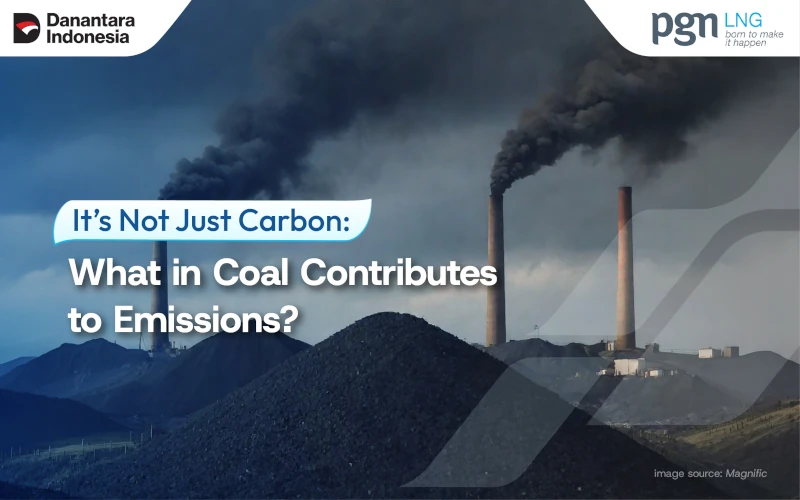
Carbon is one of the main components in coal that plays a role in generating energy. At the same time, the combustion of coal also converts carbon into carbon dioxide (CO2), which is one of the primary emissions from the use of fossil fuels.
Beyond carbon, coal also contains other elements that can affect the combustion process and emission formation. For this reason, understanding the composition of coal can be a starting point for knowing what potential it contains and what risks lie within it.
What Are the Coal Components That Trigger Emissions?
Coal is composed of various components with different roles during combustion. The composition of coal generally includes moisture, volatile matter, fixed carbon, and ash, as well as elements such as carbon, hydrogen, oxygen, nitrogen, and sulfur.
Not all of these components directly become sources of emissions, but some of them are closely related to emission formation and combustion residue.
Some coal components that affect combustion characteristics include:
- Volatile matter: material released as gas or vapor when coal is heated, affecting the ease of combustion.
- Fixed carbon: the non-volatile solid portion other than ash that remains after volatile material is released and contributes to the combustion process.
- Moisture: the water content in coal that does not generate energy through combustion and affects the energy available from the fuel.
Meanwhile, some components have a more direct relationship with the emissions and residue produced during combustion:
| Component | Condition During Combustion | Emissions |
| Carbon | Reacts with oxygen and generates energy | Carbon Dioxide (CO2) |
| Sulfur | Oxidized during combustion | Sulfur Dioxide (SO2 / SOx) |
| Nitrogen | Can contribute to NOx formation | Nitrogen Oxides (NOx) |
| Ash/Mineral Matter | Does not burn and remains as residue | Particulate Matter (PM), Fly Ash, and Bottom Ash |
Carbon holds an important position because it is one of the main elements in coal, serving as an energy source while also being directly linked to CO2 formation during combustion. However, the amount of CO2 emissions is not only determined by the percentage of carbon in the coal, but also by the amount of fuel burned and the energy produced.
Read More: Types of Coal: Which Is Best for the Energy Sector?
What Are the Challenges for Industries That Still Use Coal?
For industries that still rely on coal, the challenge is not only ensuring that the energy supply remains stable, but also maintaining fuel use efficiency and complying with emission control requirements.
Selecting the right type of coal can help control certain pollutants. However, this step does not eliminate emissions from coal combustion, particularly CO2.
The use of emission control technology and improvements in combustion efficiency can reduce emissions, but still require investment and do not eliminate the need to reduce the use of fossil fuels.
These challenges are becoming increasingly important on the energy transition agenda. The IEA notes that coal remains the largest source of electricity globally and the largest source of CO2 emissions, while its use remains important for power generation and a number of heavy industries.
Read More: The Benefits of Coal and Its Risks
Why Is Energy Diversification Part of an Industrial Transition Strategy?
Energy diversification is an approach in which companies do not rely solely on a single energy source, but also consider a combination of other energy sources suited to their operational needs.
This approach can help reduce dependence on fuels with high emission intensity, without disregarding energy needs, supply reliability, infrastructure readiness, costs, and the characteristics of industrial processes.
Because the conditions of each facility differ, the choice of energy sources and the implementation of diversification also need to be tailored to each facility’s operational needs.
Diversification also does not mean that industries have to immediately abandon coal entirely. For some industries, the transition can be carried out gradually by utilizing other energy sources to reduce the share of coal use.
The IEA notes that fuel switching, including the shift from coal to gas, can deliver reductions in CO2 and air pollutant emissions. One of the more reliable gas sources to support current industrial needs is LNG (Liquefied Natural Gas).
Read More: Why LNG Plays a Key Role in the Global Energy Transition?
LNG as One of the Options in Energy Diversification
LNG can be one of the energy diversification options because it allows industries to utilize natural gas at locations not directly connected to the gas pipeline network.
LNG is natural gas that has been cooled to around -162°C so that it becomes liquid and its volume shrinks to around 1/600 of its gaseous form. Once liquefied, the natural gas can be transported using vessels or trucks to facilities that need energy, and then regasified before use.
These characteristics make LNG relevant for industries located in areas with limited energy access but that require large amounts of energy supply.
From an emissions standpoint, the use of natural gas generally produces lower CO2 emissions compared to coal, and generates fewer air pollutants such as sulfur dioxide and particulates when burned. For this reason, LNG can be considered as part of a strategy to reduce dependence on coal.
However, the energy needs of every industry can differ, whether in terms of consumption volume, operational location, or available infrastructure. These conditions mean that LNG distribution support needs to be tailored so that supply can reach the location and support operational needs optimally.
PGN LNG Indonesia is present as a partner in meeting industrial LNG needs through solutions covering supply, storage, distribution, and regasification, helping your industry obtain a reliable and stable energy supply.
Find out what LNG solutions we provide for various industrial needs here: LNG Provider in Indonesia.
References
- EIA. Accessed 2026. Coal explained
- EIA. Accessed 2026. Coal and the environment
- IEA. Accessed 2026. Coal 2025
- USGS. Accessed 2026. Analytical Methods for Determination of Major, Minor, and Trace Elements In Coal