It is no longer a secret that coal-fired steam power plants still serve as one of the main pillars of Indonesia’s electricity system. At the same time, the direction of electricity policy continues to push for the development of renewable energy and emission reduction.
This condition places industries in the challenge of reducing dependence on high-emission energy sources while still ensuring a stable and reliable electricity supply to maintain operational continuity. Amid this dilemma, what is the best solution that industries need to consider today?
What Are Coal-Fired Power Plants and How Do They Work?
A coal-fired steam power plant is a power generation facility that utilizes thermal energy to produce high-pressure steam. In coal-fired power plants, coal is burned to generate heat that is used to heat water until it becomes steam.
This pressurized steam is then channeled to spin a turbine connected to a generator. The rotation of the turbine drives the generator, thereby producing electricity.
After passing through the turbine, the steam is cooled and condensed back into water. This water is then channeled back to be used in the next generation process, forming a cycle that repeats continuously.
In simple terms, the way a coal-fired power plant works begins with the burning of coal to generate heat, the use of that heat to produce steam, and the steam spinning the turbine and generator to produce electricity.
Read More: Diesel Fuel vs. LNG: Which Is More Efficient?
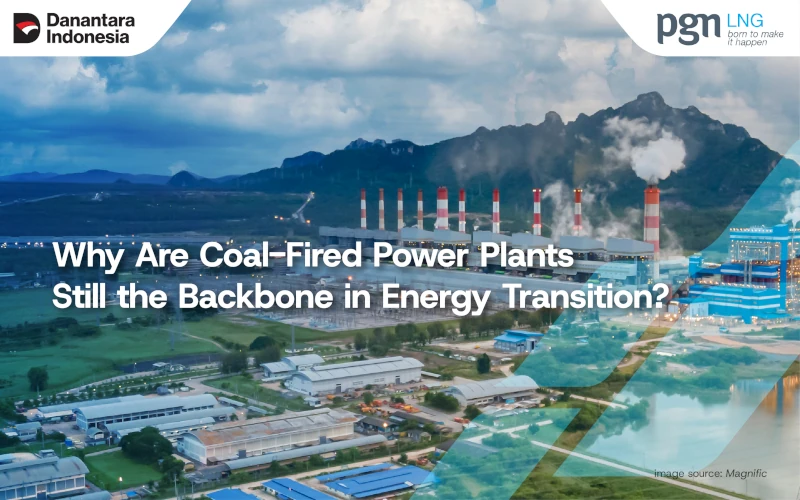
Why Do Coal-Fired Power Plants Still Serve as the Backbone of Indonesia’s Electricity System?
The significant role of coal-fired power plants in Indonesia’s electricity system is not only related to the number of existing plants, but also to the large capacity and electricity production they generate.
Amid the growing capacity of renewable energy, coal-based power plants still contribute a large share of national electricity production.
Its Contribution Is Still Large in Indonesia’s Electricity System
Data from the Handbook of Energy and Economic Statistics of Indonesia (HEESI) 2025 shows that coal-fired power plants generated around 334.3 TWh of electricity in 2025 out of a total national production of 494.4 TWh. This means coal-fired power plants contributed around 67.6% of national electricity production.
In terms of installed capacity, coal-fired power plants reached around 60.5 GW out of total national generation capacity of 107.5 GW, meaning their capacity accounts for more than half of national power generation capacity.
The large capacity and contribution to electricity production show why coal-fired power plants still hold a major role in Indonesia’s electricity system.
Can Supply Electricity at a Large and Stable Scale
Coal-fired power plants have characteristics suited to supplying electricity at a large scale and supporting system reliability because thermal power plants can be controlled according to system needs.
However, this does not mean that every coal-fired power plant always operates at full capacity at all times, because their operation is still influenced by system needs, dispatch, maintenance, and plant conditions.
Infrastructure and Supply Chains Are Already Established
Coal-fired power plants are also supported by an ecosystem that has developed over many years, from power generation facilities and transmission networks to coal supply chains, fuel transportation, and operational workforce and expertise.
This infrastructure does not always have the same level of readiness in every region, but its existence means coal-fired power plants are already integrated with the current electricity system.
This condition is one of the factors that makes reducing the role of coal-fired power plants something that needs to be done gradually and accompanied by infrastructure readiness for replacement generation sources.
Read More: The Advantages of Biodiesel: Is It Suitable for Industrial Use?
What Are the Advantages and Limitations of Coal-Fired Power Plants for Industrial Needs?
For industries with high energy needs such as smelters, mining, manufacturing, and power generation, coal-fired power plants have a number of characteristics that keep them relevant.
Coal-fired power plants are capable of generating electricity at a large scale to support continuous energy needs, while their technology and infrastructure have developed and become part of the existing electricity system.
These characteristics make coal-fired power plants one of the options for meeting the electricity needs of industries that require a large and reliable supply.
However, the use of coal-fired power plants also has limitations, particularly because coal combustion produces CO2 emissions and other pollutants. Amid decarbonization demands, companies increasingly need to address emission reduction.
For this reason, from an industrial perspective, the issue is not simply a matter of finding a low-cost energy source, but of balancing reliability, availability, cost, and emissions. The advantages of coal-fired power plants explain why they are still difficult to leave behind, while their emission impact shows why diversifying energy sources remains necessary.
Read More: Is Ethanol Fuel Ready to Become a Primary Energy Source?
Why Does the Energy Transition Require Flexible Energy Sources?
Transitioning toward renewable energy is not only about adding renewable generation capacity, but also ensuring that electricity sources with different characteristics can be well integrated into the system.
Solar power plants and wind power plants, for example, have electricity production that changes in line with the availability of sunlight and wind.
For this reason, as the use of renewable energy continues to grow, the electricity system requires supporting facilities, ranging from energy storage and a stronger electricity grid to electricity demand management and power plants that can adjust their operations to system conditions.
Under these conditions, gas-fired power plants can be one of the options to help maintain system flexibility and reliability during the transition process.
Gas-fired power generation using LNG (Liquefied Natural Gas) can be one of the options that produces lower emissions compared to coal while also helping to balance changes in electricity production from renewable energy.
Read More: How Great Is LNG’s Potential as a Cruise Ship Fuel?
How Does LNG Support Industrial Energy Needs?
LNG can be one of the solutions for meeting the energy needs of industries that require a large, continuous supply that can be distributed to various locations.
As natural gas that has been cooled into liquid form, LNG has a far smaller volume, so it can be transported using specialized modes and used at locations not directly connected to the gas pipeline network.
From an emissions standpoint, natural gas also produces lower CO2 emissions compared to coal. With these characteristics, LNG can be one of the choices for industries that want to maintain energy supply reliability while reducing emission intensity as part of the energy transition process.
Every industry has different energy needs, from the scale of consumption to the operational location. For this reason, an LNG supply solution that can adapt to these characteristics and needs is required.
PGN LNG Indonesia is present to provide LNG solutions to support industrial energy needs at various scales and locations, so that companies can obtain an appropriate energy supply to support their operations.
Want to know what complete solutions we provide for your industry? Find out more here: LNG Provider in Indonesia.
References
- ESDM. Accessed 2026. Handbook of Energy and Economic Statistics of Indonesia 2025
- ESDM. Accessed 2026. As a Transition Energy, Gas Still Plays an Important Role in Asia Pacific
- IEA. Accessed 2026. An Energy Sector Roadmap to Net Zero Emissions in Indonesia
- ScienceDirect. Accessed 2026. Coal-Fired Power Plant