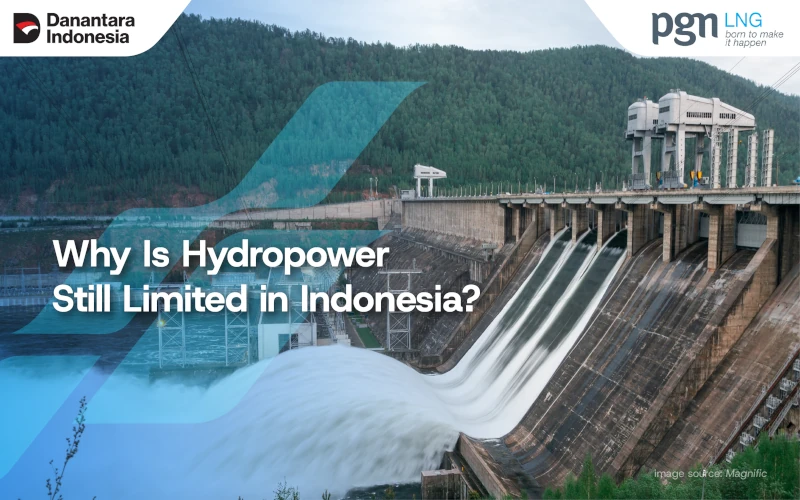
Indonesia has abundant water resources, from rivers to reservoirs, that can be utilized as renewable energy sources. However, abundant water resources do not mean that all of their potential can be developed into hydropower plants.
According to data from Indonesia’s Ministry of Energy and Mineral Resources, the installed capacity of water-based power generation in Indonesia reached 7,587.4 MW in 2025. Meanwhile, Indonesia has a water energy potential of 89.37 GW.
The gap between installed capacity and available potential shows that the utilization of water energy is still far from its maximum. So, what is preventing the development of hydropower in Indonesia from reaching its full potential?
What Is a Hydropower Plant and How Does It Work?
A hydropower plant is a power generation facility that utilizes water energy to generate electricity. In its operation, water from a river or reservoir is directed toward a turbine through a water channel.
Water flowing at a certain discharge rate and with a difference in elevation exerts a force on the turbine, causing it to spin. This rotation is then transferred to a generator to convert the mechanical energy from the turbine into electrical energy.
The ability of a hydropower plant to generate electricity is influenced by the water discharge rate and the difference in elevation between the water source and the turbine position (head). Discharge determines how much water can flow through the turbine, while the head determines the amount of energy available from the elevation difference.
For this reason, a location with a large water flow does not necessarily have the same hydropower potential if it is not supported by suitable elevation conditions and flow characteristics.
Read More: Impacts of Rising Fuel Prices That Threaten the Industrial Sector
Why Is the Utilization of Hydropower Potential Still Not at Its Maximum?
The large potential of water energy does not automatically mean that all of it can be developed into hydropower, because a location must have certain technical conditions.
For this reason, the gap between water energy potential and installed generation capacity is not only related to water resource availability, but also to the various conditions that determine whether a potential can truly be utilized.
Water Potential Does Not Always Mean Hydropower Potential
Not all rivers or water sources have conditions suitable for generating electricity. Hydropower development needs to consider water discharge and flow continuity, as well as the elevation difference that determines the amount of water energy that can be utilized.
In addition, topography and site conditions also affect whether power generation infrastructure can be built safely and in accordance with needs. This is why figures for hydro energy potential cannot be directly regarded as capacity that is ready to be built.
Potential Locations Are Not Always Close to Electricity Demand Centers
Renewable energy potential in Indonesia is spread across various regions, while electricity demand centers such as industrial areas, major cities, and densely populated areas are not always located in the same places.
The mismatch between the location of renewable energy potential and electricity demand centers is one of the challenges of renewable energy development in Indonesia. This condition means that power plant construction needs to be accompanied by transmission networks and substations so that electricity from energy source locations can be channeled to load centers.
Requires Large Scale Infrastructure Projects
A hydropower plant is not simply a matter of installing a turbine on a river flow. Its development can require various supporting infrastructure, from power generation facilities and civil structures and site access through to the network for distributing electricity.
The more complex the site conditions and the scale of the power plant, the greater the planning, investment, and time required to realize the project. For this reason, technically available water potential still requires infrastructure readiness and financing before it can be developed into a power plant.
Social and Environmental Aspects Need to Be Taken Into Account
Hydropower development, especially projects involving dams or large-scale changes to water systems, also needs to take into account conditions around the site.
Project planning can relate to ecosystems, land use, communities living around the project area, and water resource governance. These factors need to be studied from the planning stage and can influence the design and development process of the project.
Read More: Why Is Coal Still the Preferred Fuel for Industrial Boilers?
Where Is the Greatest Hydropower Potential in Indonesia?
Based on mapping, Indonesia has around 28.9 GW of identified hydropower potential. The greatest potential is located in:
- Kalimantan with more than 13 GW
- Sumatra with more than 7 GW
- Sulawesi with more than 5 GW
The large potential in these regions is supported by the availability of water resources as well as geographic and topographic conditions that can be utilized for hydropower development.
One example of its utilization is the Poso Hydropower Plant with a capacity of 515 MW in Central Sulawesi, which utilizes the flow of the Poso River. This plant strengthens the electricity supply in the Sulawesi system and serves as a power plant to meet peak load needs.
Read More: Why Does a Coal Shortage Threaten the Industrial Sector?
What Are the Advantages and Limitations of Hydropower in Meeting Electricity Needs?
Hydropower has a number of advantages as an energy source for the electricity system. This type of plant utilizes water as a renewable energy source and does not require fuel combustion in the generation process, so its operational emissions are relatively low.
Hydropower can also be developed at a large scale and can play an important role in meeting electricity needs. These characteristics make hydropower one of the renewable energy sources that can make a significant contribution to electricity supply.
On the other hand, the ability of hydropower to generate electricity is influenced by water availability and discharge, so when water discharge decreases, the plant’s ability to generate electricity also decreases.
For this reason, hydropower plays an important role in the electricity system, but still needs to be combined with various other generation sources so that electricity needs can be met reliably. LNG (Liquefied Natural Gas) can be one of the energy sources that complements this system.
Read More: Types of Coal That Best for the Energy Sector
What Is the Role of LNG in Supporting Energy Needs?
Natural gas still plays a role in Indonesia’s energy system during the energy transition. In the electricity system, gas-fired power plants can help maintain the reliability and flexibility of electricity supply, especially when renewable energy plants experience changes in production.
LNG is natural gas that has been liquefied so that its volume becomes smaller and it can be transported using ships or other modes of transportation.
This characteristic makes LNG one of the options for supplying energy to areas that do not have direct access to the gas pipeline network. As such, LNG can help meet energy needs in various locations.
However, LNG needs are not only related to supply availability, but also to how LNG can be provided and distributed in accordance with energy needs and operational site conditions. For this reason, industries need an LNG provider capable of supporting these needs.
PGN LNG Indonesia is present as an LNG provider partner that supports industrial energy needs across various locations, with solutions covering LNG supply through to distribution in accordance with operational needs.
Want to know what complete solutions we provide for your industry? Find out more here: LNG Provider in Indonesia.
References
- ESDM. Accessed 2026. Performance Report of the Directorate General of New, Renewable Energy and Energy Conservation 2025
- ESDM. Accessed 2026. Amplifying the Energy Transition, the Ministry of Energy and Mineral Resources Holds a Forum with Government Public Relations
- ESDM. Accessed 2026. Accelerating Energy Transition Efforts, the Minister of Energy and Mineral Resources Encourages the Utilization of Hydropower
- DOE. Accessed 2026. What is Hydropower?