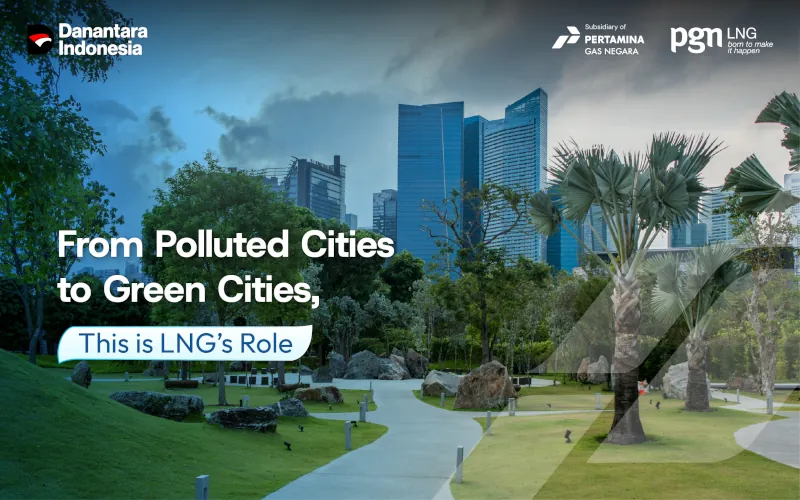
The green city concept reflects a vision of cleaner, healthier, and more sustainable urban environments. Today, urban areas remain major contributors to carbon emissions and air pollution due to high levels of transportation activity, industrial operations, and energy consumption.
To advance the transition toward green cities, transforming energy systems is one of the most crucial steps. This is where LNG (Liquefied Natural Gas) plays a role as a lower-emission energy source.
With a stable energy supply and lower pollution levels, LNG can become part of a city’s energy transition strategy toward a healthier and cleaner environment.
What Is a Green City?
A green city is an urban development concept designed to minimize environmental impact through low-carbon approaches, energy efficiency, and sustainable resource management.
A green city seeks to balance economic growth with environmental protection and social inclusion. This concept goes beyond simply providing green open spaces; it encompasses an entire urban ecosystem that intelligently manages energy, water, waste, transportation, and spatial planning.
In practice, green cities prioritize resource efficiency and sustainable consumption patterns. This includes transforming energy systems for electricity, industry, and transportation to reduce emissions while remaining aligned with environmental carrying capacity.
The fundamental difference between a green city and a conventional city lies in its level of climate resilience, infrastructure efficiency, and efforts to enhance energy independence. Green cities aim to reduce reliance on high-carbon fuels and transition toward cleaner energy sources.
Read More: Types and Benefits of Renewable Energy
What Are the Main Objectives of a Green City?
The primary objective of a green city is to create urban living environments that are not only livable, but also healthy and environmentally sustainable. Below are the key goals of green city development.
Reducing Greenhouse Gas Emissions
One of the main goals of a green city is to reduce greenhouse gas emissions in pursuit of net-zero emissions. The power generation sector, transportation, and urban industrial activities are typically the largest contributors to total emissions in urban areas.
Therefore, decarbonization efforts focus on gradually reducing the use of high-carbon fuels such as coal and petroleum, particularly in power generation and transportation.
Improving Air Quality and Public Health
Air pollution resulting from the combustion of fossil fuels can produce fine particulate matter (PM2.5), nitrogen oxides (NOx), and sulfur dioxide (SO₂), all of which directly affect human health.
Long-term exposure to these pollutants is associated with an increased risk of chronic respiratory diseases, cardiovascular diseases, and even lung cancer.
The green city concept aims to significantly reduce these pollutants through cleaner energy transitions, the development of low-emission transportation systems, and the strengthening of environmental standards.
Read More: 5 Key Roles of Small-Scale LNG
Integrating Efficient and Sustainable Energy Systems
Green cities must apply the principle of resource efficiency. This includes integrating renewable energy sources such as rooftop solar panels, as well as utilizing stable low-carbon energy sources.
Energy diversification is essential to maintain urban resilience so that cities do not rely solely on a single type of fuel that may be vulnerable to disruption.
Promoting Low-Emission Transportation
The transportation sector is one of the greatest challenges in densely populated major cities. Motor vehicle activity contributes not only to greenhouse gas emissions but also to pollutants such as NOx.
The transformation toward a green city includes developing cleaner and more efficient public transportation systems, such as electric buses, electric-powered trains, and integrated mass transit networks to reduce dependence on private vehicles. In addition, the use of lower-emission alternative fuels is also an important part of this strategy.
Read More: LNG ISO Tank, A Smart Solution for Flexible Distribution
What Challenges Do Polluted Cities Face in Achieving the Green City Concept?
Transforming cities that have long depended on conventional energy systems into green cities is a complex process. Many cities still rely on aging infrastructure, such as coal and oil-fired power plants. Replacing these systems too abruptly could risk disrupting electricity supply stability and economic activity.
Beyond technical factors, budget and investment limitations present major challenges. Developing low-carbon energy infrastructure requires substantial financing and long-term planning.
At the same time, rapid urbanization significantly increases energy demand. In some cases, city governments must still rely on available and reliable energy sources to sustain economic growth and public services.
Therefore, the transition toward green cities generally requires a gradual and realistic approach. This is where transitional technologies and fuels serve as a bridge to progressively reduce emissions while maintaining energy stability and urban economic sustainability.
Read More: Why the Energy Crisis Poses a Serious Threat to the Global Economy?
How Does LNG Support the Green City Transformation?
The transition toward green cities requires a shift from high-carbon energy sources, such as coal, to lower-emission alternatives. In this context, LNG serves as one of the transitional solutions that can help reduce emissions gradually without compromising energy supply stability.
In power generation, LNG produces approximately 45–60% lower CO₂ emissions than coal. Shifting from coal-fired to gas-fired power plants has the potential to significantly reduce urban carbon footprints in the medium term.
In terms of air quality, LNG produces significantly lower sulfur dioxide (SO₂) and particulate emissions, thereby directly contributing to improved air quality and reduced local pollution in urban areas.
Another advantage lies in operational flexibility. Gas-fired power plants can respond quickly to changes in load demand, making them highly supportive of intermittent renewable energy integration, such as solar and wind power.
This flexibility helps maintain the stability of urban electricity systems throughout the energy transition process.
References:
- FAO. Accessed in 2026. FAO Green City Principles and Criteria
- WHO. Accessed in 2026. Ambient (Outdoor) Air Pollution
- IEA. Accessed in 2026. The Role of Gas in Today’s Energy Transitions
- ScienceDirect. Accessed in 2026. Green City