For decades, coal has been considered the backbone of the global energy system, particularly in supporting industrial activities and electricity generation.
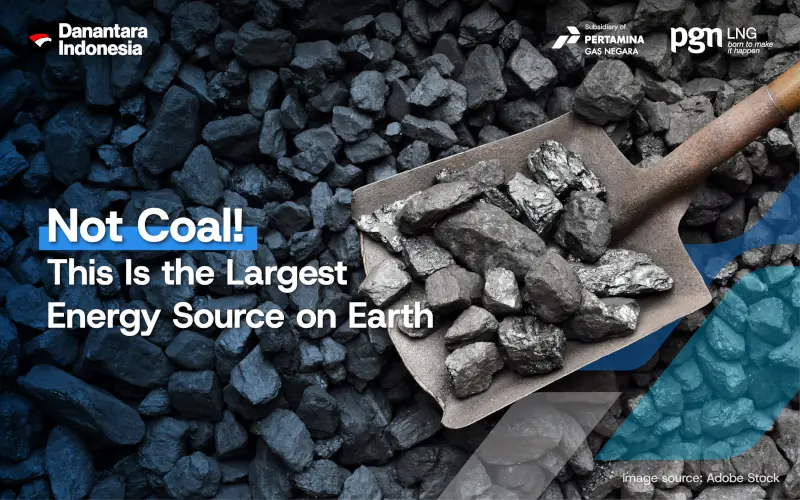
However, in fact, coal is not the largest energy source on Earth. There are other energy sources with far greater capacity, many of which are renewable.
Although the theoretical potential of these energy sources far exceeds that of fossil fuels, their utilization remains limited and has yet to fully replace the dominance of fossil energy. Curious to know what the largest energy source on Earth really is? Find the answer in this article.
What Is the Largest Energy Source on Earth?
The Sun is the largest energy source provided by nature and plays a crucial role in driving life systems on Earth’s surface. That said, besides solar energy, there are several other major energy sources. Here is the complete list:
1. Solar Energy
The Sun is the primary external energy source that drives nearly all systems on Earth’s surface. Based on measurements of Total Solar Irradiance (TSI) by NASA, approximately 1,361 watts per square meter (W/m²) reach the outer atmosphere, equivalent to around 173,000 terawatts (TW) of energy every second.
This amount of energy is more than 10,000 times the total energy consumption of the entire global population today.
Solar energy has also become one of the pillars of global clean electricity. Through technologies such as Photovoltaics (PV) and Concentrated Solar Power (CSP), the cost of solar energy production has dropped dramatically over the past decade.
Read More: Can Carbon Neutral Goals Be Achieved Without LNG?
2. Geothermal Energy
Geothermal energy originates from the natural heat within the Earth. This heat comes from two main processes: residual heat from the planet’s formation billions of years ago, and the natural radioactive decay of elements within the Earth’s crust.
Theoretically, the heat stored in the upper layers of the Earth’s crust, or at depths of around 10 kilometers, is estimated to contain energy tens of thousands of times greater than all global oil and gas reserves combined.
The key advantage of geothermal energy is its baseload nature, meaning it can operate 24/7 without depending on weather conditions, unlike renewable sources such as wind or solar.
3. Natural Nuclear Energy
Many people are unaware that Earth can be likened to a massive natural nuclear system.
This energy is generated from the natural radioactive decay of isotopes such as Uranium-238, Thorium-232, and Potassium-40 found in the Earth’s crust and mantle. This process accounts for approximately 40–50% of the Earth’s internal heat flow.
The fundamental difference between natural and artificial nuclear energy lies in concentration and control. In nuclear power plants, humans trigger controlled fission reactions within a very small volume to produce heat over a short period of time.
In contrast, natural radioactive decay occurs extremely slowly and is spread throughout the Earth’s interior. As a result, the energy is not directly harnessed but instead manifests through tectonic activity and volcanism.
Read More: The Advantages of LNG Trucks over Conventional Trucks
4. Gravitational Energy
The gravitational interaction between the Earth, the Moon, and the Sun generates enormous mechanical energy in the form of ocean tides. These ocean dynamics carry kinetic energy estimated to reach terawatt-scale levels globally.
Technologies such as tidal stream generators are used to capture this energy. While its potential is significant and highly predictable, large-scale utilization remains limited due to high infrastructure costs and marine environmental challenges, such as corrosion.
5. Fossil Energy
Technically speaking, fossil energy can be viewed as trapped solar energy. It originates from photosynthesis millions of years ago, when plants and marine organisms absorbed sunlight, were later buried, and transformed into coal, oil, and natural gas.
Although the total amount of energy stored in fossil fuels is far smaller than that of solar energy or the Earth’s internal heat, fossil fuels dominate economically due to their extremely high energy density and the ease of storage and distribution.
However, coal and oil significantly contribute to greenhouse gas emissions, prompting the global search for cleaner energy sources without completely sacrificing energy density.
The most stable solution to this challenge today is natural gas, particularly Liquefied Natural Gas (LNG).
LNG produces lower carbon emissions than coal and oil while maintaining the reliability and supply flexibility that fossil fuels are known for.
Read More: Why Offtake Stations Are Key to Smooth LNG Distribution
What Is the Role of LNG in the Modern Energy Landscape?
Amid the transition from fossil fuels to renewable energy, LNG plays a critical role as a transitional solution that bridges current energy needs with long-term decarbonization goals.
LNG is natural gas that has been cooled to approximately –162°C, reducing its volume by around 600 times. This characteristic enables efficient storage and long-distance distribution.
Among fossil fuels, LNG has the lowest emissions profile. Compared to coal, its combustion produces around 40–50% less CO₂ and almost no sulfur or particulate emissions.
These characteristics position LNG as an “energy bridge” for industrial sectors and power generation systems that cannot yet fully shift to electrification or intermittent renewable energy sources.
For companies and industrial operations, LNG offers two key strategic advantages:
- Supply flexibility, as it can be transported by tanker ships or trucks, reaching areas not connected to gas pipeline networks.
- Efficiency and environmental compliance, helping companies meet increasingly strict emissions regulations without compromising energy reliability.
By combining high energy density, relatively lower emissions, and global distribution flexibility, LNG plays a vital role in ensuring that the energy transition can proceed gradually without disrupting economic stability and industrial operations worldwide.
References:
- NASA. Accessed in 2026. Solar Irradiance Science
- IAEA. Accessed in 2026. Nuclear Fuel Cycle
- U.S. Department of Energy (DoE). Accessed in 2026. Marine Energy Basics
- U.S. Energy Information Administration (EIA). Accessed in 2026. Liquefied Natural Gas