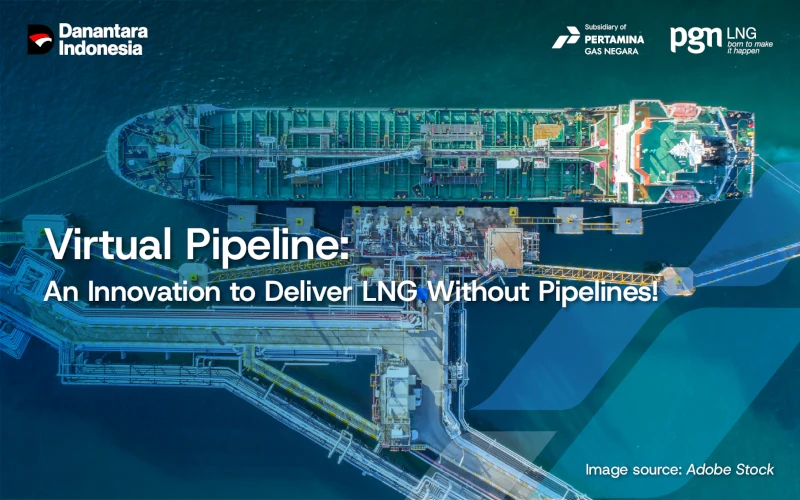
Not all regions in Indonesia are connected to natural gas pipeline networks, especially small islands and remote areas. This reality makes equitable energy distribution a major challenge.
In many cases, building new gas pipelines is not a practical solution due to high capital costs and long development timelines. Fortunately, a far more efficient alternative now exists: the virtual pipeline.
This system is designed to bridge energy demand with infrastructure limitations, enabling natural gas distribution to areas that were previously difficult or impossible to reach.
What Is a Virtual Pipeline?
A virtual pipeline is a natural gas distribution system designed to replace the function of long-distance transmission pipelines through an integrated logistics-based approach.
It enables gas to be delivered from production sources to end users without constructing underground or subsea pipelines.
In a virtual pipeline system, natural gas is first processed into a more transportable form, such as LNG (Liquefied Natural Gas) or CNG (Compressed Natural Gas).
The processed gas is then transported using various modes, including trucks, rail, or ships.
Read More: Why Is the FSU a Game Changer in the LNG Industry?
How Does a Virtual Pipeline Work?
A virtual pipeline delivers natural gas to consumers without physical pipelines by utilizing land and maritime transportation.
The system can be LNG-based or CNG-based, depending on distribution distance and demand requirements.
In an LNG-based configuration, natural gas is cooled until it becomes liquid. The LNG is then stored in ISO tanks or cryogenic tanks to maintain its low temperature.
The LNG is subsequently transported by truck, rail, or small-scale LNG vessels.
Upon arrival at the customer site, the LNG is fed into a Small-Scale Regasification Unit (SRU), where it is reheated and converted back into natural gas before being used by industrial equipment or power plants.
In a CNG-based configuration, natural gas is compressed at high pressure and transported directly using tube trailers, eliminating the need for liquefaction or regasification.
Read More: Can Natural Gas Really Run Out? Fact Check
Why Are Virtual Pipelines Important?
Virtual pipeline systems offer advantages that traditional pipeline networks cannot match, making them a vital solution for accelerating energy development. Key roles include:
Energy Distribution to Non-Pipeline Areas
The primary advantage of virtual pipelines is their ability to deliver natural gas to remote locations, small islands, mining sites, and newly developed industrial zones that are not connected to national gas pipeline networks.
This system is particularly strategic for regions with complex geography, including eastern Indonesia, which is dominated by archipelagic and maritime terrain, supporting faster and more flexible gas supply expansion.
Flexibility and Scalability
Virtual pipelines offer significantly greater flexibility and scalability compared to conventional pipeline systems. Supply capacity can be adjusted quickly in response to fluctuating customer demand.
Initial capital investment requirements are relatively low, as there is no need for massive spending on hundreds of kilometers of physical pipeline infrastructure. This makes small to mid-scale energy projects far more economically viable.
Speed of Deployment
Gas pipeline development typically requires long timelines due to land acquisition, permitting, and complex construction processes.
In contrast, virtual pipelines offer much shorter implementation timelines.
For LNG-based systems, small-scale regasification facilities can be deployed relatively quickly, while CNG-based systems require only decompression facilities.
These characteristics allow virtual pipelines to respond rapidly to demand surges or emergency supply needs, far faster than conventional pipeline construction.
Read More: Renewable Energy Explained, Types and Benefits
Applications of Virtual Pipelines Across Industries
Virtual pipeline solutions are now widely adopted across strategic sectors, supporting a cleaner energy transition. Key applications include:
Manufacturing and Petrochemical Industries
Many manufacturing and petrochemical facilities located in remote areas still rely on liquid fuels such as diesel and marine fuel oil (MFO), and in some cases LPG. These fuels generally come with higher operating costs and greater carbon emissions compared to natural gas.
By switching to natural gas supplied through virtual pipelines, industries can reduce dependence on high-emission liquid fuels and transition to a cleaner and more efficient energy source.
This shift helps lower energy costs, reduce emissions, and improve industrial competitiveness.
Power Generation (Gas Peakers and Distributed Power)
In the power sector, virtual pipelines play a critical role in supporting small- to medium-scale power generation (distributed power) in remote and island regions.
They are a key enabler of power plant gasification initiatives, particularly for replacing diesel-based generation.
Gas supply can be delivered in LNG or CNG form and used in gas turbines or gas engines operating either as peaker plants or as primary power sources for certain islands.
Mining and Remote Operations
Mining operations are typically located in remote areas with limited access to energy infrastructure.
Virtual pipelines provide a reliable and relatively cost-effective natural gas supply solution for powering mining equipment, on-site power plants, and processing facilities.
Compared to conventional pipeline development, this approach is more technically and financially viable for remote locations.
Read More: The Truth Behind Biogas, Sustainable Energy or Hidden Risk?
Why Are Virtual Pipelines Effective for Small-Scale LNG Distribution?
LNG-based virtual pipelines are highly effective in reaching locations that are not served by pipeline networks. Small-scale LNG solutions also offer flexible capacity and significantly shorter implementation timelines compared to conventional pipeline construction.
For this reason, virtual pipelines are well-suited to meeting the needs of remote areas or temporary peak demand.
In Indonesia, this model aligns closely with government policies that promote small-scale LNG development and virtual pipeline concepts to accelerate power plant gasification and ensure more equitable gas supply across islands and remote regions.
The government has identified small regasification terminals, FSRUs, and small-scale LNG carriers as key components of this implementation.
Supported by enabling policies and receiving terminals that act as regional hubs, LNG-based virtual pipelines represent a practical and cost-effective solution for expanding energy access in geographically complex countries like Indonesia.
References:
- Department of Energy. Accessed 2025. LNG Trades & Markets
- EIA. Accessed 2025. Natural gas explained
- Kementerian ESDM. Accessed 2025. Dongkrak Kebutuhan Domestik, Pemerintah Bakal Revisi Acuan Pembangunan Infrastruktur Gas Bumi
- Kementerian ESDM. Accessed 2025. Negara Kepulauan, Indonesia Kembangkan Infrastruktur Gas Skala Kecil