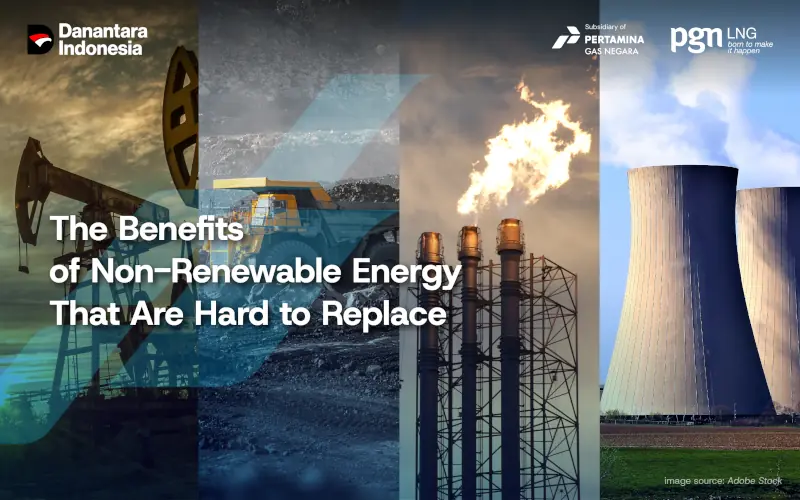
Non-renewable energy continues to play a crucial role in supporting modern life, from electricity supply and industrial activities to global transportation systems. Despite the growing momentum of energy transition initiatives and renewable energy development, the world still relies heavily on sources such as oil, natural gas, and coal.
So, why are the benefits of non-renewable energy still difficult to replace today? Find a detailed explanation in this article.
What Are the Benefits of Non-Renewable Energy in Modern Life?
The modern world is built on the foundation of non-renewable energy. Its ability to provide a large-scale energy supply has enabled the Industrial Revolution and supported the development of today’s digital era.
This is why the availability of non-renewable energy has played a major role in shaping technological and economic progress. Below are some of its key benefits:
Stable and Reliable Energy Supply
The primary advantage of non-renewable energy lies in its high energy density and consistent supply.
Unlike solar and wind energy, which depend heavily on weather conditions, fossil fuel–based power plants can operate continuously, 24 hours a day, with minimal disruption from environmental factors.
This reliability makes non-renewable energy a critical baseload source, ensuring national grid stability and preventing sudden power outages.
Supporting Industrial and Economic Activities
Non-renewable energy remains the backbone of the global manufacturing and transportation sectors. Oil is used not only as fuel but also as a key raw material in the petrochemical industry, producing plastics, fertilizers, and various medical chemicals.
In transportation, fossil fuels continue to dominate long-distance logistics, transoceanic cargo shipping, and commercial aviation.
Without affordable and stable fossil energy supplies, global production costs could rise significantly and potentially slow national economic growth.
Energy System Efficiency and Reliability
Technologies for non-renewable energy production have reached a high level of maturity, enabling controlled and predictable operations. For businesses, this provides cost certainty and relatively low risks of supply disruption.
In addition, industrial operations can be planned more accurately because energy supply is stable, easily managed, and far less intermittent than renewable energy sources.
Read More: 5 Unique Advantages of Solar Energy Over Fossil Fuels
Why Is Non-Renewable Energy Still Difficult to Replace Today?
There are several technical and structural reasons why non-renewable energy remains difficult to replace in the short term.
First, current battery technology still faces limitations in storing large-scale energy over long periods at competitive costs, particularly at the grid level.
Second, existing global infrastructure, from vehicle engines to industrial facilities and power plants, has been specifically designed to operate using fossil fuels. Replacing this entire system would require massive capital investment and a considerable amount of time.
Lastly, fossil energy still excels in terms of storage and transportation convenience, making it more flexible to distribute to remote areas and capable of supporting large-scale energy demands.
Read More: The Best Energy Alternative to Fossil Fuels
Why Is It Important to Conserve Non-Renewable Energy?
Despite its significant benefits, non-renewable energy cannot be replenished, making responsible usage essential. Below are several reasons why conserving non-renewable energy is necessary:
Limited Availability
Oil, natural gas, and coal reserves take millions of years to form naturally. Excessive exploitation without efficiency measures will accelerate the depletion of these resources.
If consumption remains uncontrolled, energy scarcity could trigger extreme price spikes and potentially lead to global energy crises in the future.
Environmental Impacts of Excessive Use
Burning fossil fuels is one of the main contributors to carbon emissions and air pollution. Energy efficiency is not only about cost savings but also a critical mitigation strategy to reduce climate change impacts.
By using energy more efficiently, the lifespan of existing resources can be extended while minimizing environmental damage.
Shared Responsibility in the Energy Transition
Energy efficiency is the most realistic first step toward a more sustainable energy system. Achieving this requires collaboration between individuals conserving electricity at home, industries adopting energy-efficient technologies, and governments implementing supportive regulations.
Energy conservation provides the necessary time and space for renewable energy technologies to mature and scale effectively.
Read More: Top Benefits of Natural Gas, More Than Just Low Emissions
What Is the Role of LNG in More Efficient Use of Non-Renewable Energy?
Liquefied Natural Gas (LNG) plays a key transitional role in improving the efficiency of non-renewable energy utilization. Compared to coal and oil, LNG enables more optimal fossil energy use due to its lower emissions and cleaner combustion process.
From an environmental efficiency perspective, LNG produces lower carbon dioxide emissions and generates almost no harmful particulate matter during use.
This positions LNG as a bridge fuel that maintains energy supply reliability while reducing negative impacts on air quality and the environment.
LNG also enhances operational efficiency, particularly in power generation and heavy industries. Its flexibility in storage and distribution allows for a more stable and adaptive energy supply that meets industrial demands.
For businesses in Indonesia, LNG’s role is becoming increasingly strategic given the country’s position in the global LNG supply chain and its potential for international cooperation with countries such as the United States and Japan.
Transitioning to LNG not only helps industries improve energy efficiency but also supports compliance with sustainability standards that are increasingly demanded by global markets. As a result, LNG enables non-renewable energy use that remains reliable while becoming more efficient and responsible.
References:
- National Geographic. Accessed in 2026. Nonrenewable Energy
- Kementerian ESDM. Accessed in 2026. Masuki Periode Transisi Energi, Kementerian ESDM Pertimbangkan Optimalkan Sumber Energi Ini
- EIA. Accessed in 2026. What Is Energy?
- IEA. Accessed in 2026. The Role of Gas in Today’s Energy Transitions