Industries such as mining, smelting, manufacturing, and processing require large and stable amounts of energy supply to maintain smooth operations. To this day, coal still plays an important role in meeting these energy needs.
Based on Indonesia’s 2025 Performance Report of the Directorate General of Minerals and Coal, 57.27% of the coal Domestic Market Obligation (DMO) absorption was used for coal-fired power plants, while 30.91%, or around 76.3 million tons, was absorbed by the metallurgy and smelter sector.
On the other hand, the need to improve efficiency while reducing emissions is pushing industries to look for lower-emission energy sources. Rooftop solar power is one of the options because it allows companies to utilize electricity from solar energy to meet part of their electricity needs.
But how much can rooftop solar displace coal as the primary energy source for industry?
What Is Rooftop Solar Power?
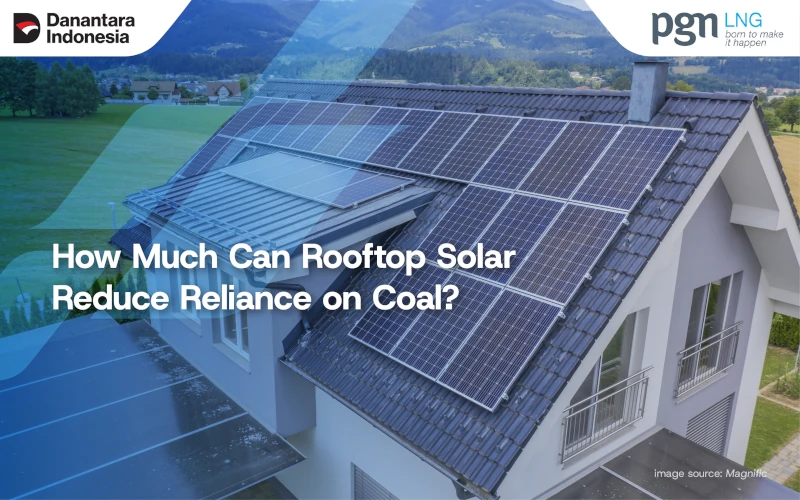
Rooftop solar power is a power generation system that utilizes photovoltaic modules installed on the roof or parts of a building to convert solar radiation into electrical energy.
The way this system works is that when sunlight hits the photovoltaic cells, energy from that radiation triggers the movement of electrons, generating electricity in the form of direct current (DC).
The electricity produced is then channeled to an inverter, which is a component that converts DC into alternating current (AC). After conversion, this electricity enters the building’s electrical installation and can be used to run operational equipment as needed.
In industrial facilities, electricity generated by rooftop solar can be directly utilized when solar electricity production is underway, for example to help supply the needs of machinery, lighting systems, and other supporting equipment.
This system can be designed without batteries or equipped with batteries, depending on the needs and installation design.
Read More: Hybrid Solar Power: An Energy-Saving Solution or Just a Trend?
How Great Is the Potential of Rooftop Solar for Industrial Needs?
The utilization of rooftop solar in Indonesia still has significant room for growth. Based on data from Indonesia’s Directorate General of Renewable Energy and Energy Conservation for 2026, the nationally installed rooftop solar capacity has reached 916.99 MW. Meanwhile, Indonesia’s Ministry of Energy and Mineral Resources estimates the national rooftop solar potential to reach 32.5 GW.
However, the scale of industrial electricity needs does not automatically determine how large a rooftop solar capacity can be installed.
The capacity that can be utilized at each facility depends on the area and condition of the roof, electricity needs and usage patterns, available power capacity, and solar radiation potential at the location.
This means rooftop solar can help meet industrial electricity needs, but it does not replace the entire electricity supply required.
Its utilization will be most effective when electricity production from the solar panels is at its peak, such as during the day. However, when production decreases, additional supply from other electricity sources is needed.
Read More: Is On-Grid Solar Power the Right Choice for Heavy Industry?
Can Rooftop Solar Displace the Role of Coal in Industry?
Rooftop solar can displace part of coal’s role in meeting industrial electricity needs, but it cannot yet fully replace it as the primary energy source.
The extent of the displacement depends on how much electricity rooftop solar can generate compared to the industry’s electricity needs. When solar electricity production can meet most of the daytime electricity needs, the need for electricity supply from coal-fired power plants can be reduced.
However, this reduction does not mean coal can be fully abandoned. Industries with large electricity needs still require supply when solar production decreases, especially in the afternoon and at night.
For this reason, rooftop solar is more realistically positioned as an electricity source that reduces part of the coal-based energy share, rather than replacing it entirely, especially in industries with large electrical loads.
Read More: How Reliable Is Off-Grid Solar Power for Remote Industrial Sites?
What Limits Rooftop Solar from Fully Replacing Coal?
Rooftop solar electricity production depends on sunlight and therefore does not run constantly throughout the day. This condition poses an obstacle for industries that require a continuous electricity supply, especially facilities with 24/7 operations.
At night or when solar production decreases, electricity needs still have to be met from other sources. The area and condition of the roof also limit the solar capacity that can be installed, so the scale of an industry’s electricity needs may not necessarily be matched by the rooftop solar capacity available at that facility.
Beyond production and capacity limitations, coal in some industrial sectors is also used directly in the production process, not only for generating electricity. In the cement industry, for example, coal is used as fuel to generate the high heat needed in the clinker manufacturing process.
Needs such as these cannot be directly replaced simply by installing rooftop solar. This means rooftop solar cannot directly replace all the functions of coal.
As an electricity source, rooftop solar has great opportunities to reduce coal-based energy use, but full replacement requires a combination of energy sources and other supporting systems.
Read More: Pros and Cons of Solar Power Plants: Proper Replacement for Fossil Fuels?
Why Does the Industrial Energy Transition Require a Combination of Energy Sources?
The limitations of rooftop solar do not mean solar energy is irrelevant for industry. Rooftop solar can still be part of an energy diversification strategy to meet part of electricity needs when sunlight is available.
If needed, an energy storage system can help extend the utilization of solar energy, while other energy sources can be used when solar production is insufficient.
For industries with large energy needs and high operational demands, combining several energy sources is more realistic than relying on a single source for all needs.
In this context, LNG (Liquefied Natural Gas) can be one of the supporting energy options that helps provide a flexible and reliable energy supply, while also supporting industry efforts to reduce dependence on fuels with higher emission intensity such as coal.
However, implementing a combination of energy sources also needs to consider how each energy supply can be made available and distributed in accordance with the industry’s operational needs. Differences in location and energy consumption scale mean that every industry requires a different energy supply approach.
For this reason, a reliable LNG supply becomes an important part of its utilization as a supporting energy source. PGN LNG Indonesia is present as an LNG provider partner that supports industrial energy needs through LNG supply and distribution solutions for various operational needs and locations reachable by pipeline.
Find the right LNG solution for your industry’s energy needs here: LNG Provider in Indonesia.
References
- ESDM. Accessed 2026. Performance Report of the Directorate General of Minerals and Coal 2025
- ESDM. Accessed 2026. Ministry of Energy and Mineral Resources Appreciates Rooftop Solar Development in the Jababeka Industrial Area
- Tata Power. Accessed 2026. Rooftop Solar/Rooftop Solar System