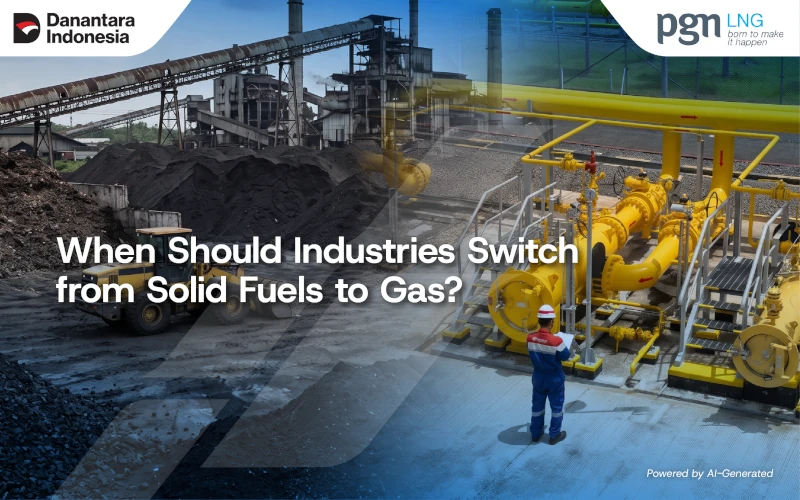
Solid fuels, such as coal, are still widely used in industrial activities and power generation to meet large-scale energy needs.
However, their use requires dedicated storage and handling facilities, management of combustion ash, and emission control. These various requirements can add to the operational burden and demand more complex management.
One alternative that industries can consider to move past these problems is natural gas. So, when is the right time to switch from solid fuels to gas?
What Are Solid Fuels and Their Types?
Solid fuels are fuels in solid form that are used to generate energy through combustion. In industrial activities and power generation, the energy from this combustion is utilized to produce heat, steam, and electricity to support various operational needs.
Some types of solid fuels commonly used in the industrial sector include:
| Fuel type | Usage Examples |
| Coal | Power generation, industrial boilers, and heating processes |
| Biomass | Industrial boilers and biomass-based power generation |
| Petroleum coke (petcoke) | Kiln fuel in the cement industry |
| Coke | Iron and steel industry, especially as a reducing agent in iron ore processing |
Among these types, coal is one of the solid fuels widely used to generate electricity, steam, and heat on a large scale. Its use is quite extensive because it can support the energy needs of various industrial processes and power generation.
Meanwhile, other types of fuel have more specific functions according to production process needs. For example, biomass can be used as an alternative energy source, while coke not only produces heat, but also acts as a reducing agent that helps remove oxygen from iron ore in the iron-making process.
This shows that solid fuels do not always function solely as an energy source, but can also play a direct role in material processing.
Read More: The Advantages of Biomass Power Plants
What Are the Challenges of Using Solid Fuels in Industry?
The use of solid fuels, especially coal, presents challenges in material handling because it requires relatively large storage space and a complex system for moving it to combustion facilities.
During storage and transfer, coal can also generate dust and spilled material. This condition requires additional control so that it does not disrupt the cleanliness of the work area and operational safety.
In addition, coal combustion produces residues in the form of fly ash and bottom ash that need to be collected, handled, and managed in accordance with environmental regulations.
Its combustion also produces emissions such as carbon dioxide (CO2), particulates, sulfur dioxide (SO2), and nitrogen oxides (NOx), so companies need emission control systems to reduce air pollution.
These various requirements can add to operational costs because companies must provide fuel storage and handling facilities, manage combustion residue, and operate emission control systems.
Read More: The Potential of Biogas Power Plants for Industry
When Does Industry Need to Switch from Solid Fuels to Natural Gas?
Switching from solid fuels to natural gas cannot be done instantly because companies need to consider infrastructure readiness, supply availability, equipment compatibility, and energy needs in the production process.
However, when industries face challenges that have the potential to disrupt operations, along with demands for better emission control, switching to natural gas becomes an option worth considering.
When Fuel Handling Operational Costs Increase
Companies need to evaluate their use of coal when operational costs are no longer dominated solely by the fuel purchase price, but also rise due to transportation, storage, material handling, facility maintenance, and combustion ash management.
These various activities require additional costs and resources to ensure that fuel supply remains available.
Under these conditions, natural gas can be an alternative because its supply can be channeled through pipeline networks or LNG distribution infrastructure, so companies no longer need the stockpiling and transfer of solid fuel as with coal use.
When Emission Control Becomes a Priority
A fuel switch is also worth considering when companies face demands for emission reduction and increasingly strict environmental standards.
Compared to coal, natural gas has combustion characteristics that produce far lower particulates and sulfur dioxide (SO2).
Based on EIA data, natural gas combustion produces emissions of around 52.91 kg of CO2, while coal produces around 93.24 kg of CO2 for the same amount of energy. This means the use of natural gas has the potential to help companies reduce the emission intensity of fuel combustion.
When More Flexible Combustion Control Is Needed
Industries with variable production capacity need a combustion system that can adjust heat supply to process needs.
In gas-fired systems, fuel flow can be regulated through burners and combustion control systems to adjust the amount of heat produced when production load increases or decreases.
This capability makes heat supply easier to adjust to operational needs, so companies can maintain temperature stability and avoid combustion that continues at a higher capacity than needed.
With this flexibility, natural gas can be considered by industries that need energy supply regulation that is more responsive to changes in production load.
Read More: 5 Signs of Severe Air Pollution Beyond Visible Smoke
What Are the Advantages of Using Natural Gas Compared to Solid Fuels?
The use of natural gas can provide a simpler operational process because fuel can be channeled directly to production equipment without going through solid fuel handling stages.
The combustion characteristics of natural gas also leave no ash residue that needs to be cleaned from the combustion chamber or managed after the production process.
From an environmental standpoint, the use of natural gas can help reduce the air pollution burden because it produces lower particulates, SO2, and CO2 emissions compared to solid fuels. Another advantage is that the combustion process can be adjusted to the heat needs at each production stage through burner regulation.
However, to obtain these benefits, industries also need to ensure the availability of natural gas supply that matches their consumption needs and operational location. This is especially important for companies operating in areas not yet connected to the gas pipeline network.
PGN LNG Indonesia is present as an LNG provider partner that supports industrial energy needs through integrated services, from LNG procurement, storage, and distribution to regasification.
With the support of these services, companies will gain assurance of access to a natural gas supply that can be tailored to their consumption needs and operational location.
Find out the energy solutions we provide for your industry here: LNG Provider in Indonesia.
References
- EIA. Accessed 2026. Use of energy explained
- EIA. Accessed 2026. Carbon Dioxide Emissions Coefficients
- DOE. Accessed 2026. LNG Basics
- DOE. Accessed 2026. Identifying Opportunities and Impacts of Fuel Switching in the Industrial Sector