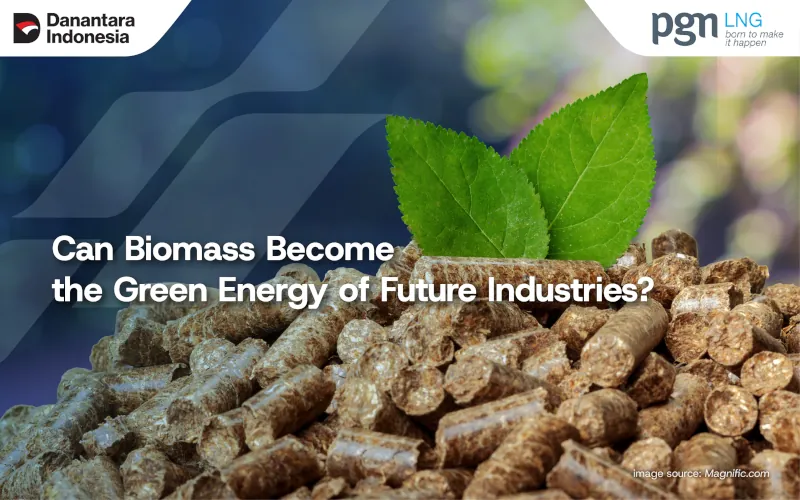
Industries today face pressure to reduce carbon emissions alongside the implementation of regulations, Environmental, Social, and Governance (ESG) targets, and commitments toward net-zero emissions.
At the same time, companies still need a stable energy supply to keep operations running optimally. This is encouraging many industries to explore green energy alternatives as replacements for or complements to conventional fuels.
One fairly attractive option is biomass, as it comes from organic materials and can be utilized to generate energy. But can biomass truly become the primary energy source for industry?
What Is Biomass?
Biomass is organic material that can be utilized as an energy source. Its sources are varied, ranging from agricultural waste, forestry waste, and agro-industrial processing waste to organic waste and livestock manure.
Biomass can generate energy through direct combustion to produce heat or through a conversion process into bioenergy, such as biogas, bioethanol, and biodiesel.
Biomass is categorized as a renewable energy source because it comes from sources that can be replenished when managed sustainably.
Read More: Will Indonesia’s Oil Reserves Last the Next 10 Years?
Is Biomass Suitable as an Industrial Energy Source?
Biomass can be one of the energy source options for industry, but it is not always suitable as the primary solution for all sectors.
Its use is generally more optimal in industries that have large heat energy needs or that produce organic waste that can be utilized as fuel. Its suitability still needs to be assessed based on the characteristics of the industry and the availability of biomass supply.
Industrial Energy Needs That Biomass Can Meet
Biomass is widely used as fuel for industrial boilers to generate steam, for biomass power plants, and for Combined Heat and Power (CHP) or cogeneration systems that produce heat and electricity simultaneously.
Its application is most suitable in the palm oil, pulp and paper, wood processing, food and beverage industries, and other industries that produce large amounts of organic waste, making biomass supply easier to obtain.
Advantages of Biomass for the Industrial Sector
Biomass offers various benefits for the industrial sector. Its use can convert waste into an energy source and has the potential to reduce carbon emissions when using biomass from sustainably managed sources.
In addition, its use also supports the application of a circular economy, reduces dependence on some conventional fuels, and adds value to production waste that was previously unutilized.
Read More: How Geothermal Works?
Can Biomass Become the Primary Energy Source for Future Industries?
Biomass has great potential as part of the industrial energy mix, especially in sectors that have access to sustainable biomass sources, such as agriculture or forestry-based industries.
In these conditions, biomass can help meet energy needs while improving the utilization of organic waste as a valuable resource.
However, the widespread application of biomass still faces challenges, particularly regarding raw material availability, which may not be sufficient if used massively across all industrial sectors.
For this reason, biomass is classified as one component of the energy transition, not as the sole energy source of the future.
Biomass does have the potential to become a primary solution in certain sectors, but it is not yet realistic as a replacement for all current industrial energy needs.
Read More: Impacts of Deforestation That Threaten Our Future
What Are the Weaknesses of Biomass as an Energy Source Today?
Although it has potential as a renewable energy source, the use of biomass in the industrial sector still faces a number of challenges that need to be considered before being widely implemented.
These challenges are not only related to raw material availability, but also to technical, logistical, and investment aspects.
Some of the weaknesses of biomass as an industrial energy source include:
- Raw material availability is affected by seasons, location, and agricultural and forestry activities.
- Relatively low energy density, requiring larger storage space and transportation capacity.
- Biomass quality is not always consistent due to variations in moisture content and calorific value.
- Some biomass requires drying or processing before use.
- Not all areas have a mature biomass supply chain.
- Its use often requires investment to adapt boilers or power generation facilities.
Read More: The Benefits of Alternative Energy over Fossil Fuel
Why Is LNG a More Ready Option for Industry Today?
The limitations of biomass, such as raw material supply that is not always consistent, the need for processing before use, and an uneven supply chain, mean that its application may not be suitable for all industrial sectors.
For industries that require large amounts of energy supply and operate continuously, these conditions can pose a challenge in maintaining operational reliability. For this reason, an alternative energy source capable of meeting industrial energy needs is required, and one of the best options is Liquefied Natural Gas (LNG).
The availability of LNG is currently supported by an adequate supply chain and infrastructure, making it capable of providing a more stable energy supply for industrial operations.
In addition, compared to coal, LNG combustion produces lower CO2 emissions, which can help companies reduce emission intensity.
To support current industrial sector energy needs, LNG can serve as a transition energy source, while biomass is used in a complementary manner according to resource availability, operational needs, and the company’s decarbonization targets.
For LNG to deliver optimal benefits, industries need a partner that is not only capable of providing a reliable LNG supply, but also delivering solutions tailored to operational needs.
To address this need, PGN LNG Indonesia provides LNG solutions covering supply, storage, distribution, and energy supply infrastructure for industry.
With this service in place, companies are supported in obtaining a stable energy supply while advancing their transition toward lower-emission energy.
Want to know what concrete solutions we provide for your industry? Find the complete information here: LNG Partner Provider in Indonesia.
References
- IPCC. Accessed 2026. Biomass and bioenergy
- IEA. Accessed 2026. Renewable fuels
- PubMed. Accessed 2026. Opportunities and Challenges in the Design and Analysis of Biomass Supply Chain
- ScienceDirect. Accessed 2026. Designing globalized robust supply chain network for sustainable biomass-based power generation problem