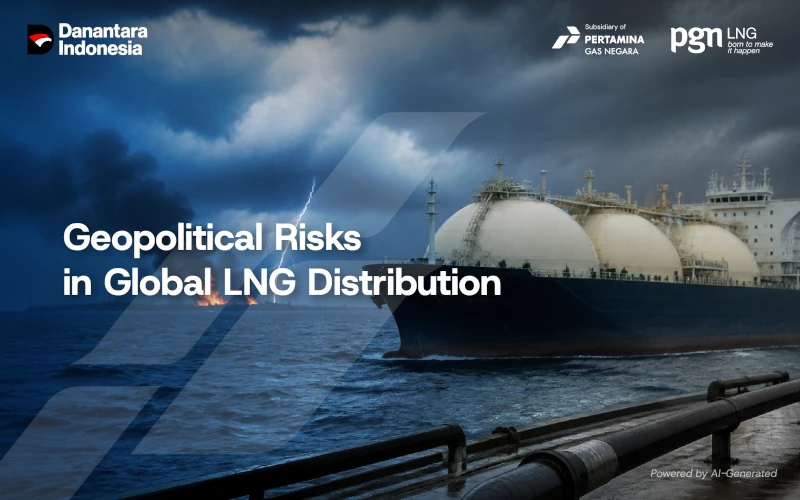
Global LNG (Liquefied Natural Gas) distribution currently relies heavily on international maritime trade routes. Qatar, one of the world’s largest LNG exporters, ships most of its supply through the Strait of Hormuz to Asian markets, including South Korea, India, China, and Japan.
Today, the strait serves as a highly strategic export corridor. When geopolitical conflicts threaten the Strait of Hormuz, such as a blockade resulting from the Iran conflict, global energy supplies can be immediately disrupted, triggering price surges and threatening the economic stability of importing countries.
What Is the Relationship Between Geopolitics and LNG Distribution?
Geopolitics refers to how geographic factors, political dynamics, and international relations influence a country’s policies and strategic interests.
In the energy sector, geopolitics encompasses a wide range of issues, including international conflicts, economic sanctions, trade route security, export policies, and competition for influence in specific regions. These factors can affect the accessibility, availability, and smooth distribution of energy resources worldwide.
LNG is an energy commodity produced in one country and traded across multiple international markets. As a result, the LNG supply chain is highly dependent on political stability, international relations, and the security of global trade routes.
When territorial conflicts, diplomatic tensions, economic sanctions, or disruptions along strategic shipping routes occur, LNG transportation can be affected. These conditions may reduce supply availability and drive LNG prices higher in global markets.
Read More: The Strategic Role of the Strait of Hormuz in Global LNG Trade
What Are the Geopolitical Risks to Global LNG Distribution?
Because global LNG distribution depends heavily on regional stability, emerging geopolitical issues can create various risks that negatively affect supply chains and global markets.
Disruptions to Strategic Shipping Routes
Strategic shipping routes such as the Strait of Hormuz, the Suez Canal, the Panama Canal, the Red Sea, and the South China Sea play a critical role in the global LNG trade, serving as primary transit routes for energy tankers between countries.
If any of these routes are disrupted due to conflict, LNG shipments may face delays, resulting in higher logistics costs and tighter global supply.
Reduced Production and Supply
International conflicts or regional tensions can directly affect LNG production and exports, as energy facilities, port infrastructure, and distribution networks may be disrupted by unstable security conditions.
As a result, market participants such as LNG traders and buyers often add a risk premium to prices to account for potential supply disruptions. This increases transaction costs and contributes to greater price volatility in global markets.
Changes in LNG Supply Flows
Economic sanctions and trade policies such as embargoes or export restrictions can reshape LNG supply flows in the global market by limiting a country’s ability to sell or purchase energy from its trading partners.
When trade access is restricted, producing countries must seek alternative markets, while importing nations need to secure new supply sources. This ultimately alters the structure of the global energy supply chain.
Damage to Energy Infrastructure
Energy infrastructure, including LNG export terminals, regasification terminals, gas pipeline networks, and production facilities, is a strategic component of the global energy supply chain and is vulnerable to disruptions caused by conflict.
Damage to or disruption of any of these facilities can create a cascading effect, ranging from reduced production capacity to interruptions in distribution to global markets. Such conditions can significantly affect the balance between LNG supply and demand.
Price Volatility Driven by Market Sentiment
Geopolitical concerns in energy markets often lead to higher LNG prices, even when there has been no actual physical disruption to supply or infrastructure.
This occurs because market participants tend to react quickly to potential risks that could threaten the smooth flow of energy distribution. As a result, prices may rise based solely on expectations or rumors surrounding geopolitical tensions, rather than changes in actual supply fundamentals.
Read More: The Domino Effect of the Iran Conflict on the Oil and Gas Industry
What Are the Direct Impacts on LNG-Using Industries?
Rising LNG prices have a direct impact on the operating costs of energy-intensive industries, including smelting, mining, manufacturing, and power generation.
When energy prices increase, production costs rise accordingly, reducing operational efficiency and, in some cases, forcing companies to scale back production. Supply instability can also disrupt business continuity.
In addition, energy price volatility makes it more challenging for companies to prepare budgets and cash flow projections due to uncertainty surrounding future energy costs.
Profit margins become increasingly compressed when energy costs rise faster than product selling prices in the market.
Read More: The Shifting Global Energy Landscape After the Iran Conflict
PGN LNG Indonesia’s Role Amid Global Uncertainty
PGN LNG Indonesia plays an important role in helping businesses secure stable LNG supplies through its domestic distribution network and access to global markets.
This role becomes increasingly critical amid geopolitical uncertainty that can disrupt international energy supply chains.
Supported by its LNG infrastructure and ecosystem, PGN LNG Indonesia helps meet the energy needs of various strategic sectors that depend on reliable energy supplies to maintain smooth operations.
Our presence provides greater flexibility for industrial players in responding to fluctuations in LNG prices and availability. As a strategic partner, we help strengthen long-term energy resilience and support businesses in navigating energy market volatility more effectively.
Contact us today to discover the best energy solutions tailored to your company’s needs: Contact PGN LNG Indonesia now.
References
- EIA. Accessed in 2026. About one-fifth of global liquefied natural gas trade flows through the Strait of Hormuz
- IEA. Accessed in 2026. Strait of Hormuz Factsheet
- IEEFA. Accessed in 2026. Impact of Middle East Crisis on Global Energy Markets
- OGJ. Accessed in 2026. Roundtable: Oil and Gas Markets Face Greater Geopolitical Risk, Logistical Fragility Than Price Signals Suggest