Greenhouse gas (GHG) emissions in Indonesia remain a major challenge in addressing climate change. According to Indonesia’s Ministry of Environment and Forestry report released in 2024, Indonesia’s total GHG emissions in 2023 reached 1,360,346.59 Gg CO₂e, or around 1,360.35 million tons of CO₂e, an increase of 10.9% compared to the previous year.
This rise in emissions comes from multiple sectors, including energy and industry, both of which continue to grow alongside national economic development and rising production demand. These two sectors are widely recognized as significant emission contributors, both from fossil fuel consumption and industrial processes.
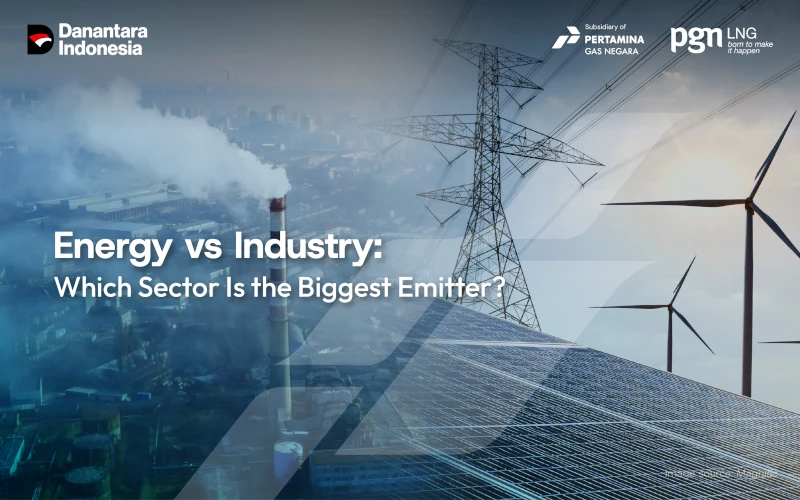
So, between the energy and industrial sectors, which one contributes the most emissions? Understanding this is an important step in designing effective emission reduction strategies and accelerating the transition toward cleaner energy use.
Which Sector Is the Largest Emission Contributor?
To monitor national emission sources, the government through Indonesia’s Ministry of Environment and Forestry conducts the National GHG Inventory, which classifies emissions into five main sectors:
- Energy
- Forestry and Other Land Use (FOLU)
- Waste
- Agriculture
- Industrial Processes and Product Use (IPPU)
Below is the emission breakdown by sector:
| Sector | Emissions (Million Tons CO2e) | Percentage |
| Energy | 752.28 | 55.3% |
| Forestry & Land Use (FOLU) | 306.90 | 22.6% |
| Waste | 136.34 | 10.0% |
| Agriculture | 104.98 | 7.7% |
| Industry (IPPU) | 59.85 | 4.4% |
Source: National GHG Inventory and Monitoring, Reporting, and Verification (MRV) Report 2024.
Based on the 2024 report covering 2023 activity data, Indonesia’s total GHG emissions reached 1,360.35 million tons CO₂e.
From this total, the energy sector is the largest contributor, accounting for more than 50% of national emissions. The energy sector includes emissions from electricity generation, land, sea, and air transportation, as well as fuel consumption across multiple sectors.
Meanwhile, the industrial sector (IPPU) ranks fifth, contributing 4.4% of total emissions. IPPU emissions originate from industrial production processes rather than fuel combustion. Examples include cement production, lime, ammonia, metals, and the use of refrigerant gases in cooling systems.
Read More: Will Indonesia’s Oil Reserves Last the Next 10 Years?
Why Is the Energy Sector the Largest Emission Contributor?
The energy sector is the largest source of greenhouse gas emissions in Indonesia because the national energy system is still heavily dominated by fossil fuels, particularly coal and oil.
This dependency is evident in the continued reliance on coal-fired power plants, which remain the backbone of Indonesia’s electricity supply.
At the same time, energy demand continues to rise due to industrial growth, urbanization, digital transformation, and the expansion of manufacturing, smelters, and mineral processing industries, all of which require large amounts of electricity and fuel.
In addition to fuel combustion, emissions from the energy sector also come from activities across the energy supply chain, including exploration, production, processing, and distribution.
Read More: Why Cutting Carbon Emissions Is Critical for the Planet’s Future?
What Are the Business Impacts for High-Emission Industries?
Indonesia’s commitment to reducing greenhouse gas emissions and achieving Net Zero Emissions (NZE) has increasingly tangible consequences for businesses, especially those operating in emission-intensive sectors such as energy, manufacturing, mining, cement, metals, and mineral processing.
As carbon pricing policies and carbon trading mechanisms develop in Indonesia, companies must prepare for expanded requirements in emissions measurement, reporting, and reduction.
This may increase operational costs, as companies need to invest in more efficient technologies, low-carbon energy sources, emissions monitoring systems, and environmental management programs to comply with evolving regulations.
At the same time, pressure is not only coming from regulators but also from investors, financial institutions, customers, and global business partners.
Emissions transparency and Environmental, Social, and Governance (ESG) performance are increasingly important factors in investment decisions and financing access.
Read More: Renewable vs Non-Renewable Energy: Here’s the Real Difference!
Why Is LNG a Transition Solution to Reduce Energy Sector Emissions?
Liquefied Natural Gas (LNG) is natural gas that has been cooled into a liquid form to make it easier to store and transport at large scale.
In modern energy systems, LNG serves as a cleaner fossil fuel compared to coal because it produces lower carbon dioxide (CO₂) emissions when used for power generation and industrial processes.
In many applications, LNG can replace coal and diesel, especially in industries that require stable and continuous energy supply.
Another advantage of LNG is its ability to provide reliable energy for 24/7 industrial operations, ensuring productivity without supply disruptions.
For companies, LNG adoption can help reduce carbon footprints while maintaining operational continuity, aligning with Environmental, Social, and Governance (ESG) goals and long-term sustainability strategies.
If you are considering an energy transition using LNG, PGN LNG Indonesia is ready to support your industry in designing reliable and sustainability-aligned supply solutions. Learn more here: LNG Supply Provider in Indonesia.
References
- KLHK. Accessed in 2026. National Greenhouse Gas Inventory (GHG) and MRV Report 2024
- IEA. Accessed in 2026. Total CO₂ Emissions from Energy
- IESR. Accessed in 2026. Indonesia Sustainable Mobility Outlook (ISMO) 2025
- ESDM. Accessed in 2026. Energy Sector Performance 2024 Report