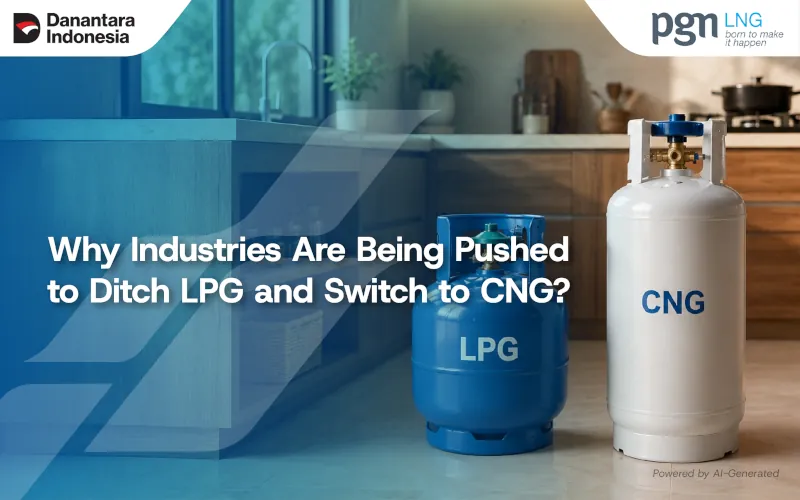
The Indonesian government is currently studying the use of Compressed Natural Gas (CNG) as an alternative to replace Liquefied Petroleum Gas (LPG).
This idea has emerged as part of efforts to find a more sustainable solution for meeting national energy needs while optimizing the domestic utilization of natural gas.
The proposal has drawn attention not only from the public as LPG users, but also from industry players because it relates to the direction of national energy policy and the potential for natural gas utilization across various sectors. So, why is CNG considered to have potential as an alternative to LPG?
Why Has There Been a Push to Replace LPG with CNG?
The push to replace LPG with CNG has emerged because Indonesia still depends on LPG imports to meet national needs.
At the same time, domestic LPG production has not been able to keep pace with continuously growing consumption, forcing the government to allocate large subsidy budgets while also bearing the foreign exchange burden from imports. This condition is driving the need for a more sustainable solution.
According to Indonesia’s Ministry of Energy and Mineral Resources, Indonesia has more abundant natural gas potential compared to LPG feedstocks. For this reason, the government is studying the utilization of CNG so it can be used more optimally.
Read More: Why Technology Is Making Fossil Fuel Use More Efficient?
What Are the Reasons for Choosing CNG as a Replacement for LPG?
The government has chosen CNG as one of the alternatives to replace LPG because it is considered capable of utilizing domestic natural gas potential more optimally while also supporting national energy security.
In addition, the use of CNG is projected to improve energy cost efficiency and reduce dependence on imported LPG if supported by adequate infrastructure.
Utilizing More Abundant Domestic Natural Gas
CNG comes from natural gas, whose reserves are more abundant in Indonesia compared to LPG feedstocks.
By utilizing these resources for domestic needs, the government can increase the added value of domestic natural gas while reducing dependence on imported energy.
Reducing LPG Imports and the Energy Subsidy Burden
One of the main objectives of CNG development is to reduce Indonesia’s dependence on LPG imports, which have long burdened the country’s foreign exchange reserves and energy subsidy budget.
If CNG utilization expands, the need for LPG imports has the potential to decrease, so government expenditure on energy provision can also become more efficient.
CNG Is Considered to Have More Competitive Costs
The government considers CNG to have more competitive cost potential because it utilizes domestic natural gas as an energy source.
However, these economic benefits still depend on the readiness of distribution infrastructure, making the development of the supply network one of the important factors in its implementation.
Read More: The Real Impact of the Energy Crisis
What Are the Differences Between CNG and LPG?
Although both are used as gaseous fuels, CNG and LPG have different characteristics in terms of composition, storage, emissions, and infrastructure requirements.
Understanding these differences is important for assessing whether CNG can be a suitable alternative to meet a company’s operational needs or energy transition plans.
| Aspect | LPG | CNG |
| Main components | Propane (C₃H₈) and Butane (C₄H₁₀) | Methane (CH₄) with >90% content |
| Feedstock Source | By-product of crude oil refining and natural gas processing | Natural gas |
| Storage form | Liquefied under moderate pressure | Compressed gas under high pressure |
| Storage pressure | Approximately 7–15 bar | Approximately 200–250 bar |
| Heating Value (Volumetric) | Higher | Lower than LPG because it remains in the gaseous state |
| Combustion emissions | Lower than conventional petroleum fuels, but higher than CNG | Lower than LPG, particularly in terms of CO₂ and particulate emissions |
| Common Applications | Households, SMEs, restaurants, and industry | Industry, commercial sector, and natural gas vehicle (NGV) transportation |
| Infrastructure | Extensive and well-established | Requires natural gas distribution networks or CNG refueling stations, which are still under development |
The differences shown in the table above indicate that replacing LPG with CNG is not simply a matter of choosing a different fuel.
Companies also need to consider infrastructure readiness, equipment compatibility, safety aspects, and the results of technical and economic analyses so that implementation can proceed optimally.
Read More: 5 Serious Impacts of Excessive Fossil Energy Use
Can CNG Be a Solution for Industrial Sector Energy Needs?
CNG can be a solution for energy needs in the industrial sector, but its application is not always the most optimal choice.
The government’s current discussions also focus on the use of CNG as an alternative to LPG to reduce imports and energy subsidies, not as a policy that requires all industrial sectors to switch to CNG.
On the other hand, CNG itself is not a new technology and has been used in various applications, such as gas-fueled vehicles, hotels, restaurants, boilers, and industries with small to medium energy needs.
For industries with large and continuous energy needs, CNG implementation requires consideration of several aspects, such as the availability of distribution infrastructure, the need for storage in high-pressure cylinders, equipment conversion investment, and logistical efficiency for delivering gas in large volumes.
For this reason, many industry players choose to evaluate other alternatives, such as LNG (Liquefied Natural Gas), which is generally more suitable for large-scale gas supply needs and continuously running operations.
Read More: What’s Really Driving the Energy Crisis
Why Is LNG a More Suitable Alternative for Industrial Energy Needs?
LNG is a more suitable alternative for industries with large energy needs because it has better storage and distribution efficiency compared to CNG. Like CNG, LNG comes from natural gas, but is processed into liquid form so its volume is far smaller.
This makes LNG more practical to store and distribute in large quantities, making it suitable for industries with high energy consumption such as mining, smelting, manufacturing, power generation, and industrial estates.
In addition, LNG distribution can be carried out using ISO tanks or LNG trucks, making it possible to reach locations not yet connected to the gas pipeline network. For industry, this provides a more stable energy supply and supports the potential for operational cost savings.
LNG also produces lower emissions compared to some conventional fuels. Even so, the choice between CNG and LNG still needs to be adjusted to the energy needs, scale of consumption, and operational conditions of each industry.
Because every industry has different operational characteristics and energy needs, LNG implementation requires tailored solutions so that its benefits can be felt optimally. From supply schemes to infrastructure support, every aspect needs to be designed in accordance with the company’s energy consumption profile and operational conditions.
To support this need, PGN LNG Indonesia provides integrated LNG solutions designed to meet the needs of various industrial sectors.
With reliable LNG services and infrastructure support, we are here to help companies obtain more efficient energy solutions with a stable supply.
Learn about the solutions we provide for your industry here: LNG Partner Provider in Indonesia.
References
- ESDM. Accessed 2026. Optimize Domestic Gas, Government Studies National CNG Utilization
- Detik. Accessed 2026. Planning to Switch to CNG, Bahlil Reveals Hundreds of Trillions in LPG Import Costs
- Antara. Accessed 2026. Bahlil: Government Studies CNG Development to Reduce LPG Imports
- IEA. Accessed 2026. The Role of Gas in Today’s Energy Transitions