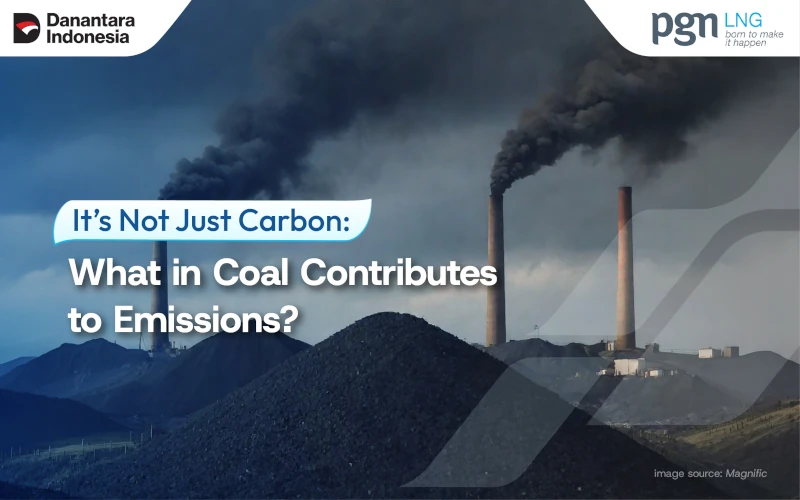
The coal combustion process produces various emissions that can affect air quality, one of which is carbon monoxide (CO). Beyond CO, this process also produces other gases and particulates that contribute to air pollution.
For this reason, the use of coal needs to be accompanied by proper emission management so that its combustion not only meets energy needs, but also considers the impact on air quality and the surrounding environment.
What Are the Gases from Coal That Cause Air Pollution?
Coal combustion produces various emissions with different characteristics and impacts on air quality. Among these emissions, carbon monoxide, sulfur dioxide, and nitrogen oxides are three groups of gases that need to be considered.
All three are formed through different processes during combustion, so the factors that influence their formation are also not the same.
Carbon Monoxide
Carbon monoxide (CO) is primarily formed when the carbon in coal undergoes incomplete combustion, meaning it is not fully oxidized into carbon dioxide (CO2).
Suboptimal combustion conditions, such as poor fuel and air mixing or inadequate combustion temperature, can increase CO formation.
This gas is colorless and odorless and can interfere with the blood’s ability to carry oxygen throughout the body, so exposure to CO at high concentrations can be hazardous to health.
Sulfur Dioxide
Sulfur dioxide (SO2) is formed when the sulfur contained in coal is oxidized during the combustion process. For this reason, the sulfur content in coal is one of the factors that influences the potential for SO2 emissions from the combustion process.
In the air, SO2 can irritate the respiratory tract and contribute to the formation of secondary particulates and acid rain that can impact ecosystems. For this reason, the sulfur content in coal is one of the aspects that needs to be considered in emission management.
Nitrogen Oxides
Nitrogen oxides (NOx) are a group of gases that include nitric oxide (NO) and nitrogen dioxide (NO2). In coal combustion, NOx can be formed from nitrogen present in the fuel (fuel NOx) as well as from the reaction of nitrogen and oxygen in the air at high combustion temperatures (thermal NOx).
For this reason, NOx formation is not only influenced by the characteristics of the coal, but also by combustion conditions, including temperature and air availability. In the atmosphere, NOx can play a role in the formation of ground-level ozone and secondary particulates that also affect air quality.
Read More: The Most Harmful Effects of Air Pollution
What Is the Impact of Gases from Coal Combustion on Air Quality?
Emissions from coal combustion can affect air quality around industrial areas, especially when their concentrations increase and are not properly managed.
CO can interfere with the blood’s ability to carry oxygen, while SO2 and NO2 can irritate the respiratory tract. For this reason, emission control is important to reduce exposure to pollutants that can be hazardous to human health.
For industries, emission control is not only about reducing the direct impact of combustion gases, but also about maintaining air quality around the facility.
Emissions that are not properly managed can increase the air pollution burden in the environment surrounding industrial activities, making emission management an important part of maintaining the environment while also supporting sustainable operational activities.
Read More: Is Carbon Capture and Storage Just a Green Gimmick?
How Can Industry Reduce Pollution from Coal?
Industry can reduce pollution from coal use through two approaches, namely controlling emissions from the combustion process and reducing dependence on coal.
For the first approach, companies can optimize the combustion process while using emission control technology to reduce pollutants before they are released into the air, for example:
- Flue Gas Desulfurization (FGD) to control SO2.
- Technologies such as Low-NOx Burners and Selective Catalytic Reduction (SCR) to reduce NOx.
- Electrostatic Precipitators (ESP) and baghouse filters to capture particulates.
The second approach is carried out by reducing dependence on coal through the use of alternative energy sources. However, before switching to another energy source, companies need to identify the energy needs of each facility.
Supply availability, energy reliability, required capacity, and compatibility with equipment also need to be considered so that the chosen energy source remains capable of meeting operational needs.
In this context, LNG (Liquefied Natural Gas) can be one of the energy sources that industries can consider as part of efforts to reduce dependence on coal.
Read More: Is LNG Truly a Low-Emission Alternative Fuel?
LNG as One of the Energy Options for Industry
Switching away from coal is not simply a matter of choosing an energy source that produces fewer pollutants. The replacement energy source also needs to be capable of meeting industrial operational needs, both in terms of capacity, supply reliability, and compatibility with the equipment being used.
In this context, LNG can be one of the alternative energy options. LNG is liquefied natural gas that can be stored and distributed to locations that need energy, including facilities not directly connected to the gas pipeline network.
LNG is also relevant to efforts to reduce air pollution from coal because the use of natural gas as a fuel can produce certain air pollutant emissions that are lower compared to coal.
With these characteristics, LNG can be considered by industries that want to reduce their dependence on coal while still needing an energy source that can support their operational activities.
However, the energy needs of every industry have different characteristics, from consumption volume to facility location and available infrastructure. For this reason, the use of LNG needs to be supported by services that can adapt distribution and energy needs to each location.
PGN LNG Indonesia is present as an LNG partner to support industrial energy needs through services covering procurement through to distribution, so that LNG can be practically utilized to support your industry.
Find out what LNG solutions we have to answer industrial energy challenges here: LNG Provider in Indonesia.
References
- WHO. Accessed 2026. Air Quality, Energy and Health
- DOE. Accessed 2026. Coal Fact Sheet
- EIA. Accessed 2026. Carbon Dioxide Emissions Coefficients
- EPA. Accessed 2026. AP 42, Fifth Edition, Volume I Chapter 1: External Combustion Sources