Coal remains one of the fuels used in the cement production process in Indonesia. Its selection as an energy source relates to the very high heat requirements for the combustion and clinker formation process.
On the other hand, the use of coal poses a challenge in decarbonization efforts because its combustion produces relatively high emissions. For this reason, LNG (Liquefied Natural Gas) can be considered as one of the alternative fuels to reduce emissions while still providing the heat needed in the production process.
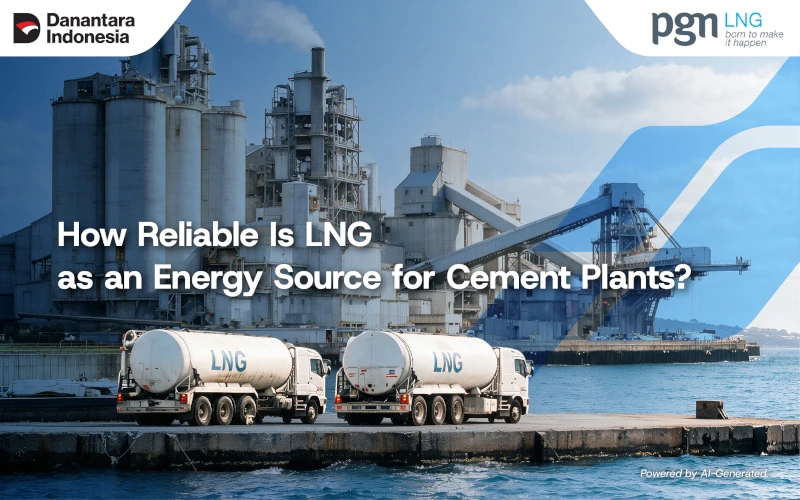
However, the question is how reliable is LNG in meeting the energy needs of cement plants continuously?
What Are the Energy Needs of a Cement Plant?
Cement production goes through several stages, including:
- Raw material processing and grinding
- Preheating
- Calcination
- Combustion in the kiln to form clinker
- Clinker cooling
- Grinding of clinker into cement
Among these stages, clinker formation is the stage that requires the most thermal energy because the raw materials must be processed at high temperatures to produce the necessary reactions.
The IEA records the thermal energy intensity of kilns at around 3.6 GJ per ton of clinker in 2022, which provides one illustration of the scale of thermal energy needs in clinker production.
For this reason, the energy needs of a cement plant consist not only of electricity to operate various production equipment, but also thermal energy from fuel to run the kiln process.
The high heat requirements and continuously running production process mean that the fuel source must be capable of providing stable and consistent thermal energy so that the clinker formation process can run in accordance with operational needs.
Read More: 7 Organic Wastes That Produce Energy
Why Is Coal Still Used in Cement Plants?
Coal is one of the fuels commonly used in the cement industry because it is capable of providing the thermal energy needed for the combustion process in the kiln.
Beyond technical factors, the use of coal has also developed over many years so that its facility infrastructure is already integrated with the production systems of many cement plants. Cost and availability factors have also historically supported its use.
However, the use of coal still presents challenges, as coal combustion produces higher CO2 emissions compared to natural gas.
In addition, the ash content from coal combustion can also affect kiln operations, requiring close supervision throughout the operational process.
Read More: Pros and Cons of Solar Power Plants
Can LNG Meet the Energy Needs of a Cement Plant?
LNG can technically be used to meet the thermal energy needs of cement plants, including in the combustion process in the rotary kiln that requires a material temperature of around 1,450°C to form clinker.
Regasified LNG can be used in kiln burners allows plants to provide thermal energy for the production process through the regulation of fuel supply and combustion conditions to match operational needs.
This capability makes LNG one of the alternative fuels worth considering for reducing dependence on coal, without setting aside the demands for temperature stability and energy continuity during the production process.
A real-world example is demonstrated by Mitsubishi UBE Cement Corporation (MUCC) at its Kyushu Plant in the Kurosaki District, Japan, through a demonstration of the use of natural gas in a commercially operating cement kiln in 2025.
In this test, natural gas supplied using LNG tank trucks replaced 40% of coal use, and the results showed no issues with operational stability or product quality. This example proves that natural gas supplied in the form of LNG can be used as part of the energy source for cement kilns.
Read More: 5 Countries That Rule the World’s Natural Gas
What Are the Advantages of LNG Over Coal for Cement Plants?
Compared to coal, LNG offers the advantage of lower greenhouse gas emissions, making it one of the alternatives to support emission reduction in the cement industry.
LNG is also capable of providing the thermal energy needed in the kiln combustion process, so its use is relevant not only from an emission reduction standpoint, but also in terms of its ability to meet production energy needs.
With these characteristics, LNG can be considered one of the energy sources to help cement plants reduce their dependence on coal, which has higher emissions.
Another advantage of LNG lies in its combustion characteristics, which do not produce solid ash like coal combustion does. This condition can reduce the need for ash residue handling and help ease operational maintenance activities.
The combination of emission reduction potential, the ability to provide thermal energy, and these combustion characteristics makes LNG an attractive option to consider in efforts to diversify cement plant fuel.
Read More: Can Bioenergy Replace Fossil Fuels?
How Reliable Is the LNG Supply for Cement Plants?
The reliability of LNG supply for cement plants is determined by the ability of the entire supply chain to provide energy consistently in accordance with operational needs.
LNG needs to be available in adequate quantities, then transported to the receiving facility, stored as inventory, and regasified before being distributed as gas to the combustion equipment at the plant. Each of these stages plays a role in maintaining supply continuity.
For cement plants that run the kiln process continuously, the reliability of LNG needs to be assessed based on the supply system’s ability to meet volume and energy continuity needs, not just the availability of LNG at the source.
Storage capacity, regasification capability, delivery schedules, and distribution systems need to be adjusted to the plant’s consumption patterns so that fuel needs can be met consistently.
The need for these services is already present in Indonesia through PGN LNG Indonesia, which provides integrated services covering LNG receiving, storage, transportation, and regasification to support industrial energy needs.
The existence of these facilities and services shows that LNG is already supported by an infrastructure chain that allows supply in gas form to be used by industrial consumers on a sustained basis.
Want to know more about how LNG can be a concrete solution for your industry? Contact PGN LNG Indonesia now.
References
- Osakagas. Accessed 2026. Japan’s First Successful Demonstration Test Using Natural Gas in a Commercially Operating Cement Kiln
- MUCC. Accessed 2026. Japan’s First Successful Demonstration Test Using Natural Gas in a Commercially Operating Cement Kiln
- IEA. Accessed 2026. Cement
- Intechopen. Accessed 2026. Energy and Economic Comparison of Different Fuels in Cement Production
- ScienceDirect. Accessed 2026. Alternative fuels co-fired with natural gas in the pre-calciner of a cement plant