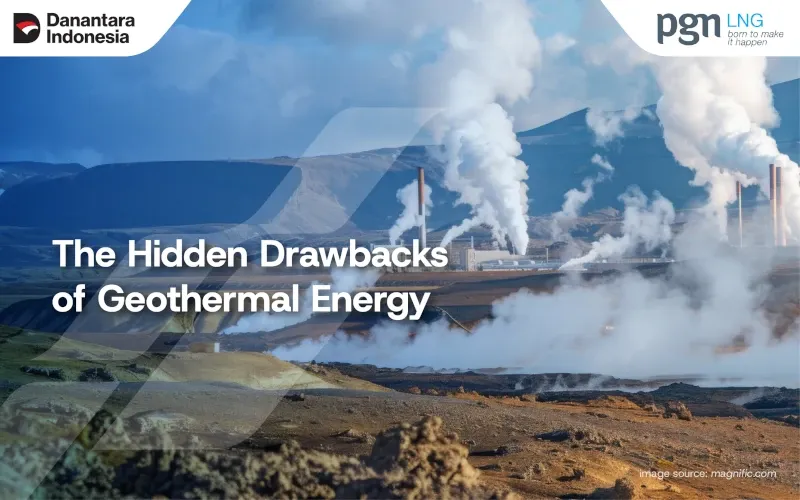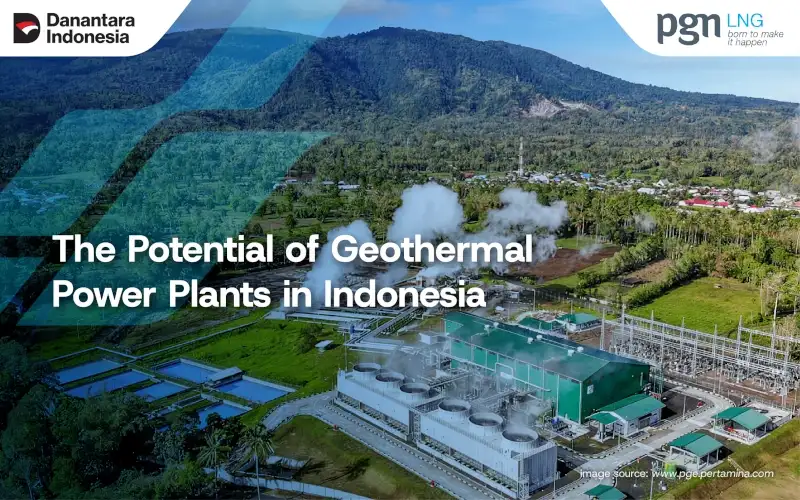
Indonesia has substantial geothermal potential because it sits within the Ring of Fire. For this reason, the government continues to push for its development as part of the country’s new and renewable energy (NRE) agenda.
Geothermal use remains limited. According to 2026 data from Indonesia’s Ministry of Energy and Mineral Resources, installed geothermal power plant capacity has reached only 11.6% of total potential.
This figure shows that the challenge in developing geothermal energy is not only the availability of resources, but also how to turn that potential into actual generating capacity.
What Are Geothermal Power Plants?
A geothermal power plant is a facility that uses heat from beneath the earth’s surface to generate electricity.
This heat produces hot fluid or steam, which is brought to the surface to drive a turbine. The turbine then spins a generator to produce electricity.
Geothermal plants can also generate power continuously, as long as the geothermal resource and the plant facilities are well managed. This allows them to serve as a baseload power source.
Read More: Why Are Coal-Fired Power Plants Still the Backbone in Energy Transition?
How Much Geothermal Power Potential Does Indonesia Have?
Indonesia has large geothermal potential, but its installed generating capacity is still far below that potential.
Data from Indonesia’s Ministry of Energy and Mineral Resources in August 2026 puts national geothermal potential at around 23.2 GW. However, installed geothermal power capacity stands at only about 2.78 GW, or 11.6% of the total potential.
| Indicator | Data |
| Geothermal energy potential | ± 23.2 GW |
| Installed geothermal power capacity | ± 2.78 GW |
| Share of potential utilized | ± 11.6% |
Even though there is plenty of room for growth, not all geothermal potential can be converted into power plant capacity right away.
Each project must go through survey and exploration stages to confirm reservoir conditions and resource reserves, followed by construction of the power plant and integration into the electricity grid.
As a result, the size of the potential does not necessarily reflect how much capacity can be developed in the near term.
Where Is Geothermal Potential Located?
Indonesia’s geothermal potential is spread across regions shaped by geological and volcanic activity, from Sumatra, Java, Bali-Nusa Tenggara, and Sulawesi to Maluku and Papua.
According to the Geological Agency of Indonesia’s Ministry of Energy and Mineral Resources, as of June 2026, Indonesia has 369 geothermal locations and 62 Geothermal Working Areas (WKP). This data shows how widely geothermal resources are distributed and how many of them could potentially be developed.
However, this distribution also affects how plants are developed, because geothermal sources are not necessarily close to where electricity is needed.
For this reason, factors such as site access, transmission line construction, and the readiness of power infrastructure must be taken into account so that electricity can be delivered to users.
Read More: Why Is Hydropower Still Limited in Indonesia?
What Are the Prospects for Geothermal Power Development in Indonesia?
The outlook for geothermal development in Indonesia is reflected in PLN’s Electricity Supply Business Plan for 2025-2034.
The plan targets an additional 5.2 GW of geothermal capacity by 2034, as part of a national plan to add 69.5 GW of generating capacity. Of that total, 76%, or 52.9 GW, is expected to come from new and renewable energy and energy storage systems.
This target shows that geothermal remains one of the energy sources being considered in the development of the national electricity system.
To support power delivery from energy sources located far from demand centers, the document also plans to build 47,758 circuit kilometers (kms) of transmission lines.
This infrastructure is intended to connect power plants with demand centers such as industrial zones and urban areas.
What Is Holding Back Geothermal Power Development?
Large geothermal potential does not mean it can all be developed into power plants right away. One of the main obstacles is exploration risk, because subsurface reservoir conditions must be proven through surveys and drilling.
If drilling does not reveal sufficient resources, the money already spent may not be recovered. In addition, developing geothermal power plants requires heavy investment from exploration through plant construction, so resource uncertainty can affect investor decisions.
Another challenge is that geothermal sources can be far from where electricity is needed, which calls for access roads and supporting infrastructure. Transmission grid readiness is also important so that the electricity generated can reach load centers.
On top of that, projects may face issues with land, permits, and community approval, especially when project sites overlap with environmental and social interests.
These factors mean that developing geothermal potential requires careful technical, financial, and social planning.
Read More: Can Wind Power Meet Future Electricity Needs?
What Energy Solutions Exist While Geothermal Is Being Developed?
Developing geothermal power plants is one way to increase the use of new and renewable energy in Indonesia. However, exploration, plant construction, and infrastructure readiness take considerable time and investment.
Meanwhile, the energy needs of industry and other sectors must still be met reliably. In this situation, liquefied natural gas (LNG) can serve as a transitional energy option to help meet energy demand, especially for industries that need a stable supply while renewable capacity is being built up.
Compared with coal, LNG can produce lower carbon dioxide emissions. LNG can also be stored and distributed to areas not yet reached by gas pipelines, supported by storage and regasification facilities.
With these characteristics, LNG can complement geothermal development in supporting energy supply reliability, especially in industrial areas that need a continuous supply.
Because energy supply must stay secure while renewable energy is being developed, industries need gas supply solutions that can reach their operating sites. This matters most for companies operating in areas not yet connected to gas pipelines or the power grid.
PGN LNG Indonesia provides LNG solutions covering supply, storage, distribution, and regasification to support the energy needs of various industrial sectors.
Through these services, LNG can be used as one option to help meet industrial energy needs while supporting operational reliability during the energy transition.
Want to learn more about LNG solutions for your industrial needs? Read more here: LNG Supplier in Indonesia.
References
- ESDM. Accessed 2026. Kejar Potensi Panas Bumi Nomor Satu Dunia, Bahlil Minta Pengembang Tak Tahan Konsesi
- ESDM. Accessed 2026. Geothermal Energy to Support Maleo Conservation
- EIA. Accessed 2026. Geothermal explained – Geothermal power plants
- IEA. Accessed 2026. The Future of Geothermal Energy