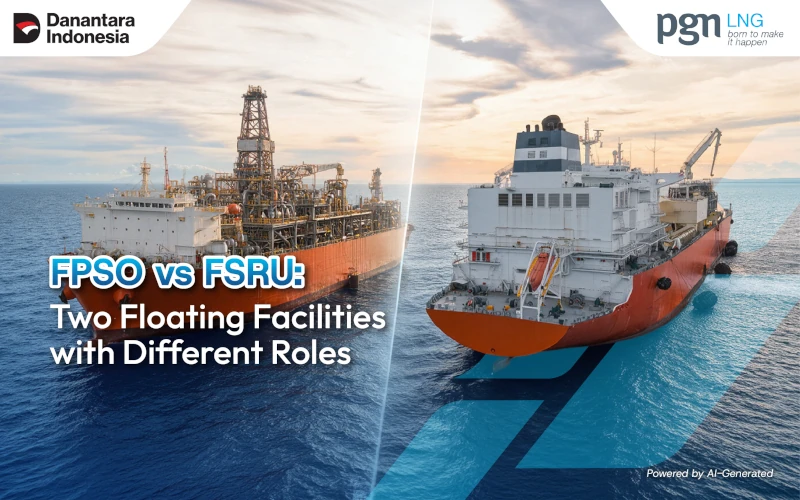
Offshore oil and gas industry operations require infrastructure that matches field characteristics and operational needs.
One of the facilities used to support these activities is a floating facility that can support production, storage, and energy distribution processes: the FPSO (Floating Production, Storage and Offloading) and the FSRU (Floating Storage and Regasification Unit).
Although both take the form of floating facilities, the FPSO and FSRU have different functions and operational processes. However, these differences give each of them its own contribution to supporting the energy supply chain.
What Are FPSO and FSRU and What Do They Have in Common?
An FPSO is a floating facility used to receive, process, store, and transfer oil and gas production from offshore wells. Fluids from the wells are channeled to the FPSO to be processed, for example by separating oil, gas, and water.
The processed output is then stored in the vessel’s tanks before being transferred to a transport vessel or other distribution facility.
Meanwhile, an FSRU is a floating facility that functions to receive, store, and convert LNG (Liquefied Natural Gas) back into natural gas through a regasification process. LNG is received from a carrier vessel, stored in dedicated tanks, then processed into gas to be channeled through a pipeline network to users.
What the FPSO and FSRU have in common lies in their form and use as floating facilities that support the energy industry chain.
However, the two have different functions, in which the FPSO manages production output from oil and gas wells, while the FSRU receives LNG and channels it back in the form of natural gas.
Read More: The Benefits of Geothermal Energy Beyond Emission Reduction
What Are the Differences Between FPSO and FSRU?
The FPSO and FSRU are two types of floating facilities used in the energy industry, but they support different operational stages. Below is a comparison of the two based on their function and operational processes.
| Aspect | FPSO | FSRU |
| Main Function | Collects, processes, and stores oil and gas production fluids before they are transferred. | Receives and stores LNG, then regasifies it into natural gas. |
| Materials Handled | Production fluids from oil and gas wells, which may include oil, gas, and water. | LNG, which is natural gas converted into liquid form to facilitate storage and transportation. |
| Operational Process | Receives fluids from wells, separates and processes their components as required, stores the processed output, and then transfers it. | Receives LNG from carrier vessels, stores it in tanks, regasifies it, and then distributes the gas through available infrastructure. |
| Process Output | Processed oil ready for storage and transfer, along with other components handled according to operational requirements. | Natural gas produced through LNG regasification. |
| Role in the Energy Supply Chain | Supports offshore oil and gas production and the handling of production fluids from offshore fields. | Supports natural gas supply from LNG for power generation and industrial needs. |
These differences show that the FPSO and FSRU serve needs at different stages of the energy chain.
An FPSO is used when production output from offshore oil and gas wells needs to be processed and handled before being transferred. Conversely, an FSRU is used when LNG transported by vessel needs to be stored and converted back into natural gas so that it can be channeled to users.
This difference in function also determines the supporting infrastructure required. An FPSO requires a connection to production wells as well as a system to transfer processed output to vessels or other facilities.
Meanwhile, an FSRU requires LNG supply from carrier vessels and gas distribution infrastructure after the regasification process.
Can FPSO and FSRU Replace Each Other?
The FPSO and FSRU cannot directly replace each other because each is designed to handle different operational needs.
In offshore oil and gas projects, fluids from wells need to be collected, processed, and stored before the output is transferred to transport vessels or other facilities. This series of processes requires production and processing systems such as those available on an FPSO.
Meanwhile, such a facility is not designed to receive LNG, store it in liquid form, and then convert it back into natural gas.
Conversely, when a project requires the receipt and storage of LNG before it is channeled as natural gas, a facility such as an FSRU is more suitable because it is equipped with LNG storage and regasification systems.
For this reason, the choice between an FPSO or FSRU must consider the project’s objectives, the characteristics of the material being handled, the operational location, and the availability of supporting infrastructure.
These factors determine the processes that need to be carried out and the facility capable of carrying them out properly.
Read More: What Locations Are Suitable for Floating Solar Power Plants?
How Do FPSO and FSRU Support Energy Availability?
The FPSO and FSRU support energy availability through different functions in the oil and gas supply chain. An FPSO supports offshore oil and gas production activities by collecting, processing, and storing production output before it is transferred to the next facility or means of transport.
Meanwhile, an FSRU receives and stores LNG, then regasifies it into natural gas so that it can be channeled to users, including power plants and industries that need gas for fuel or production processes.
Utilizing LNG to meet these needs requires a connected supply chain, from LNG availability and transportation through to receiving, regasification, and distribution to consumers.
For industries that use LNG, the smooth operation of each of these stages is an important factor in ensuring that energy supply is available in accordance with operational needs. This requires the support of an LNG provider that is not only capable of meeting supply needs, but also has services that support the entire process.
PGN LNG Indonesia is present as an LNG provider partner to support these needs through services covering supply, storage, distribution, and regasification.
With the support of a reliable LNG supply chain and flexible service schemes, we help industries obtain energy supply solutions that can be tailored to their operational scale and business location.
Want to know more about how we support your industry’s energy needs? Find complete information here: LNG Provider in Indonesia.
References
- DCO. Accessed 2026. Outer Continental Shelf National Center of Expertise (OCSNCOE)
- BOEM. Accessed 2026. Deepwater Development: A Reference Document for the Deepwater Environmental Assessment Gulf of Mexico OCS (1998 through 2007)
- DOE. Accessed 2026. Offshore LNG Technologies & Facilities