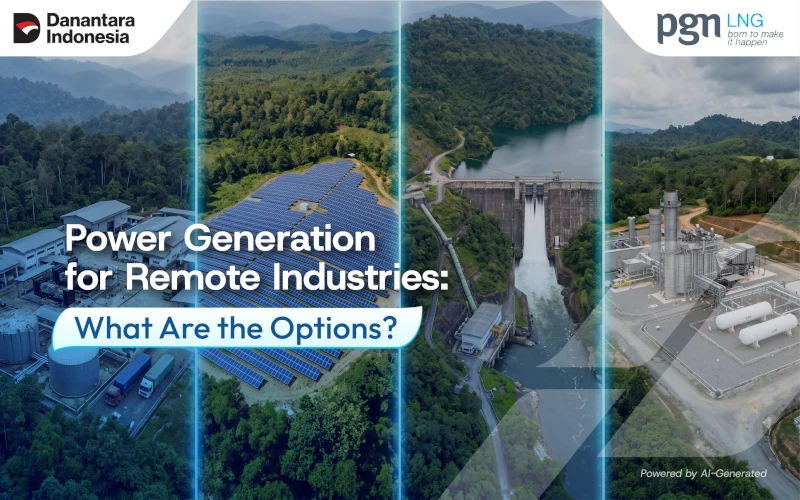
Industries operating in remote inland areas often face obstacles in obtaining an electricity supply because their locations are not yet reached by the public power grid. This condition means companies need to provide their own energy source to run operational activities.
The challenge does not stop there. Distributing fuel to remote locations also costs more because of the long travel distances and limited transportation access.
On the other hand, industrial activities require a stable electricity supply with adequate capacity so that production machinery and supporting facilities can operate without disruption. With these challenges, what are the best power generation options for remote inland areas?
What Are the Power Plant Options for Industry in Remote Inland Areas?
Limited access to the power grid and the difficulty of distributing fuel mean that industries in remote inland areas need to consider energy sources that suit the conditions of their location. Here are some suitable power plant options, including:
Diesel Power Plants
A diesel power plant uses a diesel engine to convert energy from fuel combustion into mechanical energy that then drives an electric generator.
This type of plant is flexible enough to be applied in remote locations because it can be operated independently without relying on the public power grid.
However, its operation requires a continuous diesel supply. If the industrial location is difficult to reach, fuel transportation and storage costs can increase. In addition, fluctuations in diesel prices can also affect the plant’s operational costs.
Solar Power Plants
A solar power plant uses solar panels or photovoltaics to convert sunlight into electrical energy. Indonesia has considerable solar energy potential because it is located in the tropics with sun exposure throughout the year.
This makes solar power plants one of the alternative electricity sources for industry, especially in locations with adequate sun exposure.
The drawback is that solar power plant electricity production depends on sunlight intensity, so it can decline during cloudy or rainy weather and does not generate electricity at night. For this reason, industries that need electricity supply around the clock need to consider using batteries to store energy.
Hydropower Plants
A hydropower plant utilizes energy from flowing or falling water to spin a turbine connected to an electric generator. This type of plant can be an option for industries in remote inland areas located near rivers with adequate water discharge and elevation.
However, its application depends on geographic conditions and year-round water availability. In addition, building infrastructure such as water channels, turbines, and power house structures requires proper planning.
Changes in water discharge during the dry season also need to be taken into account because they can affect the amount of electricity generated.
Gas-Fired Power Plants
A gas-fired power plant uses natural gas to generate energy through a gas turbine or gas engine connected to a generator.
This option can be considered by industries that need a consistent electricity supply because the plant’s capacity can be adjusted to operational needs.
However, its operation requires a continuous supply of natural gas. Industries not yet reached by the gas pipeline network need to consider distribution alternatives, including the use of Liquefied Natural Gas (LNG).
Read More: Renewable vs Non-Renewable Energy: Here’s the Real Difference
What Needs to Be Considered When Choosing a Power Plant?
Choosing a power plant for industry in remote inland areas needs to take into account the company’s power needs and electricity consumption patterns. The plant’s capacity must be able to meet the needs of all production equipment and supporting facilities, including when electricity consumption reaches peak load.
Industries that run production processes 24 hours a day need a generation system capable of meeting electricity needs continuously and with a backup solution when disruptions occur.
The availability of energy sources also needs to be considered because each type of power plant has different requirements. Solar power plants need sun exposure, hydropower plants depend on the availability of water flow, while diesel and gas-fired power plants require a continuous fuel supply.
Geographic conditions, transportation access, land availability, and supporting infrastructure also determine whether a power plant can be built and operated properly.
In addition, companies need to calculate the overall cost over the period of use, from initial investment and fuel procurement and distribution to maintenance and component replacement.
By considering these various factors, companies can choose a power plant that matches their operational needs while also being more economical over the long term.
Read More: Exploring LNG’s Core Engine: The Liquefaction Plant
How Does LNG Become an Attractive Option as a Power Plant Fuel?
One alternative that can be considered is using LNG as a power plant fuel. LNG is natural gas that has been cooled to around -162°C so that it becomes liquid and its volume shrinks to around 1/600 of its gas form.
This characteristic makes LNG easier to store and transport using vessels or specialized tank trucks to industrial locations not yet reached by the gas pipeline network.
Compared to diesel, natural gas has the potential to produce lower CO2 emissions for an equivalent amount of energy.
In terms of implementation, the use of LNG requires adequate infrastructure, from LNG receiving and storage facilities and transportation means to regasification facilities at the industrial site.
The availability of this infrastructure is an important factor for LNG to be utilized as a power plant energy source. However, industries do not always have to build and manage all LNG supply facilities on their own.
The support of an LNG provider partner with integrated services can help companies meet supply needs while also tailoring distribution and regasification systems to the conditions of the operational location.
PGN LNG Indonesia is present as an LNG provider partner offering integrated service solutions. Through these services, we support LNG supply needs for industries and power plants, including those operating in locations with limited energy access.
Want to know more about LNG solutions suited to your power plant and industrial needs? Find the complete information here: LNG Provider in Indonesia.
References
- ESDM. Accessed 2026. Electricity Supply Business Plan (RUPTL) on the Energy Transition of the Electricity Sector
- IRENA. Accessed 2026. Renewable power generation costs in 2025
- IEA. Accessed 2026. Hydropower Special Market Report – Executive summary
- DOE. Accessed 2026. Liquefied Natural Gas (LNG)