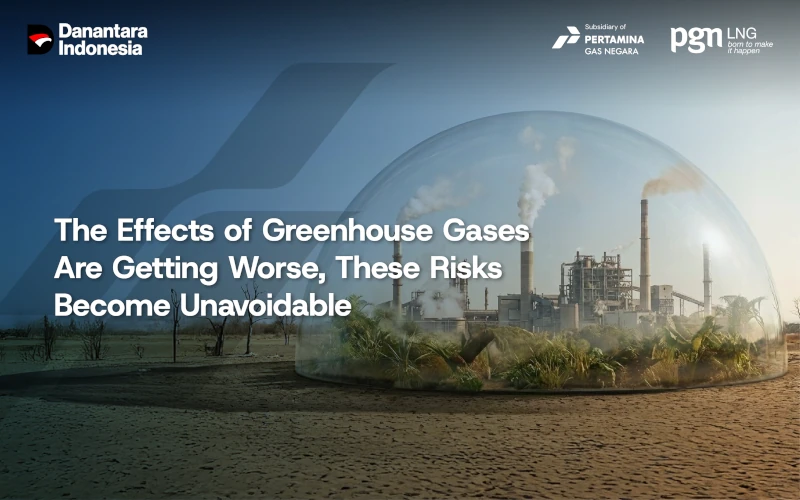
The greenhouse effect is essentially a natural process that plays a vital role in keeping the Earth warm and habitable. However, rising human activity, particularly in the energy sector, has driven atmospheric greenhouse gas concentrations far beyond their natural balance.
As a result, heat that should be reflected into space becomes trapped in the atmosphere. This excess heat accumulation is the primary driver of global warming and the wide range of impacts now recognized as the climate crisis.
Without effective and sustained mitigation efforts, these risks will continue to escalate and become increasingly difficult to control in the future.
What Happens If the Greenhouse Effect Continues to Intensify?
The growing accumulation of greenhouse gases in the atmosphere fuels global warming and climate change. This phenomenon leads to several serious risks, including:
Rising Global Temperatures
An intensified greenhouse effect causes a steady increase in the Earth’s average surface temperature. Since the late 19th century, global average temperatures have risen by approximately 1.1°C, leading to more frequent and intense heatwaves.
These conditions pose significant health risks, including a higher incidence of heatstroke, while also placing pressure on energy systems due to surging demand for air conditioning, potentially threatening grid stability.
Read More: Can Bioenergy Replace Fossil Fuels?
Shifting Climate Patterns and Extreme Weather
Global warming alters atmospheric dynamics and the hydrological cycle, resulting in changing precipitation patterns across regions.
The impacts are evident in the increasing frequency of extreme rainfall and flooding in some areas, while others experience prolonged droughts.
For the energy sector, these conditions present a serious threat, as extreme weather can damage transmission infrastructure and disrupt electricity supply, including generation from renewable energy sources.
Rising Sea Levels
The greenhouse effect accelerates the melting of polar ice sheets, leading to rising sea levels.
This impact is particularly significant for archipelagic countries like Indonesia, where many strategic energy assets, such as oil refineries and gas terminals, are located in coastal areas.
Sea-level rise increases the risks of coastal erosion and flooding, which can threaten the long-term reliability of energy supply.
Disruption to Ecosystems and Food Security
Climate change has far-reaching consequences for agriculture and food security, driven by more severe droughts and increasing uncertainty in planting seasons, both of which suppress global food productivity.
Access to clean water is also becoming more vulnerable due to a combination of higher evaporation rates and shifting rainfall patterns.
At the same time, biodiversity faces mounting pressure as many species are unable to adapt quickly enough to rising temperatures, disrupting ecosystem balance.
Read More: Wind Energy vs Fossil Fuels, The Facts and Data!
What Are the Main Drivers Behind the Intensifying Greenhouse Effect?
The rise in greenhouse gas emissions is driven by multiple factors, not solely the use of coal and oil. Key contributors include:
Fossil Fuel Combustion
The energy sector is the largest source of carbon dioxide (CO₂) emissions, primarily from coal-fired power generation and oil consumption in transportation.
These activities release billions of tons of CO₂ into the atmosphere each year. Because carbon dioxide has a very long atmospheric lifetime, its accumulation causes warming effects that can persist for centuries.
Methane Emissions from Energy Activities
Methane (CH₄) is a far more potent greenhouse gas than carbon dioxide in terms of heat-trapping capability.
Large volumes of methane are released during fossil fuel production and processing. Controlling methane leaks has therefore become a top priority for the global gas industry to slow the pace of global warming.
Deforestation
Forests act as natural carbon sinks, storing carbon in biomass and soil. Deforestation for industrial and agricultural expansion significantly reduces the Earth’s ability to absorb carbon emissions.
Moreover, forest clearing and burning release stored carbon back into the atmosphere, further accelerating greenhouse gas accumulation.
Industrial and Agricultural Activities
Beyond the energy sector, manufacturing industries and agricultural activities also contribute to greenhouse gas emissions, particularly nitrous oxide (N₂O) from the use of nitrogen-based fertilizers.
Although released in smaller quantities than carbon dioxide, nitrous oxide has an exceptionally high global warming potential.
Read More: The Truth Behind Biogas, Sustainable Energy or Hidden Risk?
What Mitigation Strategies Are Needed?
To curb rising emissions and their environmental impacts, mitigation strategies must be implemented in an integrated manner across the energy and industrial sectors.
These efforts include improving power plant efficiency to reduce fuel consumption and emissions per unit of energy, as well as controlling fugitive emissions by tightening methane leak detection and monitoring across energy infrastructure.
Equally important is accelerating the transition away from high-carbon fuels such as coal toward lower-emission energy sources.
These strategies can be further strengthened by deploying Carbon Capture and Storage (CCS) technologies to capture industrial and power generation emissions before they are released into the atmosphere.
Read More: Can Natural Gas Really Run Out? Fact Check
Can LNG Help Reduce the Greenhouse Effect?
Yes. Liquefied Natural Gas (LNG) can play a role in reducing greenhouse gas impacts.
Replacing coal with LNG in power generation has been shown to reduce carbon dioxide emissions by approximately 40–50%, making it an effective option for lowering emissions intensity in the short term.
LNG also offers supply flexibility, helping maintain energy system reliability while renewable energy deployment continues to face intermittency challenges.
For these reasons, within the context of Net Zero Emissions targets, LNG should be clearly positioned as a transition fuel, a pragmatic instrument to accelerate emissions reductions today while paving the way toward a fully renewable energy system.
References
- NASA. Accessed 2025. What Is the Greenhouse Effect?
- World Meteorological Organization (WMO). Accessed 2025. Greenhouse Gases
- U.S. Energy Information Administration (EIA). Accessed 2025. Energy and the Environment Explained
- U.S. Environmental Protection Agency (EPA). Accessed 2025. Overview of Greenhouse Gases
- International Energy Agency (IEA). Accessed 2025. New IEA Report Assesses Emissions from LNG Supply and Maps Out Opportunities to Reduce Them