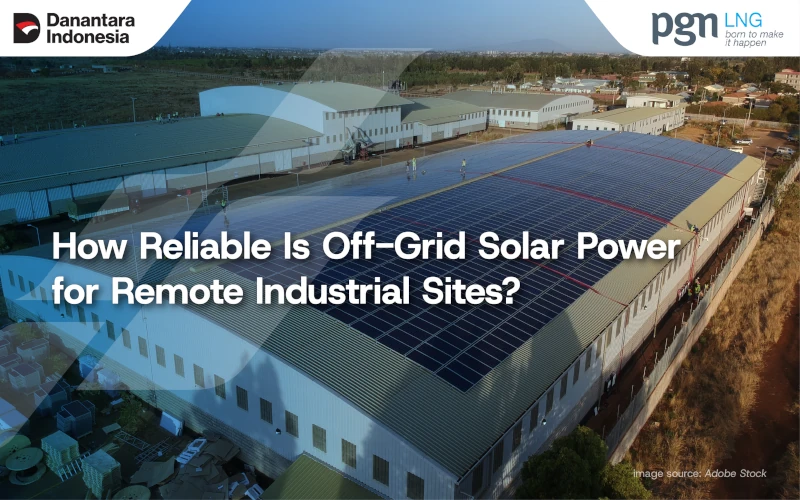
Many industries, such as mining, smelting, and plantations, operate in remote areas that are not yet connected to the electricity grid or gas pipeline networks. This condition poses a challenge because industrial operations require a stable and reliable electricity supply, especially for sectors that operate 24 hours a day without interruption.
To overcome this limitation, off-grid solar power plants are starting to be considered as one source of independent energy. This is supported by Indonesia’s abundant solar energy potential throughout the year.
However, is an off-grid solar power plant reliable enough to sustainably meet the energy needs of large-scale industries in remote areas?
What Is an Off-Grid Solar Power Plant and How Does It Work?
An off-grid solar power plant is a solar power generation system that operates independently without being connected to the PLN electricity grid.
In industrial applications, this system generally consists of several main components, namely:
- Solar panels to generate direct current (DC) electricity.
- A solar charge controller to regulate the battery charging process.
- A Battery Energy Storage System (BESS) to store electrical energy.
- An inverter to convert DC electricity into alternating current (AC).
- An Energy Management System (EMS) to regulate energy distribution and usage.
The way it works begins when solar panels generate DC electricity from sunlight. That energy is used to meet load demand, while the surplus is stored in the BESS.
When electricity production from the solar panels decreases or stops, such as at night, the battery becomes the power source for the system.
Read More: Geopolitical Risks in Global LNG Distribution
Can an Off-Grid Solar Power Plant Serve as the Primary Electricity Source for Industry?
Technically, an off-grid solar power plant can serve as the primary electricity source for industry, but its feasibility depends heavily on the energy needs of each facility.
Some of the factors that determine the capability of the system include:
- Power demand (MW).
- Daily energy consumption (MWh).
- Load profile, whether constant or fluctuating.
- Length of operational hours.
- Solar radiation potential at the location.
The greater the energy needs of an industry, the larger the solar panel capacity, Battery Energy Storage System (BESS), and investment required.
Therefore, industries with very large power needs, such as mining and smelting, require far more complex system planning compared to facilities with smaller electricity consumption. The goal of such planning is to ensure that the electricity supply remains reliable and in line with operational needs.
Read More: Energy Crisis Impact on LNG Supply Shifts
How Reliable Is an Off-Grid Solar Power Plant for Supporting Industrial Operations?
An off-grid solar power plant can be a reliable electricity source to support industrial operations, but its reliability depends on the overall system design, not just on the solar panels.
To be able to supply electricity continuously, the system must be designed according to industrial energy needs, equipped with adequate storage capacity, and supported by the right components and management.
Electricity Production Depends on Sunlight Availability
Solar panels only generate electricity when they receive solar radiation, so their production is affected by weather conditions, seasons, and the day-night cycle.
This characteristic is known as intermittency, a condition in which electricity output changes in line with sunlight availability and is therefore not always constant.
The Role of BESS in Maintaining Electricity Supply Continuity
The BESS functions to store surplus energy generated by solar panels during the day for use at night or when electricity production decreases due to weather.
Therefore, battery storage capacity is one of the main factors that determine how long an off-grid system can supply electricity without sunlight and maintain supply continuity.
Factors That Determine the Reliability Level of an Off-Grid Solar Power Plant for Industry
The reliability of an off-grid solar power plant is determined by how well the system design matches the industrial load profile, the quality of components and installation, capacity planning for power generation and energy storage, and ongoing system monitoring and management.
In other words, system reliability does not depend solely on the solar panels, but on how all components are designed and operated as a unified whole.
Read More: Causes of Petroleum Fuel Shortages and Their Impact on Industry
What Are the Challenges If Industry Relies Solely on an Off-Grid Solar Power Plant?
Although capable of providing electricity independently, implementing an off-grid solar power plant as the sole energy source for industry comes with a number of challenges.
This system requires a relatively large initial investment because it covers solar panels, a Battery Energy Storage System (BESS), inverters, control systems, and supporting infrastructure. In addition, industries with high energy consumption also need a large area of land to install a large number of solar panels.
Another challenge is the cost of maintenance and component replacement, particularly for batteries that have a limited service life.
On the other hand, electricity production can also decrease during prolonged bad weather, which has the potential to affect operational continuity if not supported by another energy source.
Read More: Effective Strategies for Overcoming Petroleum Fuel Shortages in Industry
Why Is LNG an Ideal Solution for Industrial Energy in Remote Areas?
LNG (Liquefied Natural Gas) is capable of producing a stable electricity supply and can operate continuously 24 hours a day, making it well suited to meet the energy needs of industries in remote areas.
Unlike solar power plants, LNG-fueled power plants do not depend on weather conditions, so they can be relied upon to supply large and consistent electrical loads.
For this reason, applying a hybrid energy system concept by combining off-grid solar power plants with LNG-fueled power plants is a complementary solution.
This combination provides some benefits for industrial operations, including:
- Improving electricity supply reliability.
- Reducing fuel consumption compared to operating conventional power plants.
- Lowering carbon emissions.
- Supporting long-term operational efficiency.
For many industries in remote areas, a hybrid energy system approach is a more realistic solution than relying on a single energy source, because it can balance supply reliability, energy efficiency, and sustainability targets.
For the implementation of such a system to run optimally, industries need a partner that is not only capable of providing a reliable LNG supply, but also supports distribution, storage, and supporting infrastructure needs in line with the characteristics of the operational location, including in areas with access challenges.
To address this need, PGN LNG Indonesia provides integrated LNG solutions designed to support the energy needs of various industrial sectors, including operations in remote areas.
Learn about the solutions we provide to support your industry, read the complete information here: LNG Provider in Indonesia.
References
- ScienceDirect. Accessed 2026. Reviewing the potential and cost-effectiveness of off-grid PV systems in Indonesia on a provincial level
- IRENA. Accessed 2026. Energy Storage
- Regen Power. Accessed 2026. Renewable Off-Grid vs Diesel Micro Grid
- DTsolarpower. Accessed 2026. Hybrid Solar-Storage-Diesel Microgrids: for Weak and Off-Grid Regions