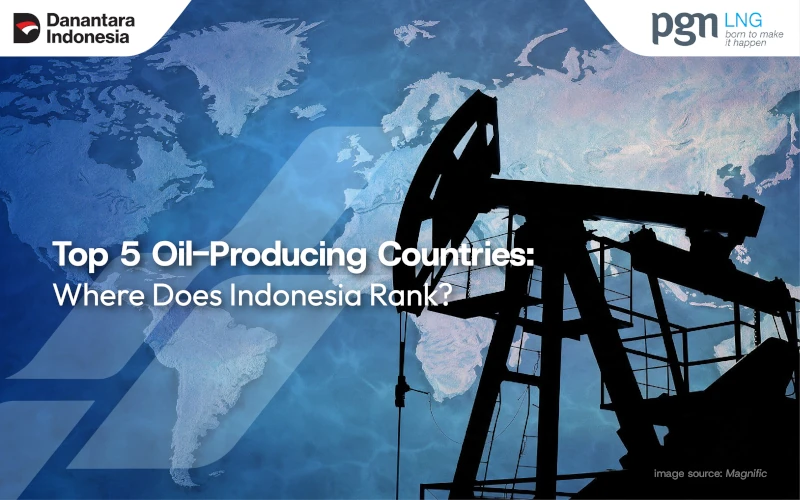
Global crude oil production is still concentrated in some countries. The group of nations that rank among the largest producers has remained relatively unchanged in recent years. The U.S. Energy Information Administration (EIA) notes that the five largest crude oil-producing countries contribute around 52% of global oil production.
The scale of a country’s oil production is not only determined by its oil reserves, but also by its ability to develop those resources through various strategies. So, which countries are currently the largest petroleum producers, and where does Indonesia rank?
The 5 Largest Petroleum Producing Countries in the World
The following rankings are based on 2025 production data from the EIA through its International Energy Statistics, which shows global crude oil production.
| Rank | Country | Oil Production |
| 1 | United States | 13.586 million barrels/day |
| 2 | Russia | 9.885 million barrels/day |
| 3 | Saudi Arabia | 9.556 million barrels/day |
| 4 | Canada | 4.964 million barrels/day |
| 5 | Iraq | 4.388 million barrels/day |
The scale of production shows that these countries play an important role in global oil supply. Changes in production from major producers can affect the balance of supply in the world market, so production developments in these countries are one of the important factors in the dynamics of global oil prices.
Read More: A Deep Dive into Petroleum: Types and Processing
Why Do These Countries Dominate Petroleum Production?
Countries with the largest oil production generally have a combination of large resources and the ability to develop them into large-scale production.
The availability of reserves serves as the foundation, but this capability needs to be supported by technology, investment, infrastructure, and an industrial ecosystem that allows production to be maintained over the long term.
The United States is one example of how technology and productivity improvements can support large-scale oil production. Advances in drilling and production activities have helped the country maintain high output levels. As a result, the EIA recorded US crude oil production reaching a record 13.6 million barrels per day in 2025.
Read More: The Negative Impacts of Petroleum
Where Does Indonesia Rank as a Petroleum Producer?
Indonesia ranks 25th as one of the world’s largest petroleum-producing countries in 2025, with crude oil production of 582 thousand barrels per day.
This position places Indonesia between the United Kingdom in 24th place at 616 thousand barrels per day and India in 26th place at 581 thousand barrels per day.
This position shows that Indonesia’s oil production capacity is still relatively small on a global scale, while its domestic needs are far greater. The EIA records oil consumption in Indonesia at around 1.69 million barrels per day, nearly three times its production capacity of 582 thousand barrels per day.
This difference shows that domestic production has not yet been sufficient to cover all domestic oil needs, so Indonesia needs to ensure the availability of energy supply to meet domestic demand.
Read More: Will Indonesia’s Oil Reserves Last the Next 10 Years?
What Are the Challenges for Industry If It Still Depends on Petroleum?
Domestic oil needs that are greater than national production mean Indonesia still requires supply from abroad to meet domestic energy needs.
This condition shows that industries dependent on oil are vulnerable to changes in global oil prices, geopolitical conditions, and potential disruptions to the energy supply chain.
Sectors such as mining, smelting, shipping, power generation, and manufacturing that require large amounts of fuel can be affected when energy costs rise. Rising fuel prices can increase transportation and operational costs, raise production costs, and under certain conditions squeeze company margins.
Companies can also face competitive pressure if their energy costs are higher than those of competitors that have access to more efficient energy.
For this reason, increasing oil production alone does not automatically eliminate all energy risks for industry. Energy source diversification can be one of the approaches to reduce dependence on a single type of fuel and manage cost and supply risks over the long term.
Read More: The Drawbacks of Crude Oil: Is It Time to Switch to Alternative Energy?
Why Is Energy Diversification Increasingly Important for Industry?
Energy diversification is increasingly important because industries need to maintain supply reliability while reducing dependence on a single type of fuel. Dependence on oil and petroleum fuels makes industry costs and operations more affected by price changes and global energy supply conditions.
By using a combination of several energy sources, companies can have more flexible supply alternatives suited to operational needs. Diversification can also help companies manage emission intensity by increasing the use of energy sources that produce lower emissions.
Diversification does not mean companies have to immediately replace all oil use or change existing facilities. Its implementation can be carried out gradually in accordance with energy needs, equipment characteristics, and infrastructure readiness at each location.
For this reason, industries need energy sources that are not only capable of providing a stable and flexible supply, but also have lower emission intensity compared to some other fossil fuels. In this context, LNG (Liquefied Natural Gas) can be one of the choices to support industrial energy diversification.
Read More: Alternatives to Petroleum: Which One Is the Most Environmentally Friendly?
LNG as a Transition Energy Solution for Industry
LNG can be one of the energy diversification options for industries that require large amounts of energy supply.
LNG is liquefied natural gas that is made easier to distribute, then shipped using vessels or trucks to the destination location. This distribution model allows natural gas to reach industrial locations without depending entirely on the pipeline network.
From an emissions standpoint, LNG can be a transition energy option with lower emissions compared to coal. For this reason, for industry, LNG can be considered as part of an energy diversification strategy during the transition toward an energy system with lower emissions.
For its use to support industrial operations optimally, LNG needs to be available with a distribution pattern suited to the needs and conditions of the location. Differences in consumption scale, operational location, and access to gas infrastructure mean that every industry has different needs.
PGN LNG Indonesia is present as a partner that supports industrial LNG needs through services covering supply, storage, distribution, and regasification, so that energy supply remains reliable.
Want to know what LNG solutions we provide for your industry? Find out more here: LNG Provider in Indonesia.
References
- EIA. Accessed 2026. Crude oil including lease condensate production 2025
- EIA. Accessed 2026. U.S. crude oil production rose in 2025, setting new record
- IEA. Accessed 2026. World Energy Outlook 2025 – Executive summary
- ESDM. Accessed 2026. Setting an Oil Lifting Target of 610 Thousand Barrels in 2026, This Is the Minister of Energy and Mineral Resources’ Strategy for Facing Production Challenges