Growing industrial and economic activity is also driving electricity needs in Indonesia. PT PLN, Indonesia’s state-owned power company, recorded a 3.75% increase in electricity sales in 2025 compared to 2024.
The annual growth in electricity needs is pushing Indonesia to continuously add generation capacity while also diversifying energy sources to maintain the sustainability of electricity supply in the future.
One renewable energy source with great potential in Indonesia to support future electricity needs is wind power. So, how great is the potential of wind energy to meet continuously growing electricity needs?
What Is a Wind Power Plant and How Does It Work?
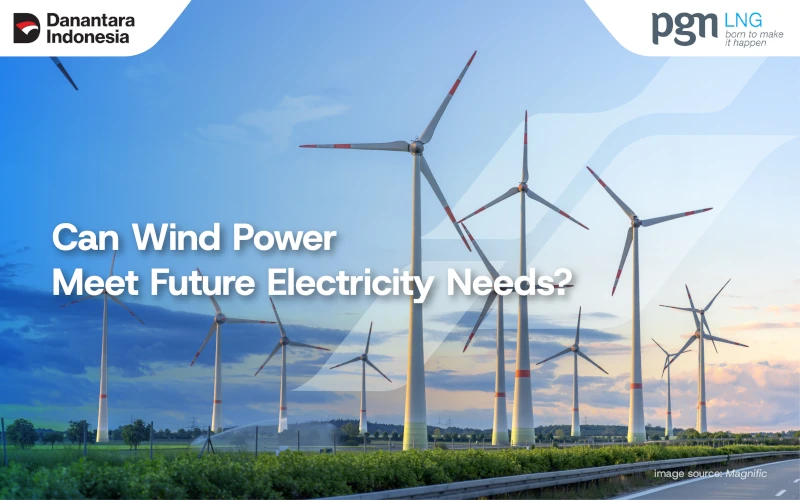
A wind power plant is a power generation facility that utilizes the kinetic energy of wind to generate electricity. The way it works begins when wind flows and rotates the turbine blades.
The rotation of the blades together with the hub forms a rotor that then drives a generator, either directly or through a specific drive system.
The generator then converts the mechanical energy from this rotation into electrical energy. The electricity produced is then channeled through electrical facilities before being distributed to the grid.
The amount of electricity a wind power plant can generate depends on the wind conditions and speed at the location as well as the characteristics of the turbine used. Because wind is not always available at the same speed, the output of a wind power plant can also change over time.
These characteristics make wind power a variable renewable energy (VRE) source, meaning a renewable energy source whose production depends on natural conditions so that its electricity output is not always constant.
Read More: The Drawbacks of Crude Oil: Is It Time to Switch to Alternative Energy?
What Are Indonesia’s Current Electricity Needs?
Indonesia’s electricity needs continue to grow along with increasing public and business activity. PT PLN recorded national electricity sales reaching 317.69 TWh in 2025, up 3.75% compared to 306.22 TWh in 2024.
The household sector was the largest user with consumption of 133.41 TWh, followed by the industrial sector at 93.35 TWh. Meanwhile, the business sector consumed 60.74 TWh.
These figures show the scale of electricity needs that must be met to support the economic activities and operations of various sectors. The increase in electricity needs is also reflected in per capita electricity consumption, which rose from 1,411 kWh per capita in 2024 to 1,584 kWh per capita in 2025.
This growth in demand has the potential to continue as industry, downstream processing, industrial estates, data centers, and other economic activities develop.
Read More: How Much of Indonesia’s Crude Oil Reserves Remain?
How Large Are Indonesia’s Future Electricity Needs?
Indonesia’s electricity needs are projected to continue growing over the next decade. Based on the PLN Electricity Supply Business Plan for 2025 to 2034, electricity sales are projected to rise from 306 TWh in 2024 to 511 TWh in 2034, an increase of 205 TWh at an average growth of around 21 TWh per year.
This projection shows that generation capacity and electricity supply need to continue being developed to keep pace with the growth in national needs.
To provide a picture of this growth in the short term, the plan projects electricity sales as follows:
- 2025: 323 TWh
- 2026: 340 TWh
- 2027: 360 TWh
- 2028: 378 TWh
- 2029: 396 TWh
This growth in demand relates to the development of industrial estates, downstream processing, special economic zones, data centers, electric vehicle ecosystems, and various other strategic projects.
This means that the increase in electricity needs does not come solely from household consumption growth, but also from the expansion of economic and industrial activities that require large amounts of electricity supply.
Read More: Why Switching to Green Energy Matters and How It Impacts the Planet?
How Does Wind Power Contribute to Electricity Supply?
Compared to the overall national generation system, the contribution of wind power is still very small. The Handbook of Energy and Economic Statistics of Indonesia 2025 records wind power capacity at 151.91 MW, while national power generation capacity reached 107.51 GW in 2025.
By comparison, this wind power capacity is equivalent to only around 0.14% of national generation capacity.
Although its scale is still small, the commercial utilization of wind energy for power generation is already underway in Indonesia. Two main examples are:
- Sidrap Wind Power Plant, South Sulawesi, with a capacity of 75 MW
- Tolo/Jeneponto Wind Power Plant, South Sulawesi, with a capacity of 72 MW
Both projects show that wind energy has been utilized to supply electricity to the national electricity system.
Read More: The Benefits of Alternative Energy Over Fossil Fuels
Can Wind Power Plants Meet Future Electricity Needs?
Wind power has the potential to become one of the important electricity sources in the future, but it is not yet realistic to expect it to meet all of Indonesia’s electricity needs.
National electricity needs are projected to increase from 317.69 TWh in 2025 to around 511 TWh in 2034. At the same time, Indonesia has wind energy potential of up to 154.6 GW, while installed wind power capacity is only around 151.91 MW.
This difference shows that the scale of wind energy potential does not yet reflect the amount of electricity that wind power can currently provide. Not all of this potential can be directly developed into power plants because it requires consideration of technology conditions, infrastructure, system needs, and location.
As such, wind power is more appropriately viewed as part of the energy mix to help meet growing electricity needs, rather than as the sole source of national electricity supply.
For this reason, increasing the contribution of wind power still needs to be supported by the development of electricity networks, energy storage, and other generation sources so that electricity supply remains reliable.
Read More: Why the Energy Crisis Poses a Serious Threat to the Global Economy?
Why Do Wind Power Plants Need to Be Supported by Other Energy Sources?
National electricity needs require a system that is not only clean, but also reliable. Wind power can add renewable energy-based electricity supply, but its production depends on wind conditions and is therefore less stable.
For this reason, when electricity production from wind power changes, the system still needs other generation sources that can help adjust supply to electricity needs. This approach is reflected in the 2025 to 2034 electricity supply plan, which plans for additional wind power capacity alongside the addition of gas-fired power plants.
As such, the energy transition does not mean replacing all power plants with a single type of energy source, but rather building a combination of energy sources with complementary characteristics.
Natural gas, including LNG (Liquefied Natural Gas), can be one of the options in this combination, especially when the system needs a more flexibly distributed energy source.
The need for a flexible energy source also needs to be supported by LNG availability that can reach operational locations with diverse characteristics. This is important because the energy needs of every industry are not always located in places directly connected to the gas pipeline network or that have the same operational conditions.
For this reason, LNG provision is not only about gas availability, but also covers how that supply can be provided, stored, and distributed according to industrial needs. PGN LNG Indonesia is present as an LNG provider partner with solutions that support industrial energy needs across various locations and operational scales.
Need an LNG solution that can support energy needs across various locations? Learn more here: LNG Provider in Indonesia.
References
- ESDM. Accessed 2026. Performance Report of the Directorate General of New, Renewable Energy and Energy Conservation 2025
- ESDM. Accessed 2026. PLN Electricity Supply Business Plan 2025 to 2034
- ESDM. Accessed 2026. Minister of Energy and Mineral Resources Announces PLN Electricity Supply Business Plan 2025 to 2034, Absorbing More Than 1.7 Million New Workers
- Centre for Research on Energy and Clean Air. Accessed 2026. Indonesia Electricity Supply Business Plan 2025 to 2034
- DOE. Accessed 2026. What Is Wind Energy?