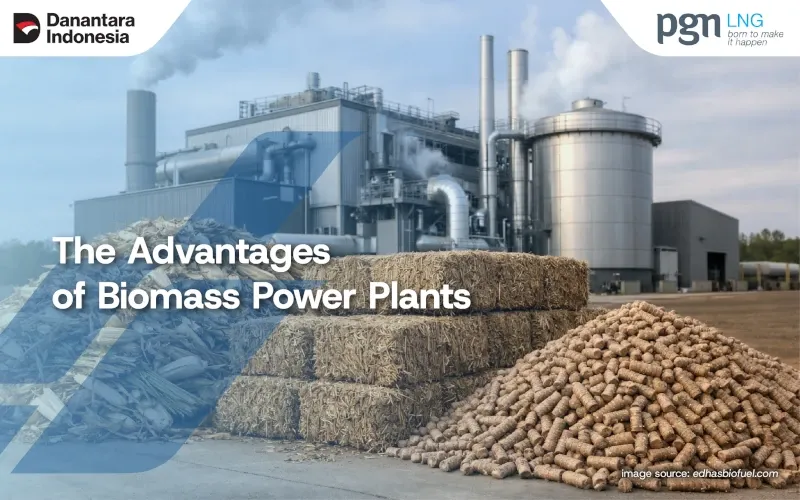
Agriculture and plantation-based industries, such as sugar and palm oil, generate biomass residues during production. Examples include bagasse (sugarcane pulp) and solid palm oil residues such as fiber and shells.
By using this biomass, companies can turn production by-products into an energy source through biomass power plants. This allows them to meet their electricity needs while reducing their dependence on fossil fuels.
So what are the advantages of biomass power plants, and when should a company consider one?
What Is a Biomass Power Plant?
A biomass power plant is a facility that uses biomass as fuel to generate electricity. Under Indonesian regulations, biomass power plants are also listed as one type of electricity supply installation based on new and renewable energy.
The biomass used can come from agricultural and plantation residues, forestry, and biomass-based industries. Examples include bagasse, palm oil fiber and shells, wood processing waste, rice husks, and residues from the pulp and paper industry.
A biomass power plant works by burning biomass to produce heat, which turns water into steam. The steam spins a turbine connected to a generator, which produces electricity.
However, not all biomass can be used as is, because its characteristics affect combustion efficiency and plant performance.
For example, high moisture content reduces the available energy because part of the heat is spent evaporating water. Particle size, density, ash content, and energy value also determine how much fuel processing is needed and which technology is suitable.
Read More: Can Water Become Energy?
What Are the Advantages of Biomass Power Plants?
Biomass power plants offer several advantages for industry, especially for companies that produce or have access to biomass residues.
These advantages relate not only to access to renewable energy, but also to resource utilization and flexibility in energy supply.
Turns Production Residues into an Energy Source
One advantage of biomass power plants is their ability to convert residues from agriculture, plantations, forestry, and industry into an energy source.
The sugar industry can use bagasse as fuel, while the palm oil industry can use palm fiber and shells.
Wood residues from the pulp and paper industry can also be used as a feedstock. This creates a double benefit, because production by-products are not merely managed as waste but are used to generate electricity.
Can Make Use of Local Energy Sources
Biomass available near an industrial site can serve as a local fuel source, reducing the need to bring in fuel from distant locations.
That said, companies need to consider the volume and continuity of supply, transport distances, collection costs, and storage requirements.
If residues are scattered across many locations or are not sufficient to meet the plant’s needs, procurement and transportation costs can rise.
For this reason, using biomass as a local energy source needs to be backed by a stable supply chain so the plant can operate economically.
Can Provide More Controllable Power
Biomass power plants are dispatchable, meaning electricity can be generated on demand as long as fuel is available and the plant is running well. This sets them apart from solar and wind power plants, whose output depends on weather conditions.
For industries that need a steady power supply to keep production running, this characteristic can help support the reliability of the energy system.
However, a biomass power plant’s ability to operate continuously still depends on its system design, generation technology, and fuel availability.
Supports the Use of Renewable Energy
Biomass power plants can be one way for a company to increase the share of renewable energy in its energy mix.
In Indonesia, the use of biomass for power generation is also reflected in government policy, including Indonesia’s Minister of Energy and Mineral Resources Regulation No. 12 of 2023, which governs the use of biomass as a co-firing fuel in coal-fired power plants. For companies, this shows that using biomass can be part of an energy diversification strategy.
Read More: Natural Gas Liquids: An Economical Energy Solution with Important Caveats
What Are the Challenges of Using Biomass Power Plants?
Although biomass power plants can use residues as an energy source, they still face challenges, particularly in keeping the biomass supply sufficient for the plant’s needs.
Available biomass cannot always be used right away, because its quantity, quality, location, and timing of availability can vary. These factors also affect fuel procurement costs and the smooth operation of the plant.
Several aspects need attention:
- Feedstock availability: The volume of biomass must meet the plant’s requirements. If the supply is seasonal, alternative sources or storage need to be arranged.
- Biomass quality: Moisture content, calorific value, size, density, and ash content affect the energy that can be produced and the amount of processing required.
- Logistics: The distance to the biomass source, transportation costs, collection processes, and storage facilities all affect supply continuity.
- Economics: Companies need to calculate the full cost, from feedstock procurement, pre-processing, transportation, and storage to plant operation.
For this reason, before making a biomass power plant a primary energy source, a company should conduct a feedstock assessment to evaluate the availability and quality of raw materials, as well as supply chain planning.
These steps help ensure that biomass is available in sufficient quantity, at the right quality, and at a cost that supports the plant’s operational viability.
Read More: Renewable Energy Explained: Types and Benefits
When Should a Company Consider a Biomass Power Plant as an Energy Source?
A biomass power plant is worth considering when a company meets several supporting conditions, most importantly:
- There is a sufficient biomass source.
- Supply is available consistently.
- The distance to the biomass source is still economical for transport.
- The biomass characteristics match the generation technology.
- The company’s electricity demand matches the plant’s capacity.
- Facilities for handling and storage are available.
Companies that produce their own biomass residues may benefit from easier access to feedstock, but they still need to assess the volume, quality, and continuity of those residues.
Meanwhile, companies that do not produce biomass themselves can still consider a biomass power plant, as long as a reliable and economical supply chain exists near the site.
The decision to use a biomass power plant should take into account the electricity demand profile, supply reliability, overall cost, supply chain readiness, and long-term energy needs, not just the presence of biomass.
In practice, a biomass power plant can also be one component of a company’s energy mix, alongside other energy sources that complement its operational needs.
When biomass cannot yet meet all of a company’s energy needs, a supporting energy source can supply the additional energy required.
One option for a supporting energy source is Liquefied Natural Gas (LNG), because it delivers high energy value and offers flexibility in distribution to reach industrial sites.
Read More: Does FSRU Make LNG Cheaper: Fact or Myth?
How Can LNG Support Industrial Energy Needs?
LNG can serve as a supporting energy source for industries that integrate biomass power plants into their energy mix.
When biomass supply is limited or energy demand rises, LNG can help meet energy needs through power generation or by providing heat for industrial processes, depending on the technology used.
This gives companies an alternative for adjusting their energy supply to their operational needs.
However, using LNG alongside a biomass power plant needs to be supported by a supply system that fits the company’s energy needs and the infrastructure conditions at the operating site.
This matters so that companies can consider gas supply availability, storage needs, distribution, and regasification before integrating LNG into their energy system.
To support these needs, PGN LNG Indonesia offers LNG solutions covering supply, storage, distribution, and regasification. These services can be an option for companies that want to explore LNG as a way to support the continuity of their industrial operations.
Find the LNG solutions that suit your company’s energy and operational needs here: LNG Supplier in Indonesia.
References
- ESDM. Accessed 2026. Minister of Energy and Mineral Resources Regulation No. 12 of 2023
- ESDM. Accessed 2026. World Biofuel Day
- International Renewable Energy Agency (IRENA). Accessed 2026. Solid Biomass Supply for Heat and Power: Technology Brief
- Economic Research Institute for ASEAN and East Asia (ERIA). Accessed 2026. Development of the Bioenergy Supply Chain in AZEC Partner Countries